
Microsoft
Unveiling the Ups and Downs of Microsoft’s Business Growth: A Closer Look at Regulatory Filings

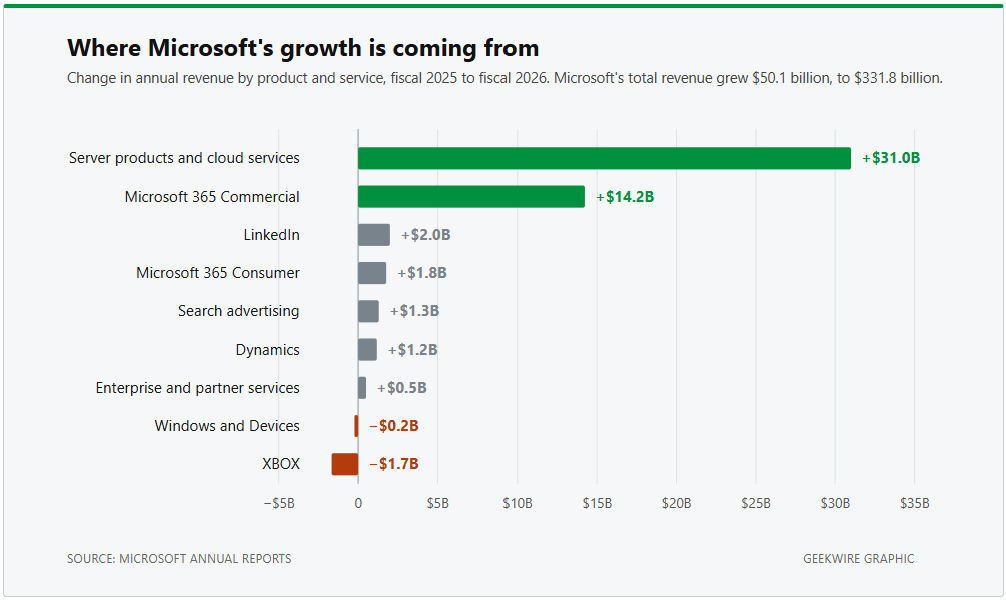
The Key Drivers of Microsoft’s Revenue Growth Revealed in Recent Financial Filing
When Microsoft releases its 10-K or 10-Q reports, one section stands out for providing a clear view of the company’s performance: the “Revenue, classified by significant product and service offerings” section, buried deep within the filing.
This section categorizes Microsoft’s revenue into Productivity and Business Processes, Intelligent Cloud, and More Personal Computing segments, offering insights into the real drivers of the business beyond the surface-level numbers.
For the fiscal year ending June 30, Microsoft reported an 18% increase in revenue, amounting to $331.8 billion. Digging into the details, two key business lines emerged as the primary growth engines for the tech giant.
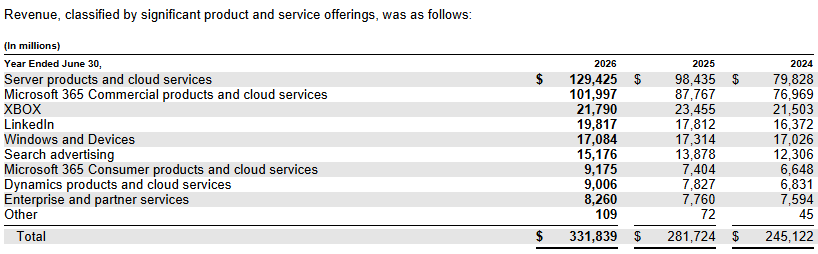
Server Products and Cloud Services: Contributing $31 billion to the overall revenue growth, this category, encompassing Azure, SQL Server, Windows Server, and more, accounted for 62% of Microsoft’s growth, with Azure surpassing $100 billion in annual revenue.
Microsoft 365 Commercial: Adding $14.2 billion in revenue, this segment saw a 16% increase, reaching $102 billion. Microsoft 365 Commercial includes Office, Teams, SharePoint, and other business subscriptions.
Together, these two business lines drove 90% of Microsoft’s growth for the year, showcasing the company’s successful monetization of AI through various offerings.
Contrastingly, two of Microsoft’s longstanding businesses experienced a decline:
- Windows and Devices revenue dropped by $230 million to $17.1 billion, reflecting a stagnant trend in the PC operating system business over the past four years.
- Xbox revenue decreased by $1.7 billion to $21.8 billion, marking the first annual decline post the Activision Blizzard acquisition, amid business restructuring and asset write-downs.
Other noteworthy insights from the financial filing:
- LinkedIn’s revenue surpassed that of Windows and Devices, reaching $19.8 billion and growing steadily.
- Microsoft 365 Consumer witnessed a 24% growth to $9.2 billion, emerging as a significant revenue contributor.
- Search advertising revenue grew by 9% to $15.2 billion, nearing the revenue generated by Windows and Devices.
- Dynamics revenue increased by 15% to $9 billion, while Enterprise and partner services saw a 6% growth to $8.3 billion.
In summary, Microsoft’s financial report highlights the pivotal role played by Azure and Microsoft 365 Commercial in driving revenue growth, while shedding light on the challenges faced by traditional business lines like Windows and Xbox.










Revolutionizing Group Travel: Vox Group’s AI-Powered Translation Technology

Unusual Sight: Quadruple Pipes Spotted in Munich

Wolverine: A Divisive Marvel Adventure

Galaxy Tab S12: Confirmed Release Date Revealed – Tech Advisor

Fitbit Charge 7: The Next Evolution in Fitness Tracking – Tech Advisor

Chift Secures €10.5 Million Series A Funding to Revolutionize Europe’s Financial Connectivity

The Evolution of Multimedia Content Processing Through AI

The Challenges Faced by Enterprise Agent Pilots in Reaching Deployment Success

The LG G7 has a Big Problem.

EU Takes Action Against Instagram and Facebook for Violating Illegal Content Rules

Warning: Facebook Creators Face Monetization Loss for Stealing and Reposting Videos

Facebook Compliance: ICE-tracking Page Removed After US Government Intervention

Facebook’s New Look: A Blend of Instagram’s Style

Facebook and Instagram to Reduce Personalized Ads for European Users

InstaDub: Meta’s AI Translation Tool for Instagram Videos

Reclaim Your Account: Facebook and Instagram Launch New Hub for Account Recovery

Meta discontinues Messenger apps for Windows and macOS

Breaking Updates: Meta Connect 2025 Unveils Latest Developments
The LG G7 has a Big Problem.

The most Beautiful Android Games you’ve never played.

Charge your Smartphone in 5 Minutes – How Batteries are about to Change!

10 CHEAP Smartphone Gadgets that Change Everything.

Huawei Mobile Cloud – The Huawei P20 Feature you didn’t know about!

PUBG MOBILE on Android – Disastrous or Revolutionary?

Why you should buy the Galaxy S8 right now.

Customize your Android Smartphone!

Xiaomi Mi Mix 2S Review – Beauty and the BEAST.
-
 Facebook11 months ago
EU Takes Action Against Instagram and Facebook for Violating Illegal Content Rules
-
 Facebook11 months ago
Warning: Facebook Creators Face Monetization Loss for Stealing and Reposting Videos
-
 Facebook11 months ago
Facebook Compliance: ICE-tracking Page Removed After US Government Intervention
-
 Facebook9 months ago
Facebook’s New Look: A Blend of Instagram’s Style
-
 Facebook9 months ago
Facebook and Instagram to Reduce Personalized Ads for European Users
-
 Facebook11 months ago
InstaDub: Meta’s AI Translation Tool for Instagram Videos
-
 Facebook9 months ago
Reclaim Your Account: Facebook and Instagram Launch New Hub for Account Recovery
-
 Apple11 months ago
Meta discontinues Messenger apps for Windows and macOS
