
Inovation
Revolutionizing Computer Memory: The Promise of New Material for Speed and Sustainability

University of Warwick Researchers Develop Innovative Room Temperature Magnetoelectric Material
A groundbreaking achievement at the University of Warwick has led to the creation of a new form of strontium manganite that functions close to room temperature. This innovative material, as detailed in a recent publication in JACS, effectively combines magnetism and electrical polarisation, offering promising implications for enhancing computer memory speed and sustainability.
The quest for magnetoelectric materials, which enable magnetic information to be manipulated through an electric field rather than a magnetic one, has intensified due to the potential to enhance the energy efficiency of computers. This advancement is particularly significant amidst the escalating demand for data centers and AI systems that heavily rely on processing power.
Despite the immense potential, most magnetoelectric materials have been limited to operation at extremely low temperatures, hindering their widespread application.
Overcoming Temperature Constraints through Structural Innovation
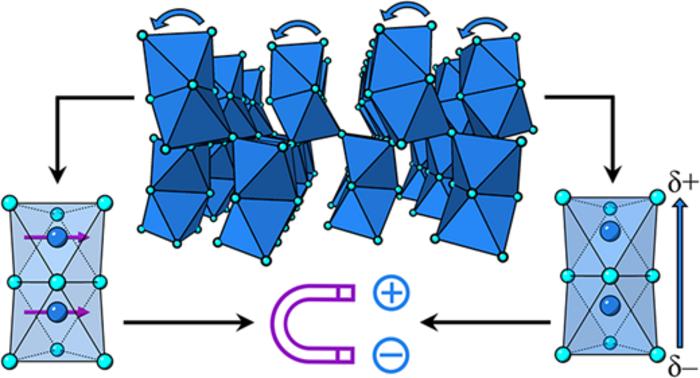
Researchers have devised a solution to the temperature challenge by introducing a structural modification in the strontium manganite. By inducing a coordinated tilt in the atom pairs within the crystal structure, the material generates an electric charge and a switchable magnetism. Unlike conventional magnetoelectrics where the charge is reliant on magnetism and only functions at freezing temperatures, the strontium manganite material sustains the structural shift and magnetism independently at warmer temperatures.
Dr. Struan Simpson from the University of Warwick’s Department of Chemistry expressed, “Discovering a material that integrates magnetism and electrical polarisation at near room temperature is a significant breakthrough. The simplicity of the mechanism, involving a minor crystal structure tilt, instills confidence in the broader applicability of this approach.”
Exploring Diverse Applications through Structural Innovations
Utilizing advanced neutron scattering and high-resolution X-ray techniques, the research team confirmed the material’s efficacy at practical temperatures and identified opportunities for enhancing its performance through minor chemical adjustments. The study leveraged the capabilities of UK national facilities, including the Diamond Light Source and the ISIS Neutron and Muon Source, in addition to the ESRF synchrotron in France.
Professor Mark Senn, also from the University of Warwick’s Department of Chemistry, emphasized the broader implications of the research, stating, “This breakthrough unveils a blueprint for exploring a range of structures previously overlooked for similar applications. The future focus will be on pushing the boundaries of these ideas and developing materials ready for real-world implementation.”
The team envisions extending the innovative design concept to a wider array of materials, paving the way for novel energy-efficient technologies beyond the current scope.













Unleashing the Potential: Kvanttinova’s Ecosystem Drives Finland’s Dominance in Semiconductors, Microelectronics, and Quantum Technologies

Xbox Saves Kojima’s PHYSINT Project from Sony’s Cancelation

The Future of Foldables: Top Pick for 2026

Google Pixel Now Playing Brings Back Notification Feature for Users

IVEX Secures €5 Million Funding to Drive Advancements in AI-Powered Automotive Safety Testing

Exploring Apple’s Enhanced Listening Features: Privacy Protection at the Core

Xiaomi Mi Mix 2S Review – Beauty and the BEAST.

Revolutionary Tech: Apple Watch Series 12 and Ultra 4 Unveiled

Revolutionary Denza Z9 GT: Affordable Luxury at $49,000

EU Takes Action Against Instagram and Facebook for Violating Illegal Content Rules

Warning: Facebook Creators Face Monetization Loss for Stealing and Reposting Videos

Facebook’s New Look: A Blend of Instagram’s Style

Facebook Compliance: ICE-tracking Page Removed After US Government Intervention

Facebook and Instagram to Reduce Personalized Ads for European Users

InstaDub: Meta’s AI Translation Tool for Instagram Videos

Reclaim Your Account: Facebook and Instagram Launch New Hub for Account Recovery

Meta discontinues Messenger apps for Windows and macOS

Breaking Updates: Meta Connect 2025 Unveils Latest Developments
Xiaomi Mi Mix 2S Review – Beauty and the BEAST.

Samsung Galaxy X – New Info!

RED MAGIC UNBOXING – The Ultimate Gaming Phone?

12 Incredible Android SECRETS, TIPS and TRICKS

The Ultimate Smartphone Camera Comparison.

Top 10 Android Launchers you’ve NEVER tried.

Our Bezel-less future! Q&A 5.0

The $200 OnePlus phone? Lenovo S5 is HERE!

OnePlus 6 vs Samsung Galaxy S9 Plus
-
 Facebook11 months ago
EU Takes Action Against Instagram and Facebook for Violating Illegal Content Rules
-
 Facebook11 months ago
Warning: Facebook Creators Face Monetization Loss for Stealing and Reposting Videos
-
 Facebook9 months ago
Facebook’s New Look: A Blend of Instagram’s Style
-
 Facebook11 months ago
Facebook Compliance: ICE-tracking Page Removed After US Government Intervention
-
 Facebook9 months ago
Facebook and Instagram to Reduce Personalized Ads for European Users
-
 Facebook11 months ago
InstaDub: Meta’s AI Translation Tool for Instagram Videos
-
 Facebook9 months ago
Reclaim Your Account: Facebook and Instagram Launch New Hub for Account Recovery
-
 Apple11 months ago
Meta discontinues Messenger apps for Windows and macOS
