
Security
Uncovering the Dangerous Tactics of Cybercriminals: Backdoor Installations via Hacked Korean Sites

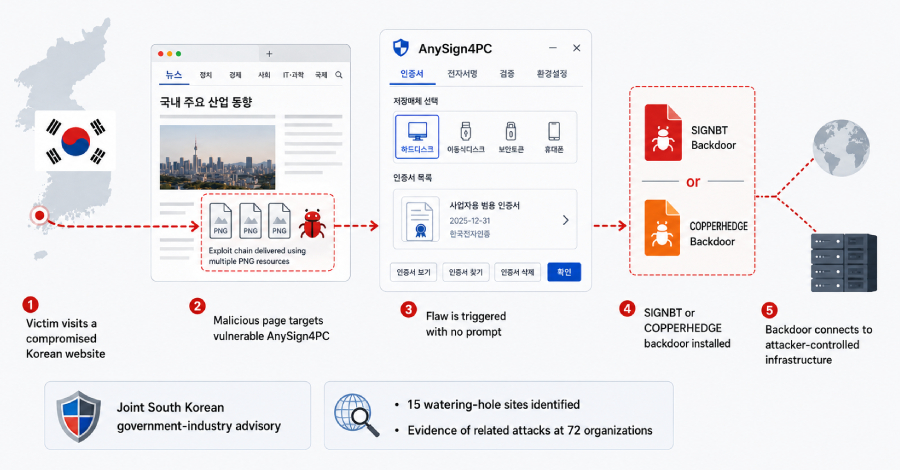
Recommended Actions:
- Delete vulnerable installations of AnySign4PC versions 1.1.4.4 through 1.1.4.6.
- Update to fixed release version 1.1.5.0.
- Be cautious of spear-phishing messages disguised as various types of content.
- Avoid visiting compromised websites, especially in the finance, healthcare, education, and manufacturing sectors.
- Monitor for signs of compromise, such as unusual network activity or unexpected file changes.
- Implement strong cybersecurity measures, including regular software updates and employee training on cybersecurity best practices.
By following these recommendations, organizations can better protect themselves against state-sponsored cyber threats and minimize the risk of falling victim to malicious attacks.
Enhanced Security Measures Recommended for Vulnerable Installations
Version 1.1.5.0 has been identified as the fixed release, with recommendations to remove vulnerable installations to prevent security breaches.
Identification of Suspicious Activities by ENKI
Reports indicate that ENKI discovered a Type 1 backdoor that deleted its registry configuration, loader, and backdoor files to evade detection. This backdoor operates in modes 1, 2, 4, or 5 with self-protection enabled, ensuring that the files remain absent from disk until a clean shutdown restores them. The altered hash of the loader emphasizes the importance of behavioral telemetry over stable-file indicators for detection.
Persistence Chain Analysis by Plainbit
Plainbit observed a persistence chain involving a scheduled task named RuntimeBroker launching task.vbs, which then executed a renamed SSH client as SearchHost.exe to establish a reverse tunnel. S2W recommends capturing process memory, command lines, registry values, DLL-load events, and network records before terminating processes or isolating systems for further investigation.
Possible Supply-Chain Compromise Identified by AhnLab
AhnLab discovered that several compromised websites were linked to the same development and management company, suggesting a potential supply-chain infiltration. While there is no evidence of compromise to the company’s source code, software-update process, or central management platform, caution is advised for potential risks associated with the connection.
Update on AnySign4PC Vulnerability
KISA’s recent notice regarding the AnySign4PC flaw does not include a CVE identifier. The Hacker News search conducted on July 30, 2026, only revealed CVE-2020-7882, an unrelated directory-traversal vulnerability affecting older versions of AnySign4PC. This discrepancy highlights the possibility of a reserved, unpublished, or differently described identifier for the vulnerability. AhnLab’s report also mentions unidentified software A and I, without specifying their affected or fixed versions.











Speeding Through 749 Kilometers at 90 Kilometers per Hour

Seattle Tech Leaders Unite for Unified Regional Strategy

UNSEEN’s Resilient Team: KEMURI’s XBOX Skipping Saga

Unveiling the Threat: How Android Malware Invades Privacy by Taking Covert Photos

Disrupting the Status Quo: Cornelis Secures $205M to Challenge Nvidia’s Reign in AI Infrastructure

Fortify Your Home: Apple Home’s Advanced Security Camera Subscription for $60/Month

Exploring the Ethics of Big Tech’s AI Slowdown: Safety Pact or Cartel?

Troubleshooting iOS 27 Update Problems: Resolving Bugs and Battery Drain

Behind the Scenes: Inside the Departure of General Motors Australia’s Former Leader

EU Takes Action Against Instagram and Facebook for Violating Illegal Content Rules

Warning: Facebook Creators Face Monetization Loss for Stealing and Reposting Videos

Facebook Compliance: ICE-tracking Page Removed After US Government Intervention

Facebook’s New Look: A Blend of Instagram’s Style

Facebook and Instagram to Reduce Personalized Ads for European Users

InstaDub: Meta’s AI Translation Tool for Instagram Videos

Reclaim Your Account: Facebook and Instagram Launch New Hub for Account Recovery

Meta discontinues Messenger apps for Windows and macOS

Breaking Updates: Meta Connect 2025 Unveils Latest Developments

How to Love your Android Phone again.

The LG G7 has a Big Problem.

The most Beautiful Android Games you’ve never played.

Charge your Smartphone in 5 Minutes – How Batteries are about to Change!

10 CHEAP Smartphone Gadgets that Change Everything.

Huawei Mobile Cloud – The Huawei P20 Feature you didn’t know about!

PUBG MOBILE on Android – Disastrous or Revolutionary?

Why you should buy the Galaxy S8 right now.

Customize your Android Smartphone!
-
 Facebook11 months ago
EU Takes Action Against Instagram and Facebook for Violating Illegal Content Rules
-
 Facebook11 months ago
Warning: Facebook Creators Face Monetization Loss for Stealing and Reposting Videos
-
 Facebook11 months ago
Facebook Compliance: ICE-tracking Page Removed After US Government Intervention
-
 Facebook9 months ago
Facebook’s New Look: A Blend of Instagram’s Style
-
 Facebook9 months ago
Facebook and Instagram to Reduce Personalized Ads for European Users
-
 Facebook11 months ago
InstaDub: Meta’s AI Translation Tool for Instagram Videos
-
 Facebook9 months ago
Reclaim Your Account: Facebook and Instagram Launch New Hub for Account Recovery
-
 Apple11 months ago
Meta discontinues Messenger apps for Windows and macOS
