SimpleHelp Vulnerability Allows Hackers to Create Unauthorized Remote Support Accounts
A critical vulnerability has been discovered in the SimpleHelp remote management software, enabling attackers to create privileged technician accounts without authentication using the OpenID Connect (OIDC) authentication protocol.
Identified as CVE-2026-48558, the flaw affects SimpleHelp versions 5.5.15 and older, as well as pre-release versions of 6.0.
Researchers from Horizon3.ai, an offensive security company, elucidate that the vulnerability stems from the improper validation of identity assertions received from an OIDC identity provider (IdP).
With OIDC authentication enabled, a malicious actor can create and access a new Technician user without undergoing the multi-factor authentication (MFA) process, granting them unauthorized access to perform management tasks such as remote endpoint control and script execution.
According to Horizon3.ai researcher Zach Hanley, SimpleHelp addressed the issue on June 9 by releasing versions 5.5.16 and 6.0RC2.
Scope of Impact
CVE-2026-48558 affects a subset of SimpleHelp servers that utilize the OIDC protocol, including the generic version and Azure AD OIDC, commonly found in large enterprises.
Exploiting the vulnerability necessitates specific conditions:
OIDC authentication must be activated
At least one Technician Group must be linked to the OIDC provider
The group must have “Allow group authenticated logins” enabled
Approximately 14,000 SimpleHelp servers are exposed to the public internet based on Shodan data, with around 7.2% configured for OIDC authentication.
Organizations are urged to update to the latest SimpleHelp versions to mitigate the risk posed by CVE-2026-48558. Alternatively, restricting technician login sources via IP-based allowlists can offer a protective measure.
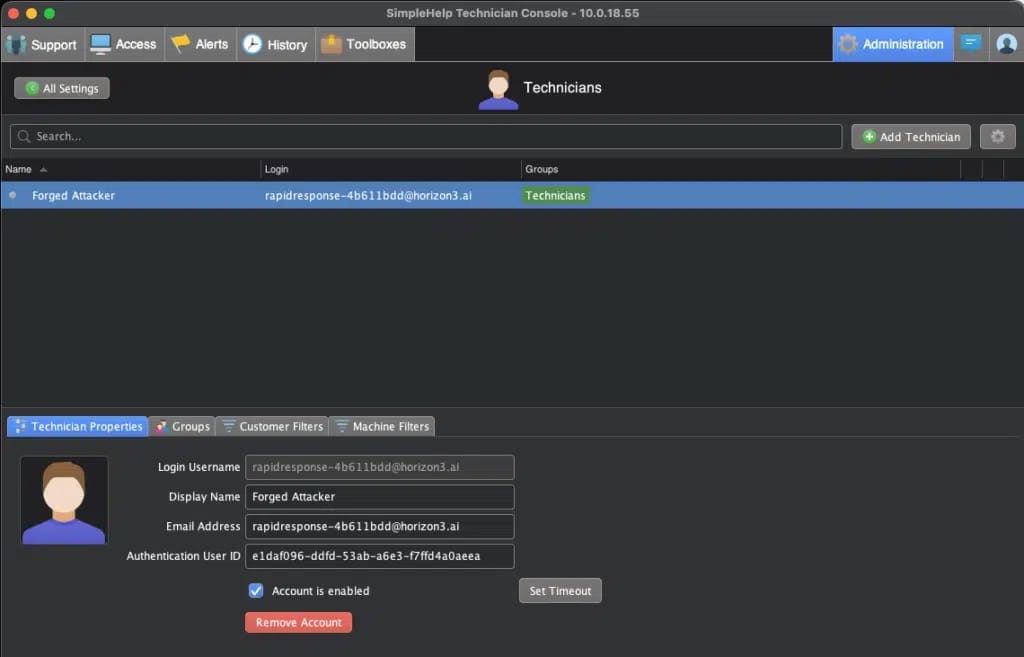
Rogue Technician account on SimpleHelp Source: Horizon3.ai
Horizon3.ai also provides indicators of compromise for detecting active exploitation, such as new authenticated technician users with suspicious details and relevant logs containing registration information and configuration alterations performed by unauthorized accounts.
While there is no evidence of active exploitation reported by SimpleHelp or Horizon3.ai, organizations should promptly implement available fixes and mitigations due to the software’s history of attracting malicious interest.
Security teams detect only 14% of successful attacks, leaving the majority unnoticed in your environment. Picus’s whitepaper demonstrates how breach and attack simulation enhances SIEM and EDR rule efficacy to prevent threats from evading detection.