
Microsoft
Microsoft’s Research and Development Jobs Decline for Second Consecutive Year as Overall Headcount Drops for First Time in Ten Years

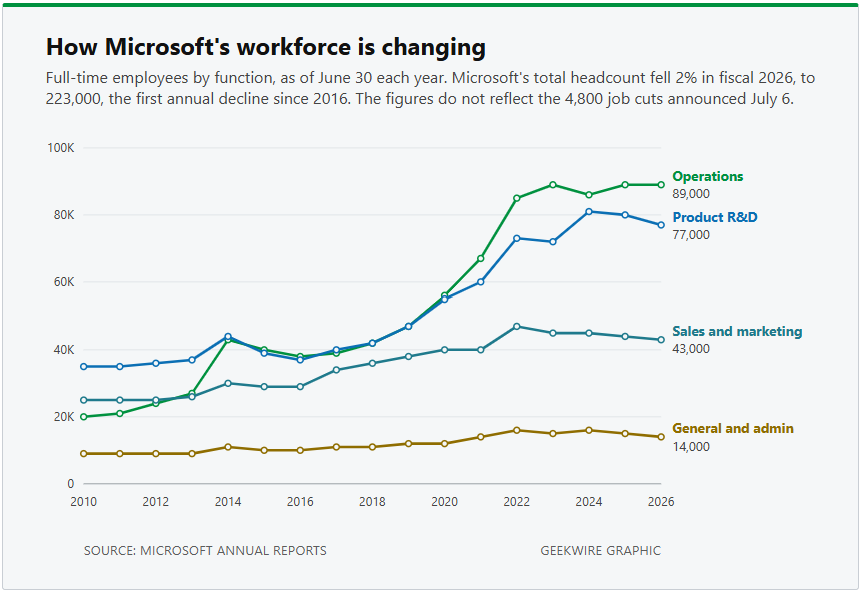
Microsoft’s Product Research and Development Roles Decline for Second Consecutive Year
In a recent annual regulatory filing, Microsoft reported a decline in the number of product research and development roles for the second year in a row. This trend sheds light on how the tech giant is restructuring its workforce in the AI era.
As of June 30, Microsoft’s total headcount decreased by 5,000 people to 223,000, marking the first annual employment decline for the company since 2016. This shift comes amidst a significant 18% revenue increase, amounting to $50.1 billion, reaching a total of $331.8 billion.
The decrease in employment is particularly noticeable in the breakdown of roles:
- The number of Product R&D roles saw a decline of 3,000, down to 77,000 from a peak of 81,000 in 2024.
- Operations roles, now Microsoft’s largest employment category, remained stable at 89,000 after a 3,000 increase in the previous year, encompassing datacenter operations, product support, consulting, and manufacturing and distribution.
- Sales and marketing roles decreased by 1,000 to 43,000, while general administration roles also reduced by 1,000 to 14,000.
- The majority of reductions were seen in Microsoft’s U.S. workforce, which dropped by 4,000 to 121,000, whereas international employment decreased by 1,000 to 102,000.
These figures reflect the approximately 9,000 job cuts implemented by Microsoft on July 2, 2025, shortly into the fiscal year. Notably, they do not include the additional 4,800 cuts announced on July 6 of the current year, spanning various departments such as sales, consulting, and Xbox.
During the recent earnings call, CFO Amy Hood confirmed a 2% year-over-year decline in total company headcount. She attributed a 10% increase in operating expenses to ongoing investments in R&D compute capacity, talent, and data to support product development across Microsoft’s portfolio.
The adoption of AI coding tools, including Microsoft’s GitHub Copilot, has become standard practice in software development at Microsoft and across the industry. These tools have streamlined processes, reduced manpower requirements, and accelerated product delivery, albeit expanding the overall scope of work.
While Microsoft has refrained from directly linking job cuts to AI, Chief People Officer Amy Coleman mentioned in a recent memo that eliminated roles were not directly replaced by AI, acknowledging the transformative impact of AI on work processes.
In response to escalating capital expenses to support AI infrastructure buildouts, tech companies, including Microsoft, have been optimizing operating expenses through workforce reductions. Microsoft’s capital expenditures reached $41 billion in the last quarter alone.
Furthermore, Microsoft is strategically reallocating engineers from product development to customer-facing roles. The launch of the Microsoft Frontier Company, a $2.5 billion initiative announced on July 2, aims to embed engineers within customer organizations building AI systems, drawing primarily from Microsoft’s existing engineering and forward-deployed teams.












Empowering Agents: Fulcra’s Universal Multiplayer Experience

Apple Unveils Groundbreaking iOS 27.2 Developer Beta for iPhone

Huawei P20 Pro vs Samsung S9 Plus!

McLaren P34 to Replace Artura in 2028: A New Era Begins

Microsoft AI CEO Warns of Real AI Threats: Anthropic’s Role in Escalating Danger

ThreatsDay: Self-Rewriting Agents, Patched Flaws, and Insider SIM Swaps – A Roundup of 22 New Stories

Mass Layoffs at Heart Machine as Publisher Cancels Unreleased Game

Enhanced Technology: Latest Features and Upgrades

Revolutionizing AI: PrismML’s Groundbreaking LLM Technology

EU Takes Action Against Instagram and Facebook for Violating Illegal Content Rules

Warning: Facebook Creators Face Monetization Loss for Stealing and Reposting Videos

Facebook Compliance: ICE-tracking Page Removed After US Government Intervention

Facebook’s New Look: A Blend of Instagram’s Style

Facebook and Instagram to Reduce Personalized Ads for European Users

InstaDub: Meta’s AI Translation Tool for Instagram Videos

Reclaim Your Account: Facebook and Instagram Launch New Hub for Account Recovery

Meta discontinues Messenger apps for Windows and macOS

Breaking Updates: Meta Connect 2025 Unveils Latest Developments
Huawei P20 Pro vs Samsung S9 Plus!

Huawei P20 vs P20 Pro vs iPhone 8 Plus vs S9 Battery Drain Test!

10 Android Mods that Change Everything

I used the first Android Phone in the World.

DOOGEE MIX 4 UNBOXING (PROTOTYPE)!

MYSTERY UNBOXING FROM SAMSUNG!

The Truth about Huawei P20 Pro – REAL Review

How to Love your Android Phone again.

The LG G7 has a Big Problem.
-
 Facebook11 months ago
EU Takes Action Against Instagram and Facebook for Violating Illegal Content Rules
-
 Facebook11 months ago
Warning: Facebook Creators Face Monetization Loss for Stealing and Reposting Videos
-
 Facebook11 months ago
Facebook Compliance: ICE-tracking Page Removed After US Government Intervention
-
 Facebook9 months ago
Facebook’s New Look: A Blend of Instagram’s Style
-
 Facebook9 months ago
Facebook and Instagram to Reduce Personalized Ads for European Users
-
 Facebook11 months ago
InstaDub: Meta’s AI Translation Tool for Instagram Videos
-
 Facebook10 months ago
Reclaim Your Account: Facebook and Instagram Launch New Hub for Account Recovery
-
 Apple11 months ago
Meta discontinues Messenger apps for Windows and macOS
