
AI
Advancements in Encoder Technology: A Journey from Basic Models to Multimodal AI

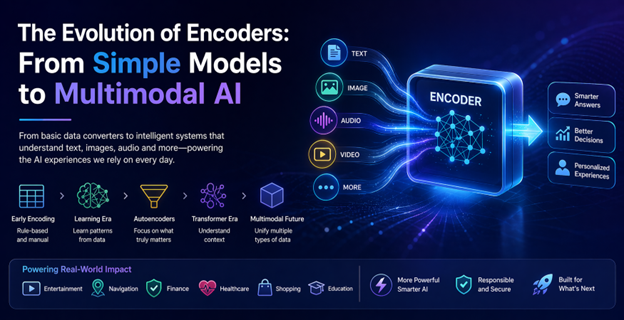
When the topic of artificial intelligence arises, the focus is often on its impressive outputs such as human-like text, stunning images, and accurate recommendations. However, what is often overlooked is the fundamental process of how AI grasps information, which is where encoders play a crucial role. Encoders can be likened to translators that convert complex real-world data into a structured language that machines can comprehend.
Over time, encoders have undergone a significant evolution, transitioning from simple data converters to sophisticated systems capable of comprehending various forms of information simultaneously. This transformation was not instantaneous but rather a narrative of gradual advancement, practical obstacles, and breakthroughs driven by real-world necessities.
The Genesis: Encoding as a Technical Necessity
In the early stages of machine learning, encoding served more as a technical requirement rather than an intelligent process. Developers had to manually determine how to represent data, converting labels like “small,” “medium,” and “large” into numerical values. While this method was functional, it only allowed the system to process numbers without truly understanding the underlying concepts. For example, an early online store might recommend products based on basic categories but struggle to recognize subtle connections. Without explicit programming, a customer purchasing running shoes might not be shown related items like fitness watches or hydration gear.
Essentially, early encoders managed data without delving into its meaning.
Learning Through Data Patterns
A pivotal shift occurred with the introduction of neural networks, enabling systems to learn patterns directly from data rather than relying solely on human instructions. Encoders evolved from mere converters to active learners.
For instance, in image recognition, developers no longer needed to specify the defining features of a cat; instead, they could train the system on a multitude of images. The encoder would autonomously identify patterns, resulting in a more adaptable and precise AI system.
A similar progression unfolded in language processing, where words were no longer treated as symbols but as mathematical vectors capturing meaning and relationships. This advancement empowered modern search engines to understand the close relationship between phrases like “cheap flights” and “budget airfare” despite variations in wording.
Autoencoders: Identifying Essential Data
The advent of autoencoders marked a significant leap in encoder technology. These models aimed to compress data and subsequently reconstruct it, requiring the encoder to distinguish crucial information from extraneous details.
This approach proved invaluable in practical scenarios; for instance, in banking, autoencoders are utilized to detect fraudulent activities by recognizing abnormal transactions based on learned patterns of “normal” behavior.
Another instance is in photo storage, where encoders facilitate the reduction of file sizes while retaining essential details, ensuring quick loading times without compromising image quality.
The Era of Transformers: Embracing Contextual Understanding
The pivotal moment in encoder evolution arrived with transformer models, distinguished by their ability to comprehend context comprehensively rather than sequentially processing information. This contextual understanding is particularly crucial in language interpretation, where ambiguities like “She saw the man with the telescope” can be resolved more accurately by analyzing the entire sentence.
Transformer-based encoders play a pivotal role in numerous daily interactions, seamlessly enabling processes like chatbot interactions, voice dictation, and online text translation to feel more natural and human-like.
Encoders in Daily Applications
Presently, encoders are omnipresent, shaping technological interactions in subtle yet impactful ways that often go unnoticed by most individuals.
Streaming platforms leverage encoders to discern viewing patterns, providing personalized recommendations based on user preferences rather than solely categorizing interests.
Navigation apps rely on encoders to process real-time traffic data, enabling the suggestion of optimal routes even before congestion becomes apparent.
In healthcare, encoders aid medical professionals in analyzing diagnostic images, offering insights that assist in making timely and accurate decisions.
Multimodal Encoders: Embracing Diverse Data
The latest advancement in encoder technology lies in multimodal capabilities, allowing encoders to process multiple data types simultaneously, including text, images, and more.
This advancement paves the way for more intuitive experiences; for instance, a multimodal encoder can analyze a user-uploaded image of a plant and provide personalized care instructions in a seamless interaction.
Moreover, e-commerce platforms are enhancing user experiences by enabling image uploads for product searches, merging visual recognition with contextual comprehension for more accurate recommendations.
This ability to integrate diverse data types propels AI closer to mimicking human sensory experiences.
Challenges Amid Advancements
As encoders advance in sophistication, they pose challenges in terms of resource requirements, with advanced models demanding significant computing power that can be costly and energy-intensive. This raises concerns regarding sustainability and accessibility.
Bias is another critical issue, as encoders learn from existing data and may inadvertently perpetuate biases present in the training data. Addressing this challenge necessitates meticulous data curation and ongoing monitoring.
Furthermore, privacy concerns arise as encoders often process sensitive personal information, emphasizing the importance of robust data protection measures to strike a balance between innovation and privacy.
The Future Trajectory
The future of encoders centers on refining existing models rather than radical breakthroughs, with a focus on enhancing speed, efficiency, and reducing resource consumption. This evolution could democratize access to advanced AI tools for smaller enterprises and independent developers.
Personalization is poised for growth, with encoders expected to adapt dynamically based on individual user interactions, tailoring experiences to meet unique preferences. In education, such systems could adjust content delivery methods based on each student’s learning style, enhancing educational outcomes.
Additionally, multimodal systems will continue advancing, seamlessly merging diverse data sources for more intuitive interfaces, bridging the gap between human-machine interactions.
Concluding Thoughts: A Silent Revolution with Far-reaching Implications
While encoders may operate discreetly in the realm of artificial intelligence, their significance cannot be overstated. The evolution of encoders from mere data processors to intelligent multimodal systems has redefined the capabilities of machines.
What makes this evolutionary journey intriguing is its alignment with real-world requirements. Each advancement in encoder technology has been driven by the need to solve practical challenges, understand language nuances, recognize visual cues, detect anomalies, and enhance daily experiences.
As artificial intelligence continues to progress, encoders will remain at the heart of this transformation, covertly converting raw data into meaningful insights. Though they may function behind the scenes, their impact is undeniably profound.













BMW M2 CS Production Concludes with Record-Breaking 2,882 Cars Sold, a 21% Increase from Previous Model

Fortnite Hearts: Keyblade Chaos under the Heart Moon

The Imperfect Brilliance of the Google Pixel 11 Pro

Cycloid Secures Spot in European Commission’s €180 Million Sovereign Cloud Framework after Successful Series A Funding Round

Exploring the Exciting Updates of iOS 27: A Look Beyond Artificial Intelligence

A $50,000 Smartphone for $400?

Ram Trucks Australia Braces for Price Increases Due to Emissions Regulations

Revving Up: Tractor Battle Adventure RPG Expands with Mod Support on Steam Workshop

Troubleshooting Guide: Unable to Access 192.168.0.1

EU Takes Action Against Instagram and Facebook for Violating Illegal Content Rules

Warning: Facebook Creators Face Monetization Loss for Stealing and Reposting Videos

Facebook’s New Look: A Blend of Instagram’s Style

Facebook Compliance: ICE-tracking Page Removed After US Government Intervention

Facebook and Instagram to Reduce Personalized Ads for European Users

InstaDub: Meta’s AI Translation Tool for Instagram Videos

Reclaim Your Account: Facebook and Instagram Launch New Hub for Account Recovery

Meta discontinues Messenger apps for Windows and macOS

Breaking Updates: Meta Connect 2025 Unveils Latest Developments
A $50,000 Smartphone for $400?

Huawei P20 Pro Unboxing!

Huawei P20 Pro vs Samsung S9 Plus!

Huawei P20 vs P20 Pro vs iPhone 8 Plus vs S9 Battery Drain Test!

10 Android Mods that Change Everything

I used the first Android Phone in the World.

DOOGEE MIX 4 UNBOXING (PROTOTYPE)!

MYSTERY UNBOXING FROM SAMSUNG!

The Truth about Huawei P20 Pro – REAL Review
-
 Facebook11 months ago
EU Takes Action Against Instagram and Facebook for Violating Illegal Content Rules
-
 Facebook11 months ago
Warning: Facebook Creators Face Monetization Loss for Stealing and Reposting Videos
-
 Facebook9 months ago
Facebook’s New Look: A Blend of Instagram’s Style
-
 Facebook11 months ago
Facebook Compliance: ICE-tracking Page Removed After US Government Intervention
-
 Facebook9 months ago
Facebook and Instagram to Reduce Personalized Ads for European Users
-
 Facebook11 months ago
InstaDub: Meta’s AI Translation Tool for Instagram Videos
-
 Facebook10 months ago
Reclaim Your Account: Facebook and Instagram Launch New Hub for Account Recovery
-
 Apple11 months ago
Meta discontinues Messenger apps for Windows and macOS
