Introduction to Black Hat 2026 Series — Cyber Defense Magazine
By Dr. Arun Lakhotia
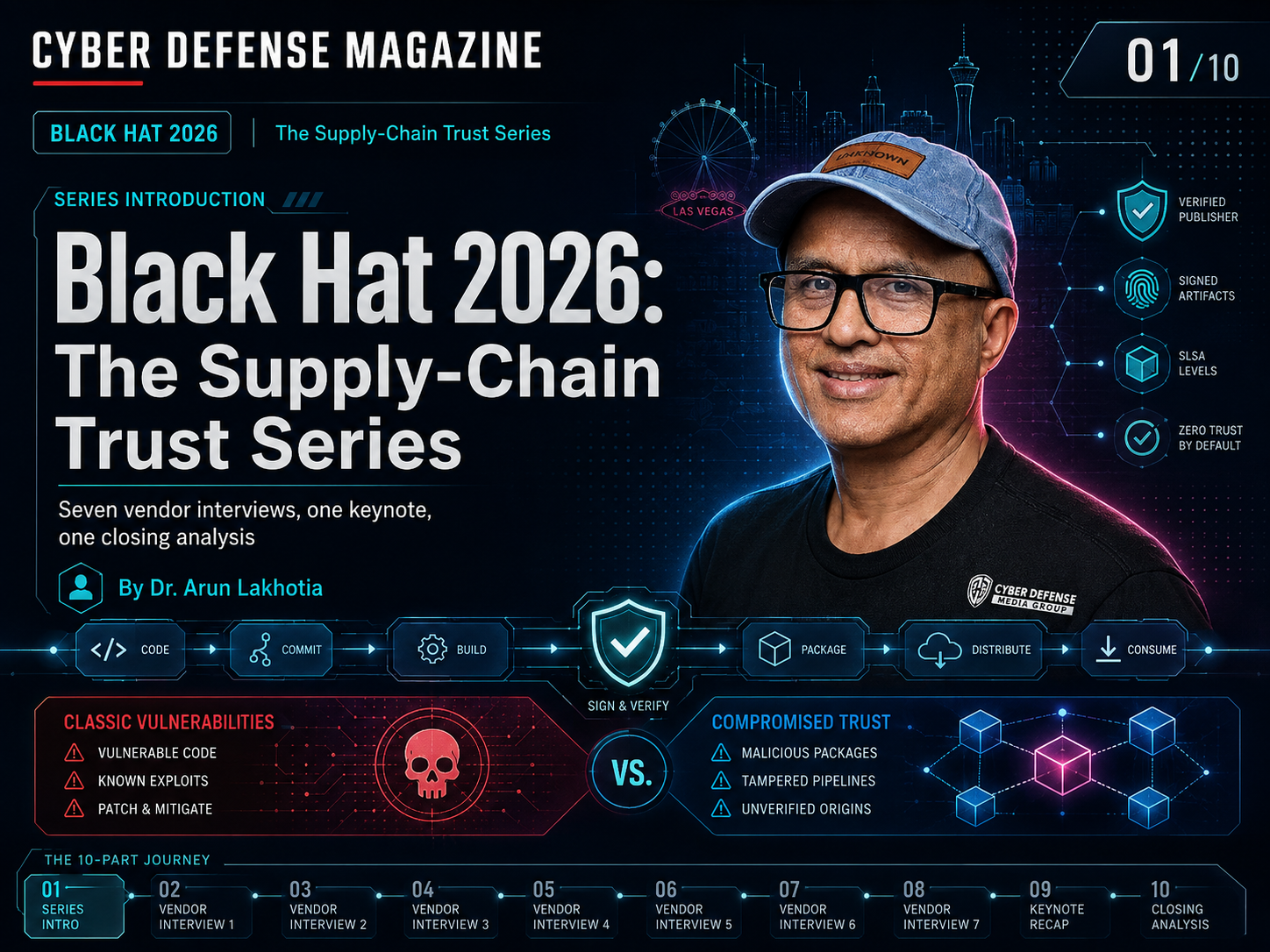
Exploring Black Hat 2026: The Supply-Chain Trust Series. This series serves as a hub for seven vendor interviews, a keynote report, and a conclusive analysis, all centered around the question of whether SBOMs and CVEs are effective defenses against software supply-chain attacks.
Figure 1 showcases embedded reporting within the Black Hat 2026 logo.
Reasons for Attendance
Earlier this year, I published a thought-provoking article questioning the efficacy of SBOMs and CVEs as defense mechanisms against software supply-chain threats. The response to this article led me to Black Hat 2026, where I delved deeper into this topic through interviews, keynote sessions, and briefings.
Over the course of two days, I engaged in seven interviews with technical experts from various vendors, attended a keynote by Microsoft security leaders, and learned about scanner vulnerabilities from ZeroPath’s Raphael Karger. This experience provided me with valuable insights into the market’s perspective on supply-chain defense.
Refining the Issue
One key takeaway from Black Hat 2026 was the realization that “software supply-chain defense” encompasses two distinct challenges:
- Problem A: Addressing vulnerabilities within the code itself, such as potential exploits in third-party libraries, as described by CVEs and SBOMs.
- Problem B: Tackling the exploitation of trust in the supply-chain process, exemplified by incidents like SolarWinds and npm Shai-Hulud. This type of attack involves malicious code infiltrating trusted systems under legitimate guises.
My initial hypothesis primarily focused on Problem B, which forms the foundation of this series and the subsequent analysis.
Series Overview
While each article in this series can stand alone, they are best understood when read together. The vendor profiles highlight each company’s strengths, while the concluding analysis critically evaluates the evidence against my hypothesis.
- Pentera: Assaf Regev – emphasizes automated security validation and exploitability assessment.
- ZeroPath: Raphael Karger – specializes in AI source scanning and highlights scanner vulnerabilities.
- Magnitude: Sean Wilcox – focuses on automating vendor risk assessments.
- ActiveState: Leslie Pascual – offers solutions like rebuild-from-source components and VEX.
- Chainguard: Patrick Smyth – provides secure image and library rebuilding from source.
- NetRise: Chris Patterson – specializes in binary analysis and provenance gating.
- ReversingLabs: Igor Lasic – focuses on deep final-build analysis and behavior assessment.
- Microsoft keynote: Aarti Borkar and Tanmay Ganacharya – examines trust exploitation through case studies.
- Synthesis: Two Problems, One Solution: Evaluates evidence for and against the “duck and cover” approach.
Approach Overview
Looking beyond marketing jargon, the tools in this series can be categorized into specific families based on their inspection focus and pipeline position. The synthesis delves deeper into these categories, but here is a brief overview:
- Structural prevention: Offered by Chainguard (05) and ActiveState (04) through clean source rebuilds and trusted proxy services.
- Registry mirroring with provenance and policy gating: Implemented by NetRise Provenance (06) and ReversingLabs’ community feed (07) to regulate ecosystem access.
- Post-build, behavior-grounded analysis: Utilized by ReversingLabs (07) and NetRise Turbine (06) to assess shipped artifacts based on behavior.
- Source scanners and vulnerability validation: Represented by ZeroPath (02) and highlighted in the Microsoft keynote’s Trivy case (08).
- Exploitability validation: Implemented by Pentera (01) to filter out relevant CVEs.
- Organizational and Nth-party trust: Addressed by Magnitude (03) at a higher level beyond code assessment.
Getting Started
For a comprehensive understanding, start with the synthesis article before exploring the individual vendor profiles. Whether you’re seeking an argumentative perspective or detailed reporting, the core message remains consistent: innovative vendors are proactively addressing supply-chain threats by scrutinizing every software update.
Acknowledgments: Special thanks to Gary Miliefsky for facilitating this investigative opportunity and to Nate Smith for assisting with the interviews.
About the Author
 Dr. Arun Lakhotia, a Computer Science Professor at the University of Louisiana at Lafayette and Co-Founder/CTO of Unknown Cyber Inc., undertook a study on software supply-chain defense at Black Hat 2026. With expertise in analyzing complex malware at scale, Dr. Lakhotia can be reached online at [email protected].