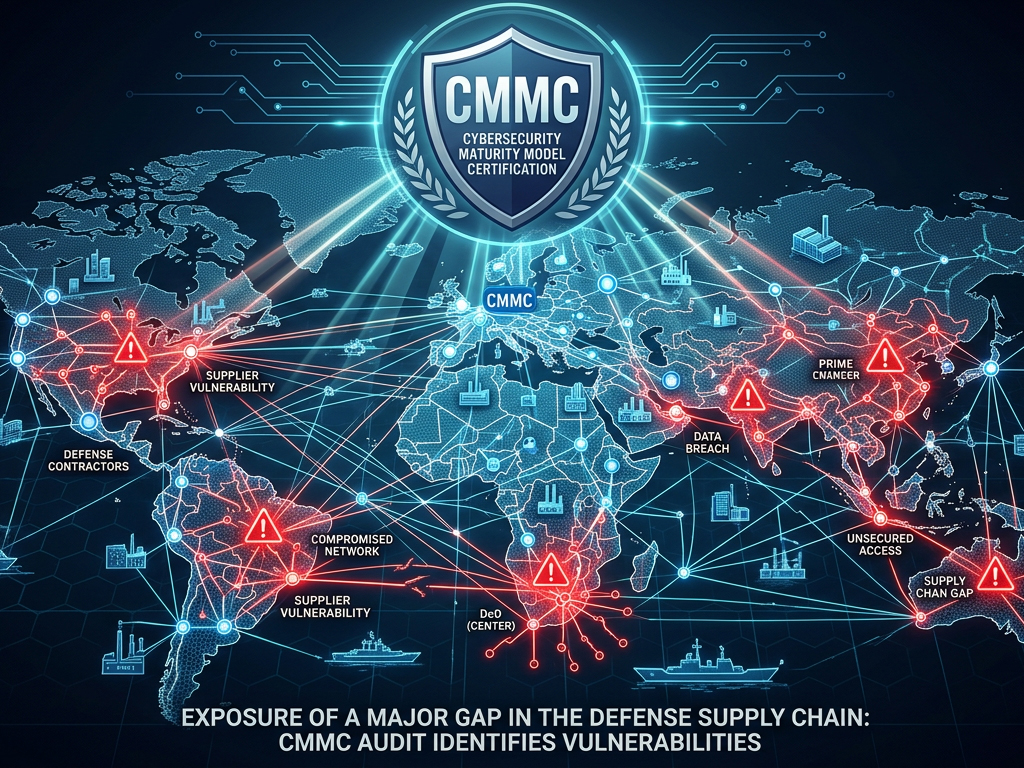
Many defense contractors have historically approached cybersecurity compliance as a process focused on preparation and documentation. They would review NIST SP 800-171, implement what they believed to be the necessary safeguards for their networks, conduct internal assessments, and assume they were on the right path.
With the emergence of CMMC requirements in Department of Defense contracts, contractors are realizing that meeting the framework goes beyond just having security tools in place. They now need to demonstrate, through documentation and technical evidence, how their systems protect Controlled Unclassified Information and ensure consistent enforcement of these protections.
Validation Through Evidence
Under the previous self-assessment model, organizations would interpret requirements within their own environment. Controls would be mapped to existing systems and marked as implemented based on internal understanding. However, CMMC introduces a new approach where safeguards must be clearly tied to system boundaries, supported by policies reflecting actual practices, and backed by reviewable evidence during assessments.
Preparing for CMMC certification often reveals that the challenge lies not in lacking security capability but in articulating and documenting the structure of their systems.
The Challenge of Defining Boundaries
Many defense contractors operate complex networks that have evolved over time to support various functions. Legacy servers coexist with cloud platforms, manufacturing equipment communicates with corporate systems, and external partners access shared tools. When Controlled Unclassified Information enters this environment, pinpointing its location and the responsible systems can be more complex than anticipated.
Establishing a defensible CMMC boundary involves mapping how sensitive data flows through the organization, identifying storage and processing systems, and documenting responsibility for each protection layer.
In environments that have grown organically, answers to these questions may not be immediately clear, with documentation possibly outdated and responsibilities shared among different teams and providers without clear ownership.
These challenges often surface during formal assessments, where straightforward controls on paper may prove difficult to demonstrate in practice.
The timeline for CMMC implementation adds pressure, with new Department of Defense contracts requiring self-assessment scores through SPRS by November 2025. Third-party certification through C3PAO begins in November 2026 for selected programs, with broader application expected by 2028.
Impact on Contractor Behavior
Prime contractors are already assessing supplier readiness for certification, which extends throughout the supply chain. Subcontractors lacking progress may face additional scrutiny during onboarding.
Early movers face the challenge of limited assessment capacity, as tens of thousands of organizations seek Level 2 certification while C3PAO numbers remain restricted. Scheduling assessments becomes crucial as more contractors enter the certification process.
Organizations that start preparations sooner have the opportunity to review boundaries, update documentation, address gaps, and compile evidence for certification. Those delaying may find themselves juggling these tasks alongside competing for assessment slots.
While CMMC does not introduce entirely new cybersecurity principles, the evaluation approach differs from past standards like NIST SP 800-171.
Demonstrating Readiness
Organizations are now required to demonstrate how their systems protect controlled data and provide evidence of consistent operation of these protections, rather than simply stating compliance.
Contractors aligning their systems, documentation, and processes with this expectation are likely to navigate certification smoothly. Those delaying preparation may find the challenge lies not in implementing safeguards but in showcasing their functionality during assessments.
Charlie Sciuto, the CISO and CTO of SSE, Inc., a Registered Provider Organization (RPO) accredited by the Cyber AB to assist companies in CMMC certification preparation, offers readiness assessments, gap analysis, remediation, and continuous monitoring for compliance.
Connect with Charlie on LinkedIn or visit the company website at https://www.sseinc.com/