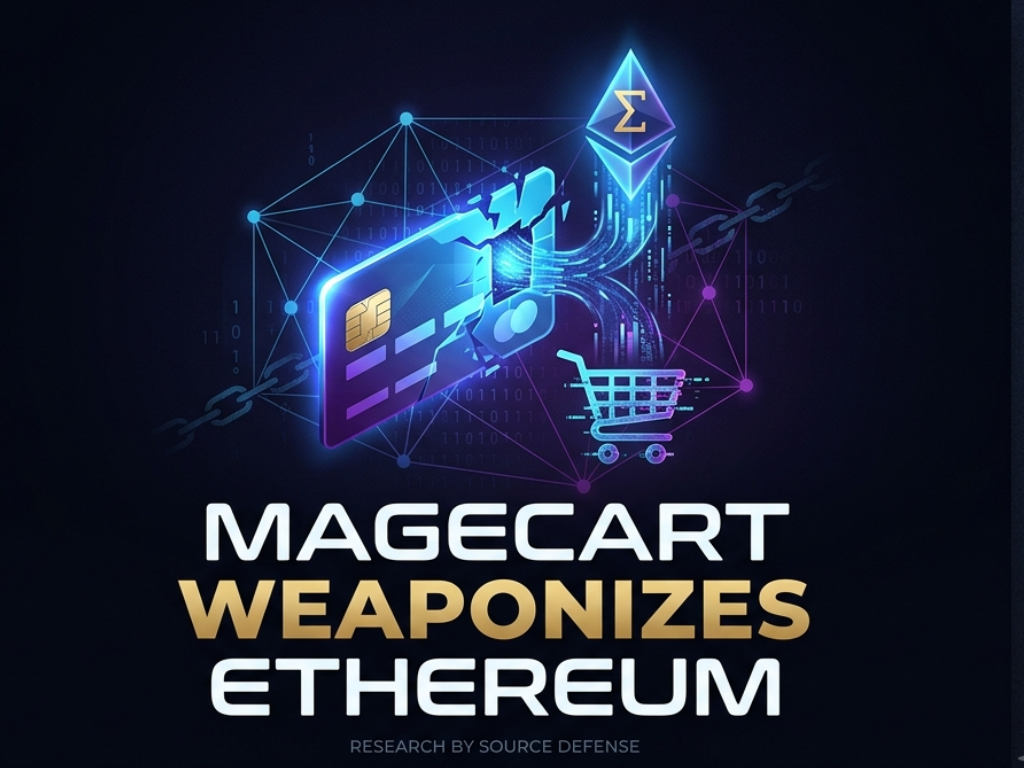
The Decentralized Era of Digital Skimming: A New Frontier in Cybercrime
A recent investigation by Source Defense has revealed a sophisticated Digital Skimming campaign, also known as Magecart, targeting retail websites worldwide. What sets this campaign apart is its utilization of the Ethereum blockchain as a robust infrastructure for command-and-control operations.
The cybercriminals behind this campaign have ingeniously concealed themselves within seemingly legitimate containers, such as spoofed Google Tag Manager containers, before transitioning to decentralized smart contracts, evading traditional security measures.
Redefining Defensive Strategies
Unlike conventional methods that rely on identifying known malicious domains, this campaign has disrupted the status quo. When a user accesses an infected payment page, the site queries a blockchain smart contract in the background. This contract returns encrypted data decrypted locally by the browser, revealing the location of the malicious server, which then injects the data-stealing payload into the browser.
Should a defender manage to block one of the external landing domains, the threat actor can effortlessly redirect the smart contract to a new link, maintaining their malicious operations seamlessly. This tactic ensures continuous data extraction without the need to tamper with the compromised website’s code.
Once embedded in the checkout process, the malicious script creates a flawless replica of the transaction form, silently collecting sensitive information like credit card details, personal data, and browser fingerprints.
“We are witnessing a shift towards sophisticated, long-lasting cyber attacks,” says Hadar Blutrich, Co-Founder of Source Defense. “By leveraging blockchain technology for routing, attackers are creating resilient command-and-control frameworks that are challenging to disrupt and adapt quickly to defensive measures.”
“Many organizations prioritize compliance over comprehensive security.”
– Hadar Blutrich, Co-Founder of Source Defense
This emerging threat comes at a crucial juncture for the e-commerce industry, as merchants strive to adhere to updated security standards like PCI DSS 4.0.1. While organizations focus on meeting regulatory requirements, adversaries are devising ways to bypass these controls.
Blutrich stresses that overlooking front-end security in favor of compliance leaves systemic vulnerabilities unchecked, paving the way for cybercriminals to exploit regulatory gaps and launch sophisticated attacks.
Adapting to Evolving Threats
Web-based theft has evolved beyond mere cryptocurrency theft. With threat actors leveraging blockchain technology, relying solely on reactive security measures is inadequate.
Source Defense advocates for continuous behavioral monitoring of front-end activities to detect and neutralize unauthorized scripts before they interact with external networks or blockchain nodes, safeguarding consumer transactions effectively.
Author’s Insights
For more information, refer to the Source Defense Threat Intelligence Research Paper titled “Magecart Evolves: Blockchain-Based Command and Control Infrastructures in E-Skimming.”
Carmen Estela, a Cybersecurity Research Analyst at Cyber Defense Magazine and a Women in Cybersecurity Award Candidate, brings a wealth of expertise. With a Master’s degree from the University of Central Florida and a background in Criminology from the University of Florida, she is dedicated to enhancing governance, risk, and compliance standards in cybersecurity.
Contact Carmen at [email protected].