
AI
Interpreting Pathology Slides Through Clinical Dialogue: A PRISM2 Model Approach

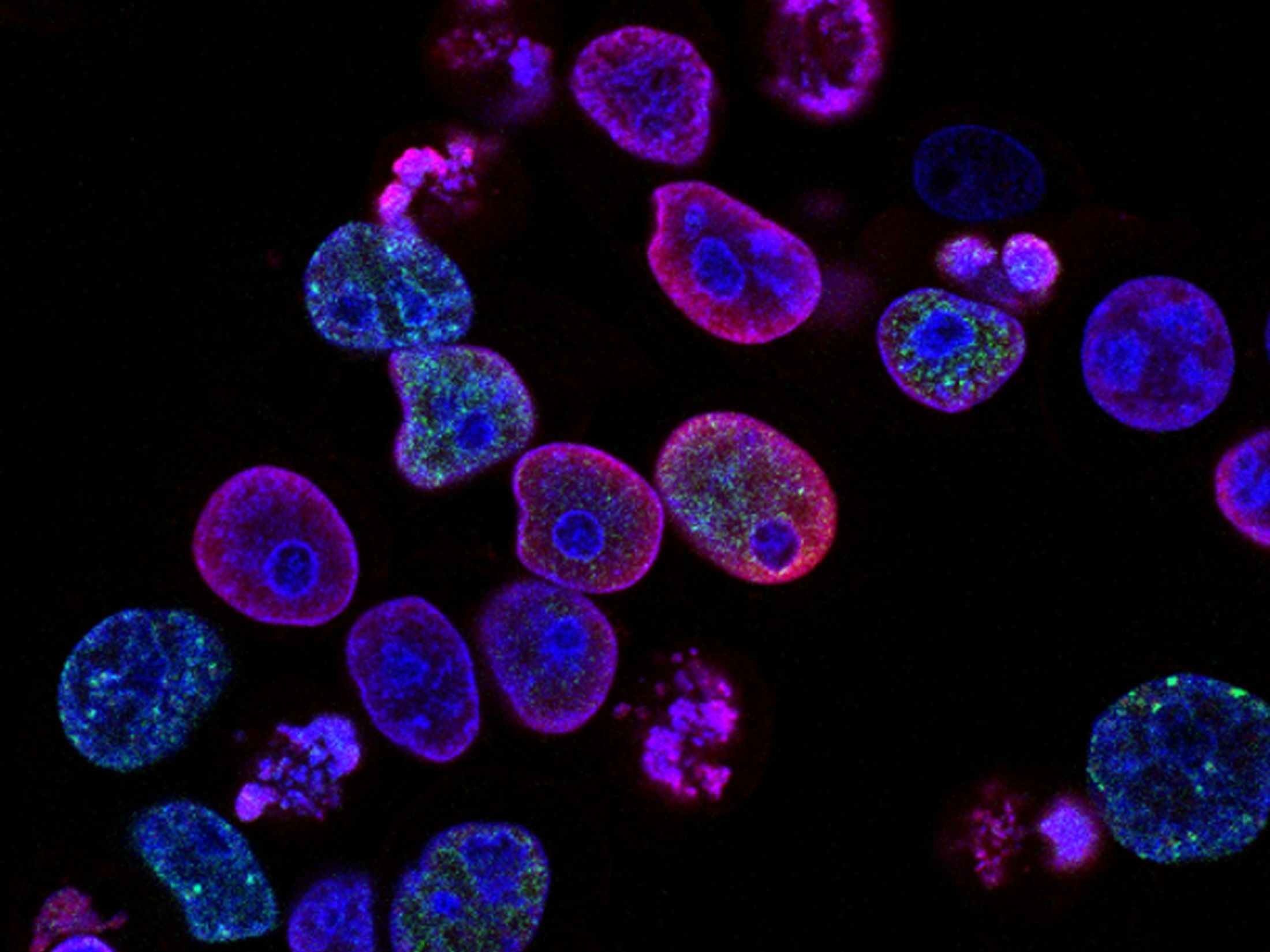
PRISM2 is a groundbreaking AI model developed by Paige and Microsoft that revolutionizes the analysis of whole-slide images in pathology. By training a perceiver-based encoder on tissue tiles and clinical dialogue from pathology reports, PRISM2 generates text that answers diagnostic questions, going beyond pixel classification.
The model is trained on a vast dataset of 2.3 million whole-slide images and 685,507 pathology reports from Memorial Sloan Kettering Cancer Center. This data is converted into question-and-answer pairs by GPT-4o, providing valuable dialogue supervision.
Architecture and Embedding Design
PRISM2’s architecture consists of two phases. The first phase focuses on training the slide encoder to aggregate tile-level features into a cohesive slide-level vector that aligns with report language. The second phase fine-tunes a language model on dialogue to understand pathology reporting conventions.
The model employs a perceiver-based slide encoder to aggregate tile embeddings, using contrastive and autoregressive objectives to optimize both retrieval and generation capabilities. By combining these training methods, PRISM2 aims to strike a balance between embedding quality and text generation.
PRISM2 introduces two separate embeddings: base embeddings from the slide encoder for biomarker prediction tasks and diagnostic embeddings from the language model for cancer detection and subtyping. Each embedding is tailored to specific diagnostic tasks.
Performance and Benchmark Results
PRISM2 excels in clinical-grade product comparisons for prostate and breast cancer detection, surpassing existing models in accuracy. The model also outperforms in breast lymph node classification without additional task-specific training.
Across pan-cancer detection tasks, diagnostic embeddings achieve high AUC scores, demonstrating the model’s versatility and effectiveness in diverse diagnostic scenarios. Linear probing confirms the superior performance of PRISM2 embeddings across various benchmarks.
Survival and biomarker tasks further showcase PRISM2’s capabilities, with embeddings consistently outperforming specialist models in overall survival predictions and biomarker analyses.
An ablation study highlights the importance of dialogue supervision in enhancing diagnostic accuracy, emphasizing the value of large-scale training data in model performance.
Data Quality, Error Rates, and Architectural Limitations
PRISM2 undergoes rigorous evaluation to ensure data quality and minimize error rates. The model’s performance is assessed across various tasks, revealing strengths and areas for improvement.
Architectural limitations, such as the lack of position encoding and fixed resolution scans, present challenges for spatial reasoning tasks and scalability. External validation is recommended to assess model performance beyond the training dataset.
While model weights are publicly available, training and inference pipelines remain proprietary, limiting reproducibility for external teams. Integration with scanner output is crucial for ensuring model parity in different settings.
In conclusion, PRISM2 represents a significant advancement in AI-driven pathology analysis, offering state-of-the-art performance across a wide range of diagnostic tasks. Continuous refinement and validation are essential for maximizing the model’s potential in real-world applications.












Microsoft Unveils Upgraded Surface Pro and Laptop with Qualcomm’s X2 Plus Processor

Revolutionizing Chip Design: The SPRIND and NADI €40m AI-Native Challenge

Experience the Power of Dynasty Warriors 3 Remastered: Join Forces in Online Co-op Today!

Samsung Gallery App Now Syncs with Google Photos – Stay Organized Across Platforms!

Xiaomi 18 Pro: Conquering the Global Market in 2026

Insurtechs Embrace a New Approach: Finding Customers Instead of Chasing Them

Google DeepMind’s Gemini 4: A Launch on the Horizon

Apple Enhances Camera Compatibility with RAW Support for 11 Models

Samsung Galaxy S9 Plus Gaming Review! (vs OnePlus 5T)

EU Takes Action Against Instagram and Facebook for Violating Illegal Content Rules

Warning: Facebook Creators Face Monetization Loss for Stealing and Reposting Videos

Facebook’s New Look: A Blend of Instagram’s Style

Facebook Compliance: ICE-tracking Page Removed After US Government Intervention

Facebook and Instagram to Reduce Personalized Ads for European Users

InstaDub: Meta’s AI Translation Tool for Instagram Videos

Reclaim Your Account: Facebook and Instagram Launch New Hub for Account Recovery

Meta discontinues Messenger apps for Windows and macOS

Breaking Updates: Meta Connect 2025 Unveils Latest Developments
Samsung Galaxy S9 Plus Gaming Review! (vs OnePlus 5T)

THE BEST PHONE HTC EVER MADE?

The Truth about Google?

Samsung S9/ S9+ vs iPhone X vs Galaxy Note 8 Battery Life DRAIN TEST

Samsung S9 / S9+ vs Mate 10 Pro vs iPhone X Charging SPEED Test

The BEST APPS in 2018 – ft. MKBHD, UrAvgConsumer, iJustine + More

The ULTIMATE Smartphone Unboxing!!

HOW GOOD can a $250 Smartphone Camera be!?

10 Android Apps you NEED to try in 2018
-
 Facebook11 months ago
EU Takes Action Against Instagram and Facebook for Violating Illegal Content Rules
-
 Facebook11 months ago
Warning: Facebook Creators Face Monetization Loss for Stealing and Reposting Videos
-
 Facebook10 months ago
Facebook’s New Look: A Blend of Instagram’s Style
-
 Facebook11 months ago
Facebook Compliance: ICE-tracking Page Removed After US Government Intervention
-
 Facebook10 months ago
Facebook and Instagram to Reduce Personalized Ads for European Users
-
 Facebook11 months ago
InstaDub: Meta’s AI Translation Tool for Instagram Videos
-
 Facebook10 months ago
Reclaim Your Account: Facebook and Instagram Launch New Hub for Account Recovery
-
 Apple11 months ago
Meta discontinues Messenger apps for Windows and macOS
