
Inovation
Revolutionary Metal Composite: Unmatched Strength and Heat Resistance

Researchers at the University of Toronto have created an innovative composite material that is exceptionally lightweight and incredibly strong, capable of withstanding temperatures up to 500 degrees Celsius.
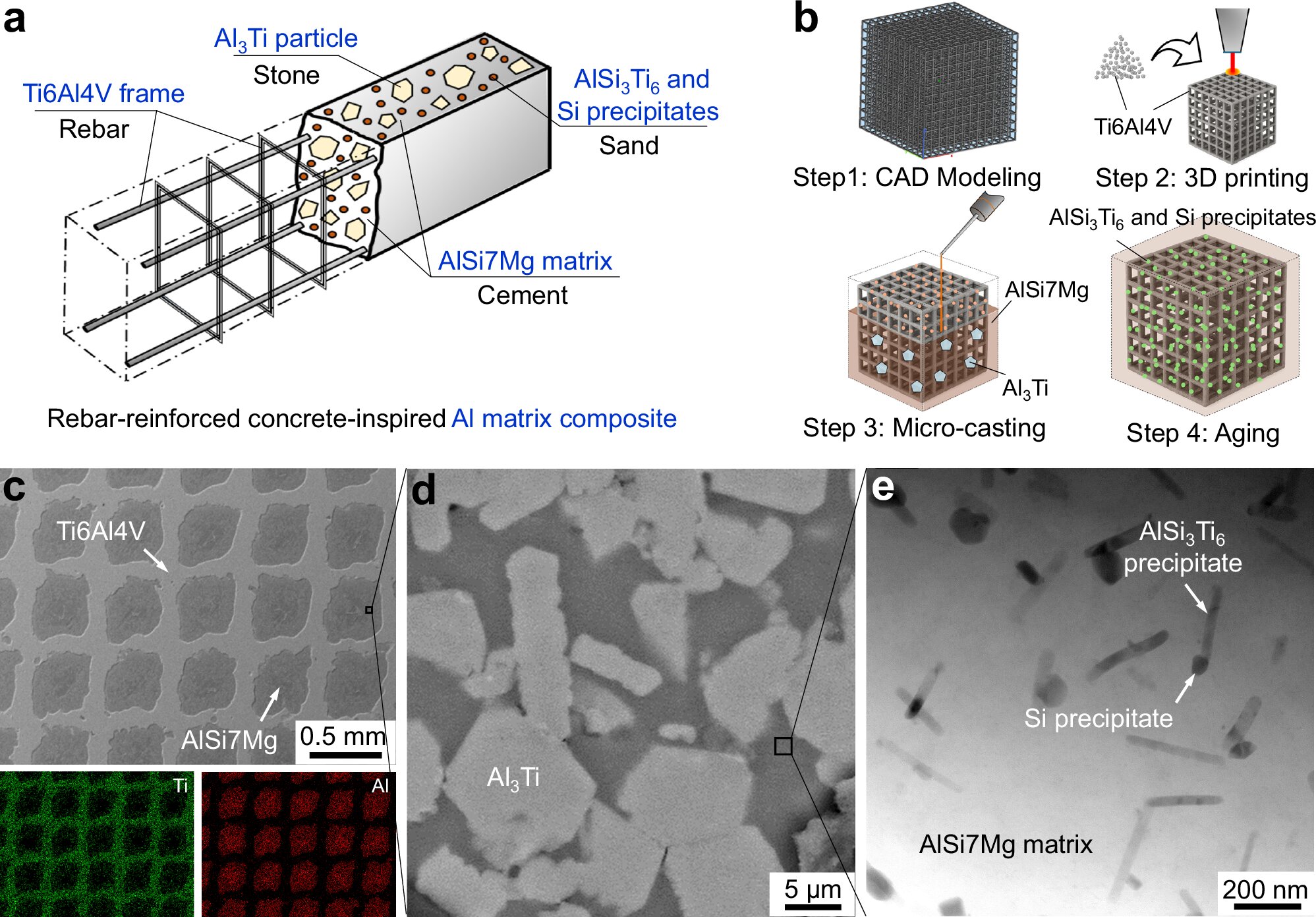
The composite material, detailed in a study published in Nature Communications, is composed of various metallic alloys and nanoscale precipitates, featuring a structure that resembles reinforced concrete but on a microscopic scale.
These distinctive properties make it highly valuable for applications in the aerospace industry and other high-performance sectors.
Yu Zou, the senior author of the study and an associate professor in the Department of Materials Science and Engineering at U of T’s Faculty of Applied Science & Engineering, explains, “New techniques such as additive manufacturing, also known as 3D metal printing, have now enabled us to mimic this structure in the form of a metal matrix composite. This approach gives us new materials with properties we’ve never seen before.”
The Significance of Lightweight Materials in Aerospace
While steel remains a primary structural material in trains and automobiles, aluminum offers advantages in aircraft due to its reduced weight.
Lightweighting, the process of reducing component weight while maintaining strength, enhances vehicle efficiency by requiring less power for propulsion, leading to improved fuel economy. This is particularly critical in aerospace, where weight plays a crucial role.
However, aluminum alloys have historically faced challenges, especially in maintaining performance at high temperatures. Chenwei Shao, the lead author of the study and a research associate in Zou’s lab, notes, “Until now, aluminum components have suffered from performance degradation at high temperatures, rendering them unsuitable for many applications.”
The Development of the New Composite Material
To address this issue, the research team aimed to create a composite material with a structure akin to reinforced concrete, featuring a mesh of titanium alloy struts surrounded by a matrix of elements such as aluminum, silicon, and magnesium.
The spaces between the struts were filled using micro-casting to form a cement-like matrix, while strength was further enhanced by embedding micrometer-sized particles of alumina and silicon nanoprecipitates within the matrix.
Performance Testing at High Temperatures
The newly developed material underwent rigorous testing to assess its strength properties.
Shao highlights, “At room temperature, the material exhibited a yield strength of around 700 megapascals, significantly higher than traditional aluminum matrices. Remarkably, at 500 degrees Celsius, the yield strength remained between 300 and 400 megapascals, showcasing its exceptional performance even under extreme heat conditions.”
Moreover, the material’s ability to resist degradation at high temperatures was attributed to a unique deformation mechanism termed ‘enhanced twinning,’ as revealed by detailed computer simulations conducted by Huicong Chen, a co-author of the study.
Future Prospects in Industrial Applications
While the widespread adoption of the new material may require time, Zou emphasizes the potential benefits of emerging technologies like additive manufacturing.
Zou states, “We believe this is a significant advancement towards the development of stronger, lighter, and more efficient vehicles. As more companies invest in advanced manufacturing technologies, we anticipate a reduction in production costs, making high-performance materials like this more accessible.”











Revolutionary Safety Feature: Tesla Roadster with Retractable Movable Wing

Microsoft Announces Discontinuation of Copilot Plus PC Brand

Goblin Invasion: Hytale’s Chapter 1 Update Introduces Epic Boss Battles and Intricate Dungeons

Samsung Galaxy S27 Pro and Ultra: Enhanced with Larger Batteries

Innovative Health Benefits for Emerging Businesses

Comparing Apple Home’s AI Camera to Amazon and Google: A Test of Smart Home Technology

AirPods Enhancements: The Long-Awaited Update

The Evolution of the ALPINA X5: From Secret Prototype to BMW X5 4.6iS

Microsoft’s Revolutionary Copilot: A Game-Changer in the Battle Against Anthropic and OpenAI – GeekWire

EU Takes Action Against Instagram and Facebook for Violating Illegal Content Rules

Warning: Facebook Creators Face Monetization Loss for Stealing and Reposting Videos

Facebook’s New Look: A Blend of Instagram’s Style

Facebook Compliance: ICE-tracking Page Removed After US Government Intervention

Facebook and Instagram to Reduce Personalized Ads for European Users

InstaDub: Meta’s AI Translation Tool for Instagram Videos

Reclaim Your Account: Facebook and Instagram Launch New Hub for Account Recovery

Meta discontinues Messenger apps for Windows and macOS

Breaking Updates: Meta Connect 2025 Unveils Latest Developments

Samsung Galaxy S9 Plus vs iPhone X

The BEST $300 Phone (2018) ft. MKBHD, Technical Guruji, iJustine + More

Samsung Galaxy S9 Plus Gaming Review! (vs OnePlus 5T)

THE BEST PHONE HTC EVER MADE?

The Truth about Google?

Samsung S9/ S9+ vs iPhone X vs Galaxy Note 8 Battery Life DRAIN TEST

Samsung S9 / S9+ vs Mate 10 Pro vs iPhone X Charging SPEED Test

The BEST APPS in 2018 – ft. MKBHD, UrAvgConsumer, iJustine + More

The ULTIMATE Smartphone Unboxing!!
-
 Facebook11 months ago
EU Takes Action Against Instagram and Facebook for Violating Illegal Content Rules
-
 Facebook12 months ago
Warning: Facebook Creators Face Monetization Loss for Stealing and Reposting Videos
-
 Facebook10 months ago
Facebook’s New Look: A Blend of Instagram’s Style
-
 Facebook12 months ago
Facebook Compliance: ICE-tracking Page Removed After US Government Intervention
-
 Facebook10 months ago
Facebook and Instagram to Reduce Personalized Ads for European Users
-
 Facebook12 months ago
InstaDub: Meta’s AI Translation Tool for Instagram Videos
-
 Facebook10 months ago
Reclaim Your Account: Facebook and Instagram Launch New Hub for Account Recovery
-
 Apple11 months ago
Meta discontinues Messenger apps for Windows and macOS
