Many of the challenges faced this week stem from trusted entities acting in ways they were authorized to do.
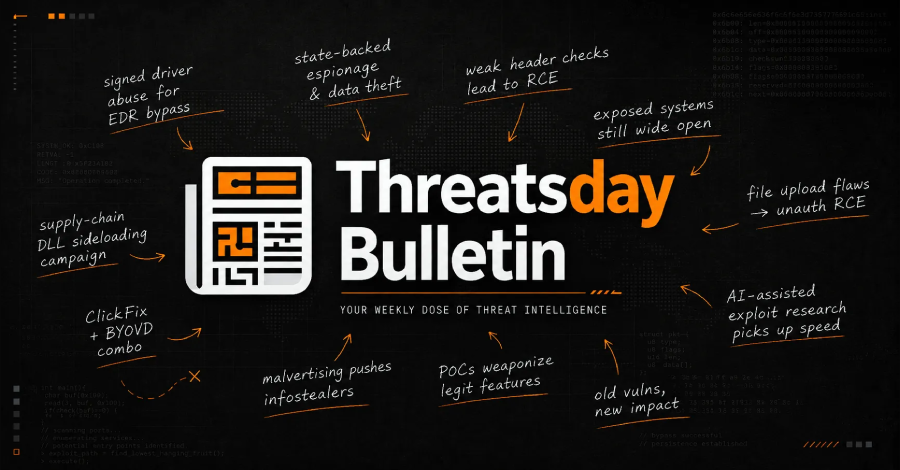
Digitally signed drivers are being exploited to bypass security measures. Legitimate applications are being used to camouflage malware. A vulnerability in header checking is allowing for code execution. Additionally, there are exposed systems, outdated vulnerabilities, unconventional hiding techniques, and AI-powered exploit research, all contributing to the ease with which damage can be inflicted.
No elaborate embellishments are required here. The existing loopholes are already causing significant harm.
The landscape of threats evolves constantly. Stay informed by subscribing to our ThreatsDay Bulletin to receive alerts whenever a new issue is released.
-
Exploitation of Signed Drivers
Check Point’s research has uncovered the repurposing of Microsoft Defender’s signed Defender Boot-Time Removal driver to evade endpoint security solutions. This manipulation, facilitated through a “golden window” of system start-up, allows for unauthorized kernel operations without relying on vulnerable drivers. Security researcher Jiří Vinopal noted that traditional signature-based blocking is ineffective against this tactic. Additionally, a weaponization tool like BTR_CLI mimics the behavior of the genuine Windows Defender remediation process, further complicating detection.
Weeks like this underscore the fact that cyberattacks often exploit vulnerabilities in trusted systems and processes rather than resorting to sophisticated techniques. By enhancing trust mechanisms, questioning assumptions, and scrutinizing overlooked areas, organizations can better defend against evolving threats.