
Security
Exploiting Qilin Ransomware: Harnessing WSL for Linux Encryptors on Windows


A recent discovery has unveiled the Qilin ransomware operation’s tactics of executing Linux encryptors within Windows using the Windows Subsystem for Linux (WSL) to avoid detection by conventional security tools.
Originally known as “Agenda” when it emerged in August 2022, the ransomware rebranded itself as Qilin by September and has continued its malicious operations under this new name ever since.
Qilin has rapidly become one of the most active ransomware operations globally, with reports from Trend Micro and Cisco Talos indicating that the cybercrime group has targeted over 700 victims across 62 countries in the present year.
Both cybersecurity firms have highlighted the group’s prolific nature, with statistics showing that Qilin has been responsible for over 40 new victims per month in the latter half of 2025.
According to research findings, Qilin affiliates employ a combination of legitimate software and remote management tools to infiltrate networks and steal credentials. These tools include AnyDesk, ScreenConnect, and Splashtop for remote access, as well as Cyberduck and WinRAR for data theft.
Furthermore, the threat actors utilize common Windows utilities like Microsoft Paint (mspaint.exe) and Notepad (notepad.exe) to scan documents for sensitive information before exfiltrating them.
Exploiting Vulnerable Drivers to Disable Security Measures
Recent observations by Trend Micro and Talos have revealed that Qilin affiliates engage in Bring Your Own Vulnerable Driver (BYOVD) attacks to circumvent security software before deploying encryptors.
The attackers deploy signed but vulnerable drivers, such as eskle.sys, to halt antivirus and EDR processes. Additionally, they use DLL sideloading to introduce additional kernel drivers (rwdrv.sys and hlpdrv.sys) that provide elevated kernel-level privileges.
Talos noted that the threat actors utilize tools like “dark-kill” and “HRSword” to disable security software and erase any traces of their malicious activities.
Cisco Talos explained, “We have frequently observed attempts to disable EDR through various methods, including directly executing the EDR’s ‘uninstall.exe’ or stopping services using the sc command. Moreover, attackers have been seen using open-source tools like dark-kill and HRSword.”
Launching Linux Encryptors via WSL
In December 2023, reports surfaced regarding a new Qilin Linux encryptor that specifically targets VMware ESXi virtual machines and servers.
The encryptor offers command-line options for debug mode activation, conducting dry runs without encryption, and customizing the encryption process for virtual machines and their snapshots.
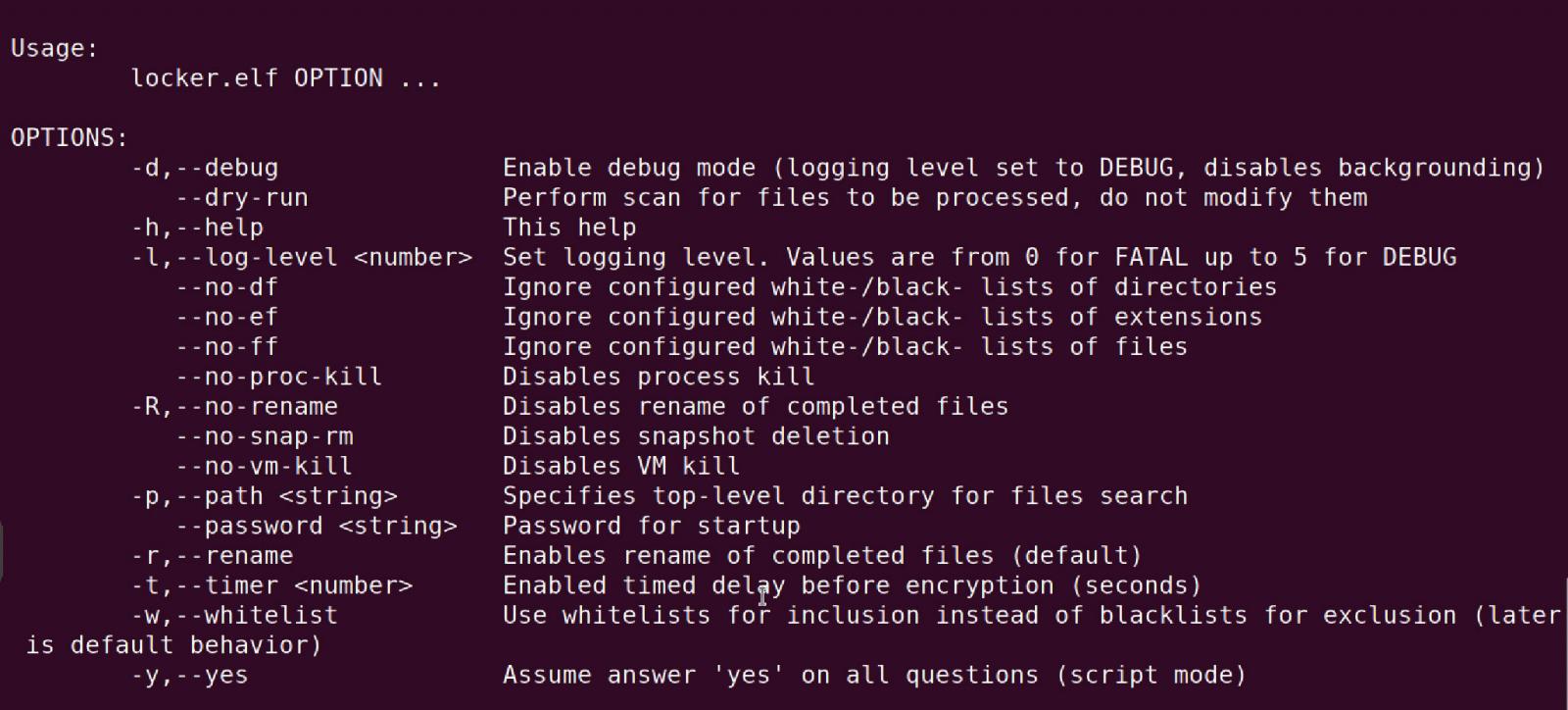
Source: BleepingComputer
Researchers at Trend Micro have identified instances where Qilin affiliates leverage WinSCP to transfer the Linux ELF encryptor to compromised devices. Subsequently, the encryptor is launched using the Splashtop remote management software (SRManager.exe) within the Windows environment.
Although initially labeled as cross-platform, Qilin’s Linux encryptors are ELF executables, necessitating a runtime environment like the Windows Subsystem for Linux (WSL) for execution.
Further investigations revealed that threat actors indeed utilize WSL to execute the encryptor on compromised systems.
WSL is a Windows feature that enables the installation and operation of Linux distributions directly within the Windows environment. Threat actors exploit this feature by installing WSL upon gaining access to a device and using it to execute the Linux encryptor, effectively evading traditional Windows security measures.
Trend Micro highlighted, “The threat actors were able to run the Linux encryptor on Windows systems by leveraging the Windows Subsystem for Linux (WSL), a built-in feature that facilitates the execution of Linux binaries on Windows without the need for a virtual machine.”
As many Windows EDR products focus on Windows PE behavior, malicious activities occurring within WSL often evade detection, allowing ransomware to bypass traditional security measures.
This technique underscores ransomware operators’ adaptation to hybrid Windows and Linux environments to expand their reach and outsmart conventional defenses.
46% of environments had passwords cracked, nearly doubling from 25% last year.
Discover more insights on prevention, detection, and data exfiltration trends in the Picus Blue Report 2025.









Reimagining the Next Generation: A Closer Look at the Apple TV 4K and HomePod Mini

Samsung Galaxy S9 & S9+ UNBOXING!

Revolutionary Safety Feature: Tesla Roadster with Retractable Movable Wing

Microsoft Announces Discontinuation of Copilot Plus PC Brand

Goblin Invasion: Hytale’s Chapter 1 Update Introduces Epic Boss Battles and Intricate Dungeons

Samsung Galaxy S27 Pro and Ultra: Enhanced with Larger Batteries

Innovative Health Benefits for Emerging Businesses

Comparing Apple Home’s AI Camera to Amazon and Google: A Test of Smart Home Technology

AirPods Enhancements: The Long-Awaited Update

EU Takes Action Against Instagram and Facebook for Violating Illegal Content Rules

Warning: Facebook Creators Face Monetization Loss for Stealing and Reposting Videos

Facebook’s New Look: A Blend of Instagram’s Style

Facebook Compliance: ICE-tracking Page Removed After US Government Intervention

Facebook and Instagram to Reduce Personalized Ads for European Users

InstaDub: Meta’s AI Translation Tool for Instagram Videos

Reclaim Your Account: Facebook and Instagram Launch New Hub for Account Recovery

Meta discontinues Messenger apps for Windows and macOS

Breaking Updates: Meta Connect 2025 Unveils Latest Developments
Samsung Galaxy S9 & S9+ UNBOXING!

Samsung Galaxy S9 Plus vs iPhone X

The BEST $300 Phone (2018) ft. MKBHD, Technical Guruji, iJustine + More

Samsung Galaxy S9 Plus Gaming Review! (vs OnePlus 5T)

THE BEST PHONE HTC EVER MADE?

The Truth about Google?

Samsung S9/ S9+ vs iPhone X vs Galaxy Note 8 Battery Life DRAIN TEST

Samsung S9 / S9+ vs Mate 10 Pro vs iPhone X Charging SPEED Test

The BEST APPS in 2018 – ft. MKBHD, UrAvgConsumer, iJustine + More
-
 Facebook11 months ago
EU Takes Action Against Instagram and Facebook for Violating Illegal Content Rules
-
 Facebook12 months ago
Warning: Facebook Creators Face Monetization Loss for Stealing and Reposting Videos
-
 Facebook10 months ago
Facebook’s New Look: A Blend of Instagram’s Style
-
 Facebook12 months ago
Facebook Compliance: ICE-tracking Page Removed After US Government Intervention
-
 Facebook10 months ago
Facebook and Instagram to Reduce Personalized Ads for European Users
-
 Facebook12 months ago
InstaDub: Meta’s AI Translation Tool for Instagram Videos
-
 Facebook10 months ago
Reclaim Your Account: Facebook and Instagram Launch New Hub for Account Recovery
-
 Apple11 months ago
Meta discontinues Messenger apps for Windows and macOS
