
Gadgets
Ultimate Guide to Android Theft Protection: Secure Your Phone in 5 Minutes

Summary generated by Smart Answers AI
In a nutshell:
- Android’s new AI-powered theft protection features, like Theft Detection Lock and Offline Device Lock, are highlighted by Tech Advisor to combat the increasing phone theft and financial fraud.
- These security tools automatically lock phones when theft patterns are detected or when devices go offline, preventing thieves from accessing banking apps and personal data.
- Identity Check, Factory Reset Protection, and Samsung’s Security Delay must be manually activated by users for comprehensive protection, as most anti-theft features are disabled by default.
Last November, my colleague’s Pixel 9 Pro was stolen on Tottenham Court Road. She was using Maps when a thief on a bike snatched it. Despite her quick call to the bank, the thief had already attempted to access her banking apps.
In 2025, the Metropolitan Police in London recorded 71,391 stolen phones. The real concern is not losing the device but the potential financial losses from unauthorized banking app access.
Android has had theft protection tools since 2024, which were further enhanced in 2026 with additional features such as Identity Check for banking apps.
However, many Android users are unaware of the existence of these theft protection features on their devices. These features are often hidden in Settings and deactivated by default, with Google not actively promoting them.
Here’s a comprehensive guide to safeguarding your phone, data, and finances.
Theft Detection Lock
To enable: Settings > Google > All services > Theft protection > Theft Detection Lock
Nikhil Azza / Foundry
This feature is designed for the situation described above. It uses AI to protect your Android phone by automatically locking the screen when a theft attempt is detected. The on-device AI combines the accelerometer, gyroscope, Wi-Fi, and Bluetooth to identify sudden movements like jerks, running, cycling, or driving. If these patterns match a theft scenario, the screen locks before the thief can disable security measures.
However, there is a limitation to be aware of: it only works on an unlocked, active screen. If someone takes the phone without any sudden movements, the algorithm won’t trigger. It also won’t activate if the phone is connected to a stable Wi-Fi or Bluetooth network, reducing false alarms, according to Google.
In early 2025, Google enhanced theft detection to be more robust. This means that fast movements like jogging might trigger the lock screen, which, although potentially annoying, demonstrates the effectiveness of the feature.
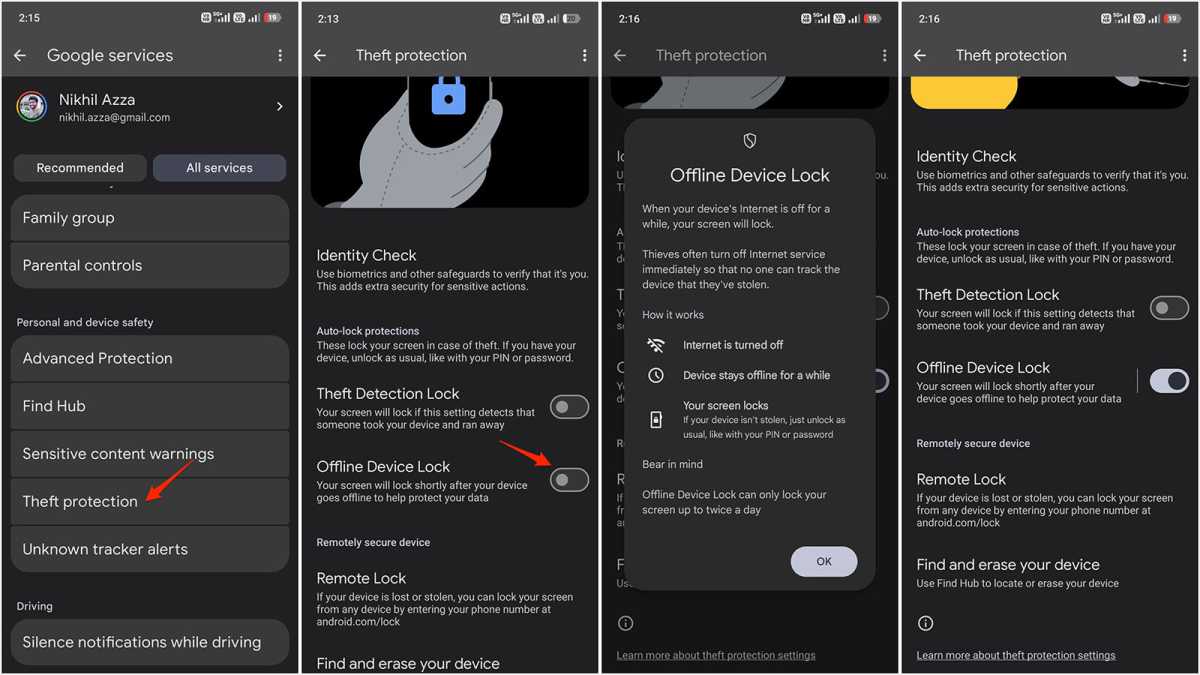
Offline Device Lock
To enable: Settings > Google > All services > Theft protection > Offline Device Lock
Nikhil Azza / Foundry
The first step most thieves take is to disconnect the internet. By going offline, a connected device can be tracked, locked, and wiped remotely. The offline device lock is specifically designed to prevent this scenario.
If your unlocked phone remains offline for an extended period, the screen will lock automatically. It also activates after multiple failed attempts within a short timeframe. Google has not disclosed the exact threshold, but it does not trigger immediately. For instance, a brief signal drop like entering a basement or tunnel won’t trigger it, but prolonged offline status will.
Similar to Theft Detection Lock, your phone must be unlocked when losing connectivity for the offline device lock to activate.
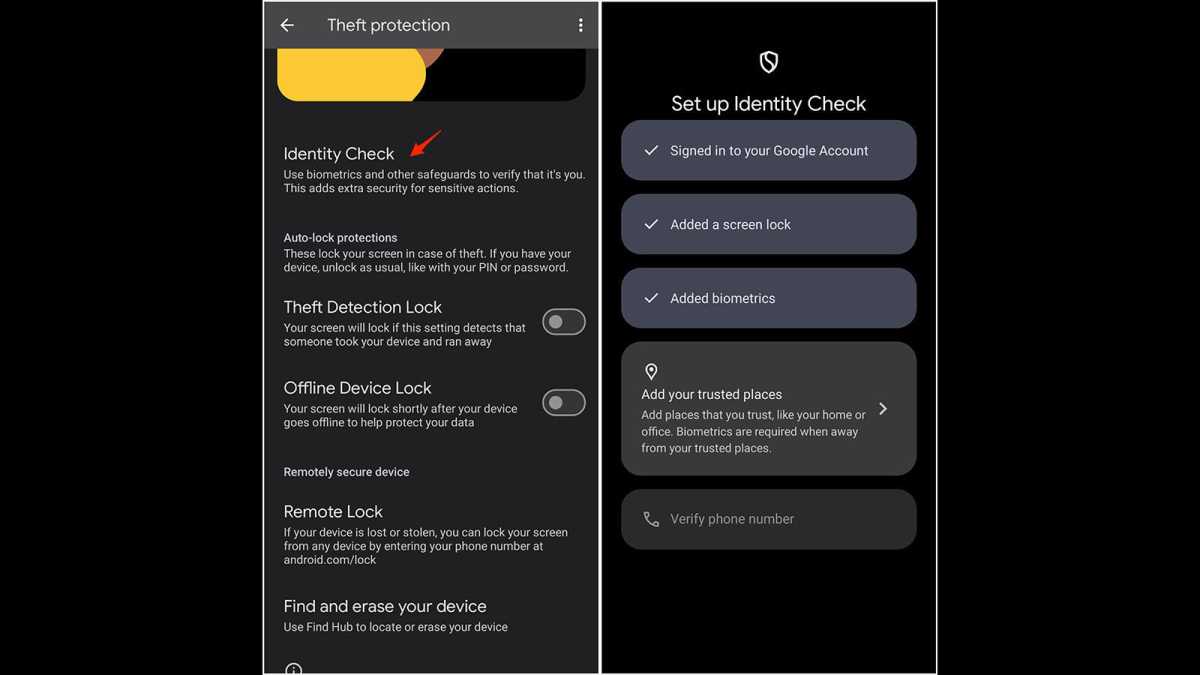
Identity Check
On a Pixel: Settings > Google > All services > Theft protection > Identity Check
This security measure is crucial yet often misunderstood. It can prevent a thief from gaining unauthorized access to your phone in the first place.
Imagine this scenario: someone observes you entering your PIN at a coffee shop, then steals your phone. They can easily break in, change the PIN, disable Find Hub, perform a factory reset, and lock you out completely within minutes, before you have a chance to report or track the device.
With Identity Check, sensitive actions like changing your lock screen, factory resetting, accessing passkeys, or opening banking apps cannot be executed outside a trusted location without your fingerprint or face. A PIN alone will not suffice for these operations; biometric authentication is required.
Samsung’s One UI introduces an additional layer with Security Delay. If an attempt is made to reset biometric data outside the trusted location on a Galaxy phone, a one-hour waiting period is enforced before any changes take effect.
This hour window allows you to access Samsung Find from a computer, activate Lost Mode on the phone, and thwart the unauthorized access before it’s complete. It’s a clever feature.
Factory Reset Protection
Factory Reset Protection has been a feature since Android 5.1, and it serves a critical purpose. If a thief resets your phone from settings, Factory Reset Protection kicks in. When they reach the setup screen again, they must provide the previous Google account credentials. Without these credentials, the phone cannot be set up and becomes unusable, making it challenging for thieves to resell stolen Android devices.
There is no toggle for Factory Reset Protection; it automatically activates when you add a Google account. Chances are, you already have it enabled.
However, there is a loophole to be aware of: if a thief knows your PIN, accesses Settings, and removes your Google account before performing a factory reset, Factory Reset Protection will not trigger. The account was removed before the reset.
This is where multiple security measures work together, highlighting the importance of Identity Check beyond just banking apps. Outside a trusted location, removing a Google account necessitates biometric authentication, not just a PIN. This prevents the account from being removed and thwarts the Factory Reset Protection bypass.
Moreover, wiping the device remotely via Find Hub completely eliminates Factory Reset Protection. After such a wipe, anyone can set up the phone from scratch. Therefore, it’s advised to lock the device first at android.com/lock and only perform a wipe if recovery seems unlikely.
Essential Settings to Activate Immediately
Most phones have all features except Factory Reset Protection disabled by default. You must enable Theft Detection Lock and Offline Device Lock. Remote Lock requires verified contact information, and Identity Check necessitates a complete setup.
A few minutes spent in Settings can mean the difference between losing your phone and risking unauthorized access to your bank account and personal information.
Three weeks after the incident, my colleague recovered her Pixel. It was returned to a police station in Hackney, still locked. Although two attempts were made to access banking apps, a third was prevented.
Next, explore everything you need to know about Android 17.










Unbeatable Deals on Australia’s Most Affordable Seven-Seat Diesel SUV

Forza Horizon 6: Revving Up for a 2027 Release on PS5

Embracing Success: A Geek’s Guide to Conquering the Stereotypes of Villainy

Uncovering the Bronze Age Influence in Paradox’s Afterworld: A Deeper Dive Beyond the Top Five Reference Points

iPhone Duo: The Future of Mobile Dominance

Tech Advisor: The Delayed Android 17 QPR1 Update for Pixel 11

Venture Capital Firm Monte Carlo Capital Secures €13 Million for Fund II to Back Early-Stage DeepTech, AI, and SpaceTech Startups

The Battle Over iPhone Driver’s Licenses: Florida and Rhode Island Stand Firm

How Smart is the AI-Powered Huawei Mate 10 – with EMUI 8.0?

EU Takes Action Against Instagram and Facebook for Violating Illegal Content Rules

Warning: Facebook Creators Face Monetization Loss for Stealing and Reposting Videos

Facebook’s New Look: A Blend of Instagram’s Style

Facebook Compliance: ICE-tracking Page Removed After US Government Intervention

Facebook and Instagram to Reduce Personalized Ads for European Users

InstaDub: Meta’s AI Translation Tool for Instagram Videos

Reclaim Your Account: Facebook and Instagram Launch New Hub for Account Recovery

Meta discontinues Messenger apps for Windows and macOS

Breaking Updates: Meta Connect 2025 Unveils Latest Developments
How Smart is the AI-Powered Huawei Mate 10 – with EMUI 8.0?

I used a 2012 Smartphone in 2018 – Here’s what happened.

How to send ANY file Anywhere!

NEW Oneplus 5T Sandstone White Unboxing – The Ultimate Oneplus 5T?

HUAWEI P20 – THE SMARTPHONE REVOLUTION IS HERE?

How OnePlus succeeded when they should have failed.

Samsung sent us THIS! #AD

Ulefone Power 3 – Quad Camera Smartphone that last 2 weeks!

EPIC Smartphone FAILS that people will never forget.
-
 Facebook12 months ago
EU Takes Action Against Instagram and Facebook for Violating Illegal Content Rules
-
 Facebook12 months ago
Warning: Facebook Creators Face Monetization Loss for Stealing and Reposting Videos
-
 Facebook10 months ago
Facebook’s New Look: A Blend of Instagram’s Style
-
 Facebook12 months ago
Facebook Compliance: ICE-tracking Page Removed After US Government Intervention
-
 Facebook10 months ago
Facebook and Instagram to Reduce Personalized Ads for European Users
-
 Facebook12 months ago
InstaDub: Meta’s AI Translation Tool for Instagram Videos
-
 Facebook10 months ago
Reclaim Your Account: Facebook and Instagram Launch New Hub for Account Recovery
-
 Apple12 months ago
Meta discontinues Messenger apps for Windows and macOS
