
Security
Exploring the Evolution of DDoS-as-a-Service: Trends and Implications


The Evolution of DDoS Attacks: From Scripts to Packaged Services
Have you ever encountered a situation where a website suddenly stops loading, a login page times out, or an online service becomes unreachable at the most inconvenient time? These scenarios could be a result of a Distributed Denial-of-Service (DDoS) attack, aimed at overwhelming the service from external sources.
DDoS attacks have long been a simple yet effective method to disrupt online services by flooding them with excessive traffic, depleting their infrastructure, and rendering them inaccessible without compromising the target’s systems. Recently, DDoS attacks have been commercialized and marketed with the sophistication of a mature online service, with significant real-world consequences.
In 2025, Cloudflare reported blocking a massive 7.3 Tbps attack and later mitigated a staggering 31.4 Tbps attack in the fourth quarter of the same year. Microsoft also thwarted a 15.72 Tbps attack in October 2025, attributed to the Aisuru botnet.
Behind these high-profile incidents, underground sellers are vying for the same clientele with refined pitches. Recent research by Flare analysts reveals a competitive landscape where DDoS attack panels, API access, monthly subscription plans, reseller options, customer support, botnet-powered capacity, game-server techniques, and claims of bypassing Cloudflare protections are prevalent.
A comparison of DDoS-related underground activities between the first five months of 2023 and 2026 illustrates a significant transformation in the market. What was once predominantly scripts, tutorials, leaked tools, and scattered forum discussions has now evolved into packaged, easily accessible products.
A DDoS attack aims to inundate a website, application, network, or server with traffic from multiple sources simultaneously. Some attacks target network capacity, while others focus on application layer resources like login pages and APIs. The primary goal is to render the service unavailable, unstable, or financially burdensome to maintain.
DDoS-as-a-service has further lowered the barrier to entry for attackers. Instead of setting up their infrastructure, malicious actors can now purchase access to a web panel, select a target, specify the duration of the attack, and leverage someone else’s botnet, proxy network, or third-party attack infrastructure.
Analysis by Flare Researchers
Flare researchers conducted an analysis of DDoS-related underground activities during two distinct periods: the first five months of 2023 and 2026. The data was meticulously curated to extract valuable insights.
| Topic | 2023 | 2026 | Change |
|---|---|---|---|
| Volume of records | 4,403 | 4,964 | Slight increase |
| High-signal DDoS service ads | 38 | 364 | ~10x increase |
| Unique ad clusters | 31 | 123 | ~4x increase |
| Unique actors | 15 | 41 | ~3x increase |
| Sources observed | 22 | 43 | ~2x increase |
It is important to note that this research focused specifically on distributed denial-of-service (DDoS) attacks, distinct from denial of service (DoS) attacks, although the end goal remains the same. The study exclusively delved into DDoS offerings while excluding DoS-related content.
DDoS-as-a-service platforms are openly promoted on dark web forums and cybercrime communities, which are continuously monitored by Flare. This monitoring extends to underground marketplaces, botnet infrastructure discussions, and threat actor activities across numerous dark web sources, enabling security teams to anticipate emerging threats proactively.
Detect your exposure for free
Transition from Fragmented Tools to Packaged Solutions
The content of posts from 2023 exhibited a more diverse range of topics, with offerings revolving around scripts, leaked tools, tutorials, and generic “botnet service” advertisements.
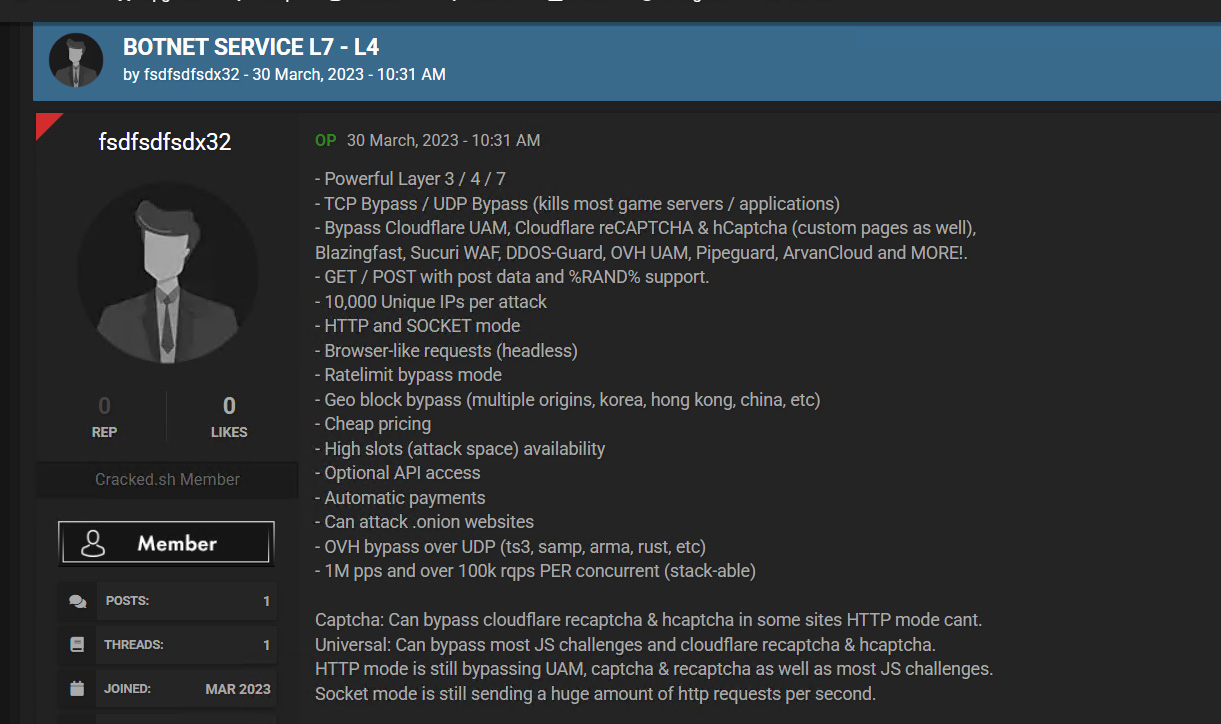
One prevalent post from 2023 promoted a “Botnet Service L7 – L4,” boasting capabilities across Layer 3, Layer 4, and Layer 7, optional API access, automated payments, high attack slots, game-server targeting, and bypass mechanisms for Cloudflare protections. This marketing text was echoed across multiple sources and actors, indicating potential copying, reselling, or recycling of promotional material.
Conversely, recent posts from 2026 emphasize pricing and the specific offerings provided. An advertisement for “SatelliteStress” described the service as an IP stresser with a user-friendly panel, API access, game-server support, and monthly plans starting at €20. The service, claimed to be “100% botnet-powered,” aimed to differentiate itself from competitors relying on third-party infrastructures.
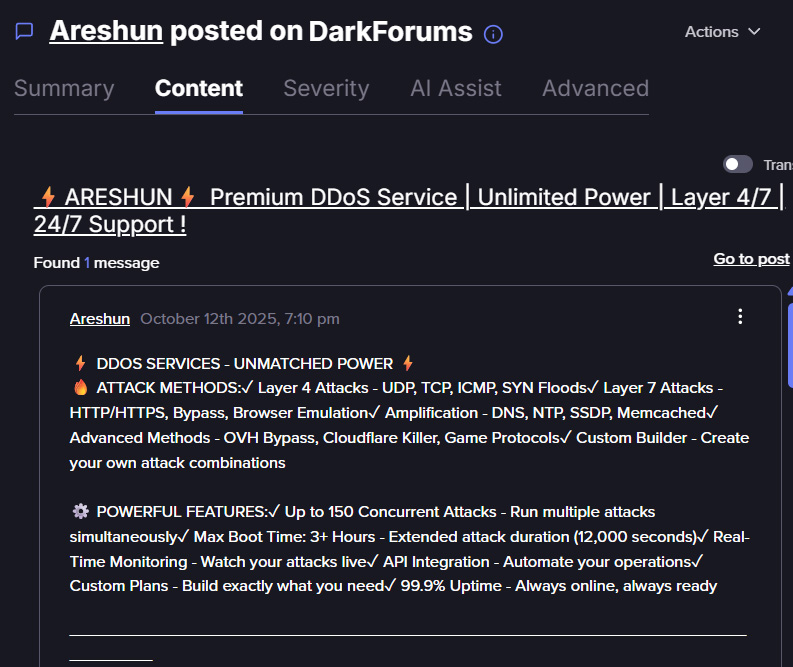
Another post highlighted “Areshun,” offering a “Premium DDoS Service” featuring Layer 4 and Layer 7 attacks, monitoring, API integration, custom plans, 24/7 support, and promotional discounts, focusing on the specific service and its pricing.
Similarly, “RebirthStress” marketed itself as a botnet-powered IP and web stressing tool, offering a free Layer 7 hub, over 400 slots, reselling capabilities, and plans starting at $15 per month.
An analysis of these posts highlights a clear trend. The 2026 advertisements focus on the product, with sellers competing on customer acquisition by packaging their services attractively with features like ease of use, full automation, comprehensive support, guaranteed privacy, reselling options, and reliability.
While technical specifications remain integral, they are now seamlessly integrated into the sales pitch. The 2026 ads frequently combine Layer 4 and Layer 7 claims, accompanied by terms such as “panel,” “API,” “slots,” “bypass,” “monitoring,” “uptime,” and “support.”
Some advertisements boast over 7,000 active Layer 4 bots, bandwidth analytics, and attack-vector statistics. Others highlight “professional stress testing” with claims of bypassing Cloudflare and DDoS-Guard protections, high concurrency, and extended attack durations. While sellers may exaggerate their capabilities, the consistency in their marketing language provides valuable insights.
The pricing of DDoS attacks in 2026 varies widely, ranging from inexpensive offers to more premium packages. Some actors advertise attacks starting at $100 per day, while others adopt a tiered pricing model based on the target’s perceived strength.
The segmentation of the market caters to different buyer profiles, offering cheap tests for novice users, daily pricing for short disruptions, private negotiations for extended campaigns, and high-value infrastructure or reseller options for sophisticated clients. Public reports on the booter economy align with this model, with some DDoS booter services available for less than $25 per month, including limited trial options.
Key Takeaways
DDoS-as-a-service has evolved beyond mere traffic volume considerations. The market now prioritizes accessibility, ease of operation, and resale potential. The focus has shifted from the sheer power of an attack to how effortlessly it can be launched via user-friendly panels, diverse plans, comprehensive support, API integration, and rented infrastructure.
This democratization of DDoS services accommodates different actor profiles, from entry-level users seeking quick, affordable attacks to seasoned buyers negotiating complex, high-impact campaigns. Resellers further expand the market reach, indicating that sophisticated attackers are not the sole perpetrators of disruptive DDoS activity.
Looking ahead, the DDoS-as-a-service market is likely to refine its service models, offering clearer pricing structures, enhanced automation, robust reseller programs, and heightened emphasis on bypass capabilities and attack reliability.
Discover more insights by signing up for our free trial.
Presented by Flare.












Exclusive: Apple Website Leak Reveals iPad mini 8 Release

Unleashing Potential: Overcoming Limitations

Uncovering the Bystander Problem: Insights from a Former AWS Security Engineer on Amazon’s Bee AI Devices

Arizona Sunshine: Unleashing the Doggy Co-op Mode in January

International Collaboration: Surrey, Sheffield, and Melbourne Join Forces on £3.2m Project to Create Provably Secure Sandbox for AI Agents

Tech Advisor Announces Samsung Galaxy Phones Now Available on Google Play Store

Exploring the Boundaries of Physical AI: Insights from an Nvidia Veteran Turned Investor

The Latest Updates on Apple’s iPhone Duo

Google Unveils Revolutionary ‘Universal’ Online Shopping Cart for Seamless Shopping Experience

EU Takes Action Against Instagram and Facebook for Violating Illegal Content Rules

Warning: Facebook Creators Face Monetization Loss for Stealing and Reposting Videos

Facebook’s New Look: A Blend of Instagram’s Style

Facebook Compliance: ICE-tracking Page Removed After US Government Intervention

Facebook and Instagram to Reduce Personalized Ads for European Users

InstaDub: Meta’s AI Translation Tool for Instagram Videos

Reclaim Your Account: Facebook and Instagram Launch New Hub for Account Recovery

Meta discontinues Messenger apps for Windows and macOS

Breaking Updates: Meta Connect 2025 Unveils Latest Developments

Finally Fixing my Wi-Fi – Zyxel Multy X!

$25,000 Gaming Setup – EVOLUTION!

The Maze Alpha X is HERE!

Cool Tech under $100 – December!

MYSTERY UNBOXING FROM GOOGLE!

TOP 6 Smartphones from Companies you NEVER Expected!

A Surprise Smartphone from EE!

DOOGEE MIX 2 VS DOOGEE MIX 1!

INCREDIBLE Smartphone Gadgets on Amazon!
-
 Facebook12 months ago
EU Takes Action Against Instagram and Facebook for Violating Illegal Content Rules
-
 Facebook1 year ago
Warning: Facebook Creators Face Monetization Loss for Stealing and Reposting Videos
-
 Facebook10 months ago
Facebook’s New Look: A Blend of Instagram’s Style
-
 Facebook1 year ago
Facebook Compliance: ICE-tracking Page Removed After US Government Intervention
-
 Facebook10 months ago
Facebook and Instagram to Reduce Personalized Ads for European Users
-
 Facebook1 year ago
InstaDub: Meta’s AI Translation Tool for Instagram Videos
-
 Facebook11 months ago
Reclaim Your Account: Facebook and Instagram Launch New Hub for Account Recovery
-
 Apple12 months ago
Meta discontinues Messenger apps for Windows and macOS
