
Inovation
Kingston University London spearheads UK’s groundbreaking Waste and Recycling Robotics Hub

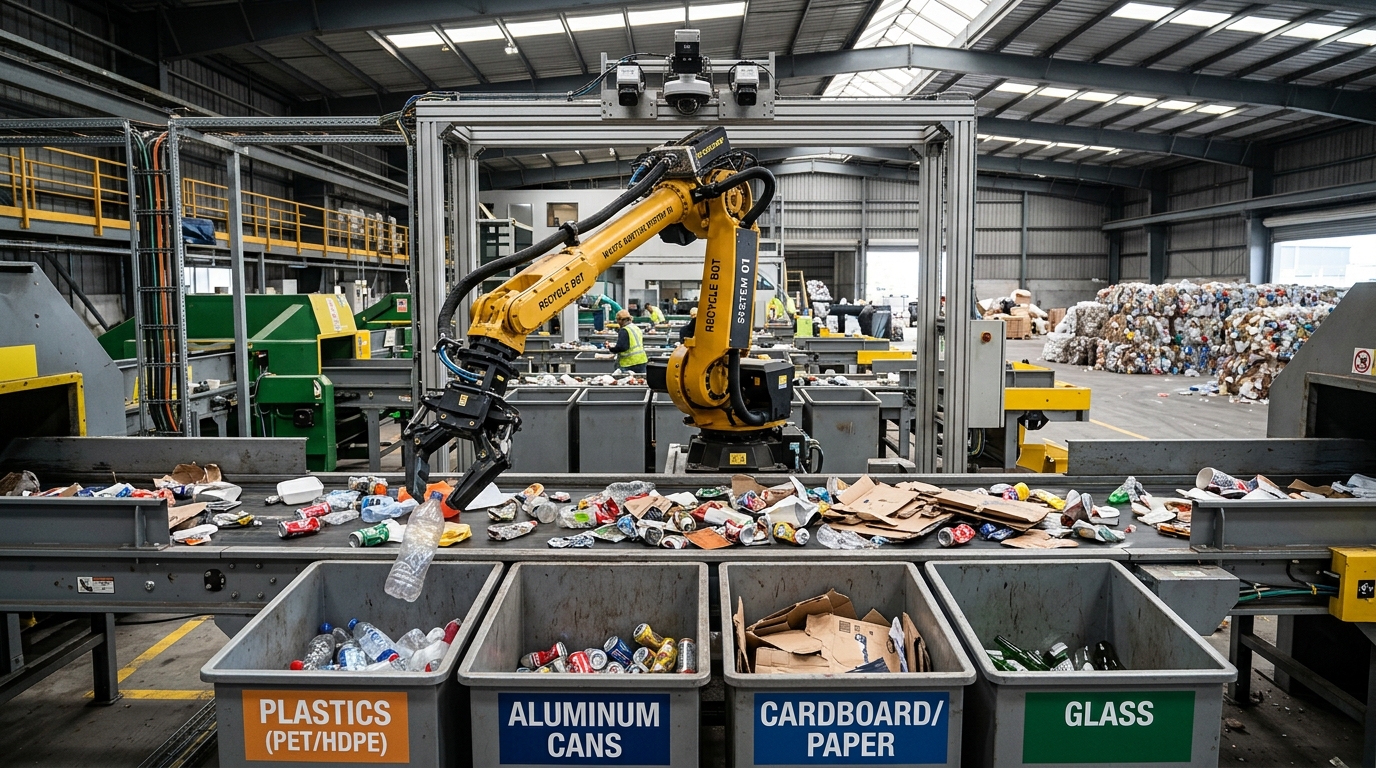
Kingston University Leads UK’s First Waste and Recycling Robotics Adoption Hub
Kingston University, located in London, has been chosen to spearhead the UK’s inaugural waste and recycling robotics adoption hub as part of a £40 million government initiative.
The National Waste and Recycling Robotics Adoption Hub (NORAH), supported by Innovate UK and situated in the Southeast of England, is among eight Robotic Adoption Hubs planned nationwide to offer guidance and assistance to businesses and public services seeking to implement cutting-edge technologies and transition to automation.
Under the leadership of Professor Vasilis Argyriou, a specialist in computer vision and AI at Kingston University, the NORAH project, valued at £3.6 million (£1.5 million allocated to Kingston University), aims to assist waste and recycling facilities in the UK in testing and integrating robots to enhance material recovery, reduce landfill waste, and create skilled job opportunities by expediting the adoption of automation in a challenging industrial setting.
Less than 5% of UK waste facilities have adopted automation
The low adoption rate is attributed to the difficulty robotic systems face in functioning effectively in waste environments characterized by contamination, diversity, and deformable materials. This unpredictability hinders operators from assessing performance, determining ROI, or confidently implementing systems.
The hub seeks to bridge this gap by facilitating the testing, validation, and implementation of robotic systems on genuine waste streams. Initial emphasis will be on complex materials like textiles, mixed recyclables, and soft waste, where existing systems exhibit lower reliability but offer significant gains in recovery and productivity.
Through the utilization of advanced sensing technologies, multi-arm robotic sorting cells, and digital simulations, the project will validate technologies on live contaminated waste streams, generating precise data on classification accuracy, throughput, contamination management, and material recovery. Economic modeling tailored to specific sites will provide detailed payback and investment scenarios, reducing uncertainty and expediting adoption.
Key services offered by the hub include:
- Real testbeds featuring contaminated, diverse waste streams such as textiles, mixed recyclables, and deformable materials
- Independent benchmarking using waste samples from operators to provide accurate performance data rather than vendor-derived metrics
- Support for integration within Materials Recovery Facilities and existing infrastructure, including constrained layouts and varying feedstock
- Training and workforce transition programs focused on safe operation in contaminated waste environments
- Innovation initiatives addressing sector-specific challenges like mixed fiber sorting, contamination removal, and automated disassembly
- Access to waste operators, local authorities, and commercial facilities to facilitate deployment and operational validation
The NORAH project, led by Kingston University, will involve a consortium comprising the University of Kent, the West London Waste Authority, robotic developers, waste operators, local authorities, and national bodies. This collaborative effort will combine deployment with research capabilities and policy alignment to ensure solutions meet industry requirements, regulatory standards, and are scalable for widespread adoption.
Professor Argyriou, discussing the project, outlined plans to assist over 150 organizations and achieve operational deployments by 2030. He emphasized that the National Waste and Recycling Robotics Adoption Hub aims to facilitate the transition of proven robotics from laboratories to live operations, thereby diverting valuable materials from landfills, reducing carbon emissions, creating skilled jobs, and promoting a circular economy.












10 Years of Excellence: A Comprehensive Review of the 2027 GWM Ora 5 Ultra

Ubisoft to Close the Trials of RedLynx

Google’s Enhanced TV Streaming Device Poised to Challenge Apple TV 4K

Kingston University London spearheads UK’s groundbreaking Waste and Recycling Robotics Hub

Samsung’s Lucky Escape: How the Delayed Googlebook Saved the Day

Breaking China’s Hold: Scimplify Secures $25M to Revolutionize Critical Materials with AI

Mind Robotics Welcomes Doug Field as President to Drive Innovation at Rivian Partner
![Apple releases fourth iOS 27.2 developer beta for iPhone [U: Public]](https://bennetttechinnovation.com/wp-content/uploads/2026/10/Apple-unveils-latest-iOS-272-developer-beta-for-iPhone-Now-80x80.jpg)
Apple unveils latest iOS 27.2 developer beta for iPhone: Now available to the public

TOP 6 Smartphones from Companies you NEVER Expected!

EU Takes Action Against Instagram and Facebook for Violating Illegal Content Rules

Warning: Facebook Creators Face Monetization Loss for Stealing and Reposting Videos

Facebook’s New Look: A Blend of Instagram’s Style

Facebook Compliance: ICE-tracking Page Removed After US Government Intervention

Facebook and Instagram to Reduce Personalized Ads for European Users

InstaDub: Meta’s AI Translation Tool for Instagram Videos

Reclaim Your Account: Facebook and Instagram Launch New Hub for Account Recovery

Meta discontinues Messenger apps for Windows and macOS

Breaking Updates: Meta Connect 2025 Unveils Latest Developments
TOP 6 Smartphones from Companies you NEVER Expected!

A Surprise Smartphone from EE!

DOOGEE MIX 2 VS DOOGEE MIX 1!

INCREDIBLE Smartphone Gadgets on Amazon!

10 Android Apps you NEED to try in 2017 / 2018

The Most Bizarre Smartphone we’ve seen all year.

Best Tech under $2000 – December 2017 / January 2018!

This could be your next Smartphone.

Top 10 most INSANE Limited Edition Smartphones!
-
 Facebook12 months ago
EU Takes Action Against Instagram and Facebook for Violating Illegal Content Rules
-
 Facebook12 months ago
Warning: Facebook Creators Face Monetization Loss for Stealing and Reposting Videos
-
 Facebook10 months ago
Facebook’s New Look: A Blend of Instagram’s Style
-
 Facebook12 months ago
Facebook Compliance: ICE-tracking Page Removed After US Government Intervention
-
 Facebook10 months ago
Facebook and Instagram to Reduce Personalized Ads for European Users
-
 Facebook12 months ago
InstaDub: Meta’s AI Translation Tool for Instagram Videos
-
 Facebook10 months ago
Reclaim Your Account: Facebook and Instagram Launch New Hub for Account Recovery
-
 Apple12 months ago
Meta discontinues Messenger apps for Windows and macOS
