
Security
Enhancing Security: NTLM Disabled by Default in Upcoming Windows Versions

The End of an Era: Microsoft to Disable NTLM Authentication Protocol in Future Windows Releases
Microsoft recently announced its decision to disable the decades-old NTLM authentication protocol by default in upcoming Windows releases due to significant security vulnerabilities that could expose organizations to cyberattacks.
NTLM, which stands for New Technology LAN Manager, was introduced in 1993 with Windows NT 3.1 as a challenge-response authentication protocol. It served as the successor to the LAN Manager (LM) protocol.
However, Kerberos has since superseded NTLM and is now the default protocol for domain-connected devices running Windows 2000 or later. Despite this, NTLM is still utilized as a fallback authentication method when Kerberos is unavailable, even though it poses security risks due to weak cryptography and susceptibility to attacks.
Over the years, NTLM has been exploited in various cyberattacks, including NTLM relay attacks and pass-the-hash attacks. These vulnerabilities have allowed threat actors to escalate privileges, take control over Windows domains, and steal sensitive data from targeted systems.
The Phasing Out of NTLM
In a strategic move towards passwordless and phishing-resistant authentication methods, Microsoft announced that NTLM will be disabled by default in the next major Windows Server release and associated Windows client versions. This marks a significant shift towards more secure Kerberos-based authentication.
Microsoft has outlined a three-phase transition plan to mitigate NTLM-related risks while minimizing disruptions. In the first phase, administrators will have access to enhanced auditing tools to identify where NTLM is still in use.
The second phase, scheduled for the second half of 2026, will introduce new features such as IAKerb and a Local Key Distribution Center to address common scenarios that trigger NTLM fallback.
Finally, in the third phase, network NTLM will be disabled by default in future releases, although the protocol will remain present in the operating system and can be explicitly re-enabled through policy controls if necessary.
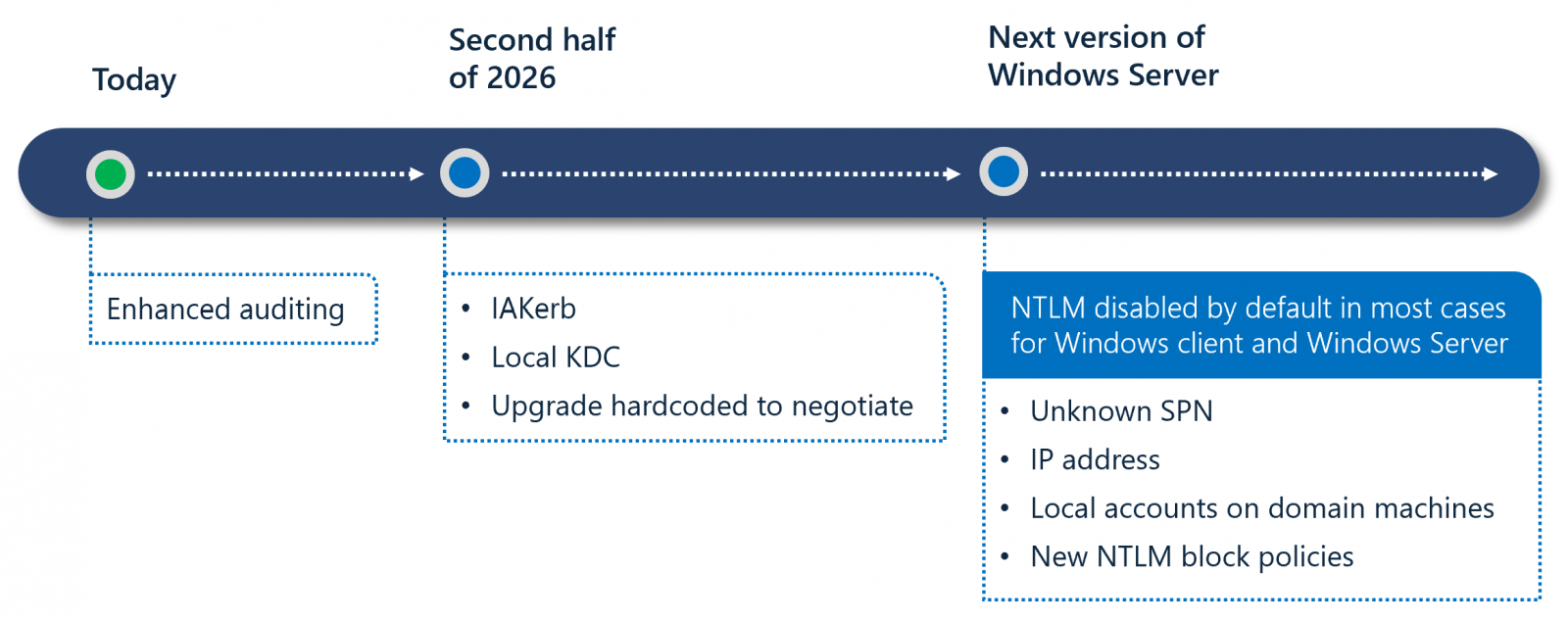
Microsoft clarified that disabling NTLM by default does not entail completely removing it from Windows yet. Instead, Windows will prioritize modern, secure Kerberos-based alternatives while addressing legacy scenarios through upcoming capabilities like Local KDC and IAKerb.
In October 2023, Microsoft initially announced plans to retire the NTLM authentication protocol, emphasizing the importance of transitioning to more secure authentication methods to prevent future vulnerabilities. By July 2024, Microsoft officially deprecated NTLM authentication on Windows and Windows servers, urging developers to switch to Kerberos or Negotiation authentication.
Developers have been advised to stop using NTLM in their applications since 2010, and Windows admins are encouraged to disable NTLM or configure their servers to block NTLM relay attacks using Active Directory Certificate Services (AD CS).

With MCP (Model Context Protocol) becoming the standard for connecting LLMs to tools and data, security teams are swiftly enhancing the safety of these new services.
Download our free cheat sheet outlining 7 best practices for securing MCP services.













Black Salt Games Launches Team Trifold Studio, Unveiling Nothing Lost

Unlocking Your Phone Made Easy: How Android Users Can Use Their Google Account

Bixdo Glossonic Brush Pro: The Ultimate Electric Toothbrush for Whiter Teeth – A Tech Advisor Review

Virtual Me: Engage with My Interactive Avatar

5 Revolutionary Apple Products on the Horizon for 2026

10 Incredible Android DIY Hacks!

Cyberpunk 2077: The Endless Battle with Phantom Liberty’s Chimera Tank

Unlock the Power of Adobe Premiere with a Free App for Android Phones – Tech Advisor

iBeer: How One App Took the App Store by Storm

EU Takes Action Against Instagram and Facebook for Violating Illegal Content Rules

Warning: Facebook Creators Face Monetization Loss for Stealing and Reposting Videos

Facebook’s New Look: A Blend of Instagram’s Style

Facebook Compliance: ICE-tracking Page Removed After US Government Intervention

Facebook and Instagram to Reduce Personalized Ads for European Users

InstaDub: Meta’s AI Translation Tool for Instagram Videos

Reclaim Your Account: Facebook and Instagram Launch New Hub for Account Recovery

Meta discontinues Messenger apps for Windows and macOS

Breaking Updates: Meta Connect 2025 Unveils Latest Developments
10 Incredible Android DIY Hacks!

Does a Cheap 2018 Smartphone beat a 2013 Flagship?

Samsung Galaxy S9 & S9+ UNBOXING!

Samsung Galaxy S9 Plus vs iPhone X

The BEST $300 Phone (2018) ft. MKBHD, Technical Guruji, iJustine + More

Samsung Galaxy S9 Plus Gaming Review! (vs OnePlus 5T)

THE BEST PHONE HTC EVER MADE?

The Truth about Google?

Samsung S9/ S9+ vs iPhone X vs Galaxy Note 8 Battery Life DRAIN TEST
-
 Facebook11 months ago
EU Takes Action Against Instagram and Facebook for Violating Illegal Content Rules
-
 Facebook12 months ago
Warning: Facebook Creators Face Monetization Loss for Stealing and Reposting Videos
-
 Facebook10 months ago
Facebook’s New Look: A Blend of Instagram’s Style
-
 Facebook12 months ago
Facebook Compliance: ICE-tracking Page Removed After US Government Intervention
-
 Facebook10 months ago
Facebook and Instagram to Reduce Personalized Ads for European Users
-
 Facebook12 months ago
InstaDub: Meta’s AI Translation Tool for Instagram Videos
-
 Facebook10 months ago
Reclaim Your Account: Facebook and Instagram Launch New Hub for Account Recovery
-
 Apple11 months ago
Meta discontinues Messenger apps for Windows and macOS
