
Startups
Choosing the Right PPC Strategy for Your Local Business: AI-Driven vs Performance-Based

Preview of Posts
- Insight into AI-Driven PPC Campaigns
- Exploration of Performance-Based PPC Campaigns
- Distinguishing AI from Performance-Based PPC
- Advantages and Disadvantages of AI-Driven PPC
- Pros and Cons of Performance-Based PPC
- Choosing the Best Strategy for Your Business
- Future Trends in Local PPC Advertising
- Summary
In the rapidly changing realm of digital marketing, local businesses are continuously seeking effective ways to enhance their online presence and nurture deeper connections with customers. Two standout strategies in this quest are AI-driven Pay-Per-Click (PPC) campaigns and the more traditional performance-based PPC campaigns. By delving into the distinct benefits and potential drawbacks of each, businesses can tailor their approach for optimal results. Many businesses turn to expert guidance in local service PPC management to streamline campaign efforts and achieve success.
It’s essential in today’s competitive digital landscape to understand the differences between these two PPC models. AI technologies offer automation and data-driven insights, allowing for more strategic focus, while traditional performance-based PPC relies on manual optimization. Knowing how and when to leverage each approach can help businesses stay agile and efficient in their marketing endeavors.
Given the complexities of these PPC methods, it’s vital to recognize that a campaign’s triumph isn’t solely dependent on technology. The right blend of strategy, supervision, and technology often sets high-performing campaigns apart from the rest.
For local businesses aiming for sustained growth, navigating the latest trends and methodologies in PPC can be challenging yet rewarding. Whether contemplating automation for efficiency or manual management for complete control, informed decision-making starts with a comprehensive understanding of both options.
Insight into AI-Driven PPC Campaigns
AI-driven PPC campaigns utilize machine learning to manage and optimize online advertising. These platforms analyze extensive datasets to determine the most effective combinations of ad copy, placements, and bidding strategies. AI can refine campaigns in real-time, making adjustments to boost conversions or reduce costs, which can be particularly advantageous for local businesses with limited resources.
By automating tasks such as keyword selection, budget allocation, and ad scheduling, AI-driven campaigns lessen the day-to-day management burden and potentially deliver more consistent results. According to Search Engine Journal, AI-powered tools can now discern customer intent, forecast click-through rates, and adjust spending in ways that would be challenging to replicate manually.
Exploration of Performance-Based PPC Campaigns
Performance-based PPC relies on hands-on management from marketers who leverage their expertise to select keywords, craft ad copy, set bids, and interpret campaign data. This traditional model allows for greater oversight and customization but heavily relies on the advertiser’s skill and availability. Regular monitoring and adjustments are crucial for sustained success, as ad performance can fluctuate frequently with market conditions.
Manual control enables advertisers to swiftly respond to new opportunities or challenges. This can be ideal for local businesses wanting to maintain close alignment between their advertising and brand voice, or for those in stable industries where trends are more predictable. However, it can become labor-intensive when managing campaigns across multiple platforms or locations.
Distinguishing AI from Performance-Based PPC
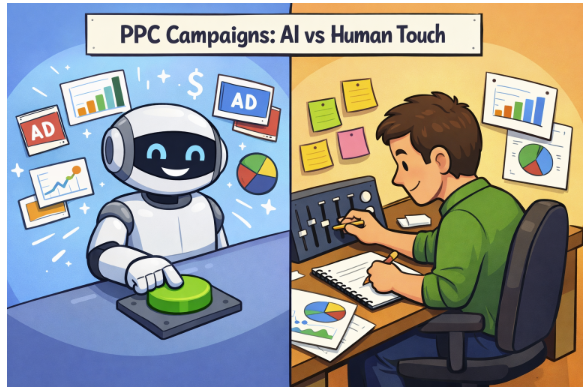
- Automation vs. Manual Control: AI platforms handle routine campaign decisions automatically, while manual PPC relies on individual expertise and oversight.
- Data Processing: AI can analyze large data volumes to detect patterns faster than humans, often revealing insights that might otherwise go unnoticed.
- Adaptability: AI adjusts to performance changes in real-time, while manual campaigns may lag as they rely on periodic data analysis and reaction.
Advantages and Disadvantages of AI-Driven PPC
Pros:
- Efficiency: Automation reduces the time and effort needed to manage multiple campaigns.
- Scalability: AI operates across numerous channels simultaneously without compromising performance, supporting business expansion.
- Data-Driven Decisions: Leveraging extensive data leads to more precise targeting and can enhance return on investment.
Cons:
- Lack of Human Insight: AI might overlook subtle branding elements or emotional triggers that resonate with target audiences.
- Dependence on Data Quality: Incomplete or poor-quality data can mislead AI systems, impacting campaign outcomes.
- Limited Transparency: Some platforms offer minimal insight into the rationale behind specific decisions, limiting learning opportunities for advertisers.
Pros and Cons of Performance-Based PPC
Pros:
- Control: Full oversight of every aspect of your campaign, from creative to targeting.
- Flexibility: Immediate adjustments in response to evolving business objectives or market changes.
- Brand Alignment: Hands-on management ensures messaging remains closely aligned with your distinct brand identity.
Cons:
- Time-Consuming: Continuous monitoring and manual adjustments require a significant time commitment.
- Limited Scalability: As campaigns multiply, so do the demands on your resources and attention.
- Potential for Human Error: Relying on intuition or incomplete information can lead to mistakes that automated, data-centric systems might avoid.
Choosing the Best Strategy for Your Business
When deciding between AI-driven and performance-based PPC, local businesses should consider factors like available resources, industry dynamics, and campaign complexity. Larger organizations running extensive campaigns may benefit from AI’s efficiency and reach, while smaller businesses or those in stable, well-established markets might favor the accuracy and direct involvement of manual management. Budgetary considerations are also crucial; AI may require a higher initial investment, but it can lead to savings through improved efficiency and outcomes over time.
For further insights on balancing digital strategies with business requirements, refer to resources such as Forbes’ AI in marketing guide.
Upcoming Trends in Local PPC Advertising
The integration of AI in local PPC is on the rise, introducing more advanced targeting, deeper analysis, and streamlined campaign management. Yet, the human element remains essential, especially for creative direction, unique brand positioning, and strategic decision-making. A hybrid approach, utilizing AI for data and automation while retaining human oversight for nuanced decisions, is likely to dominate in the foreseeable future.
Businesses that stay adaptable, experimenting with new platforms and refining strategies based on evolving tools, are best positioned for success. Keeping abreast of changes in advertising technology and staying informed will be crucial for maintaining a competitive edge in local markets.
Summary
AI-driven and performance-based PPC campaigns provide essential tools for local businesses seeking to expand their customer base and revenue. By evaluating the advantages and drawbacks of each and aligning the strategy with their specific business goals, local businesses can implement PPC solutions that yield the best ROI and support long-term growth.













Fungal Fury: A Mycelial Roguelike Adventure in Early Access

The Top 9 Game-Changing Startups Unveiled at Y Combinator’s Demo Day, as Voted by Venture Capitalists

Tim Cook’s $47M Apple Pay: The CEO Standard

Rare Sighting: Eight Ferrari F40 Supercars Converge in Paris

Saudi Investors Eye Formation of Gaming Giant with EA and Savvy Games Merger

Furo Secures €3.44 Million Funding to Revolutionize Industrial Battery Storage

Apple’s Latest Innovation: iPhone Game Controllers in the Works

Apple Strengthens Sensor Technology with Acquisition of Sonera

The most Beautiful Android Games you’ve never played.

EU Takes Action Against Instagram and Facebook for Violating Illegal Content Rules

Warning: Facebook Creators Face Monetization Loss for Stealing and Reposting Videos

Facebook’s New Look: A Blend of Instagram’s Style

Facebook Compliance: ICE-tracking Page Removed After US Government Intervention

Facebook and Instagram to Reduce Personalized Ads for European Users

InstaDub: Meta’s AI Translation Tool for Instagram Videos

Reclaim Your Account: Facebook and Instagram Launch New Hub for Account Recovery

Meta discontinues Messenger apps for Windows and macOS

Breaking Updates: Meta Connect 2025 Unveils Latest Developments
The most Beautiful Android Games you’ve never played.

Charge your Smartphone in 5 Minutes – How Batteries are about to Change!

10 CHEAP Smartphone Gadgets that Change Everything.

Huawei Mobile Cloud – The Huawei P20 Feature you didn’t know about!

PUBG MOBILE on Android – Disastrous or Revolutionary?

Why you should buy the Galaxy S8 right now.

Customize your Android Smartphone!

Xiaomi Mi Mix 2S Review – Beauty and the BEAST.

Samsung Galaxy X – New Info!
-
 Facebook11 months ago
EU Takes Action Against Instagram and Facebook for Violating Illegal Content Rules
-
 Facebook11 months ago
Warning: Facebook Creators Face Monetization Loss for Stealing and Reposting Videos
-
 Facebook9 months ago
Facebook’s New Look: A Blend of Instagram’s Style
-
 Facebook11 months ago
Facebook Compliance: ICE-tracking Page Removed After US Government Intervention
-
 Facebook9 months ago
Facebook and Instagram to Reduce Personalized Ads for European Users
-
 Facebook11 months ago
InstaDub: Meta’s AI Translation Tool for Instagram Videos
-
 Facebook9 months ago
Reclaim Your Account: Facebook and Instagram Launch New Hub for Account Recovery
-
 Apple11 months ago
Meta discontinues Messenger apps for Windows and macOS
