
Tech News
Navigating the Path to Efficient Business Operations

The Power of ERP AI Chatbots in Transforming Enterprise Operations
- AI/ML
- Last Updated: June 10, 2026

Your ERP system is a treasure trove of information about your business, holding every transaction, invoice, inventory record, and payroll detail. However, extracting actionable insights from it can often be a time-consuming process, leading to delays in decision-making.
Many enterprises face the paradox of having powerful ERP systems that are more like systems of record than systems of speed. Navigating these systems requires training, patience, and sometimes the assistance of specialists. This often results in a significant portion of the workforce using the ERP system inefficiently.
Employees resort to workarounds like emailing screenshots of dashboards, using public AI tools to analyze sensitive data, or creating parallel spreadsheets to track information already present in the ERP. This phenomenon, known as shadow IT, is more prevalent than many IT leaders realize.
The information lag caused by these inefficiencies can lead to delayed decision-making, unnoticed errors, and additional costs for the enterprise. Organizations end up paying twice – once for the ERP license and again for the inefficiencies layered on top of it.
AI integrated into ERP systems is changing this equation. Instead of replacing the ERP system, AI acts as a conversational layer on top of it. An ERP AI chatbot allows any user in the organization to ask questions in plain language and receive accurate, role-specific answers within seconds, without the need to understand complex modules, menus, or integrations.
Key Takeaways
- ERP systems hold valuable data, but accessing it manually still slows everyday business decisions.
- ERP AI chatbots make business data instantly accessible through simple, natural conversations.
- Businesses can start small with high-impact use cases and expand based on real results.
- The shift is already happening. ERP systems are becoming more intelligent and responsive.
- The real opportunity is turning your ERP into a system that works for your team.
- Integration challenges, data quality issues, and adoption resistance are solvable with the right partner.
- ERP systems are evolving toward more proactive and personalized operational support.
What Makes an ERP AI Bot “Enterprise-Grade”
Not every chatbot claiming ERP integration deserves the label of “enterprise-grade.” A consumer-grade bot simply connected to an ERP API is not sufficient for handling critical functions like procurement approvals, financial queries, or production decisions.
An ERP AI chatbot developed by the right software services partner should possess the following capabilities:
Natural Language Querying of ERP Data
The chatbot should understand real employee language, allowing users to ask questions in a conversational manner without needing to know the ERP’s data structure.
Transaction Execution via Chat
Going beyond data retrieval, the chatbot should be able to perform actions like approving purchase orders, submitting leave requests, or updating stock counts directly through the conversation interface.
Context-Aware Multi-Step Workflows
Enterprise tasks often involve multiple steps. An effective AI ERP bot should be able to guide users through complex processes, remembering previous steps and providing guidance through multi-stage workflows.
Role-Based Personalization
Different users may require different types of information. The chatbot should be able to provide personalized responses based on the user’s role within the organization.
Cross-Module Intelligence
Enterprise data is often spread across multiple ERP modules. The chatbot should be capable of pulling data from various modules to provide a comprehensive response.
Voice and Multimodal Interaction
For employees working in non-desk environments, voice commands and image inputs can enhance ERP accessibility. Voice-enabled interactions and image recognition can be the next frontier in ERP usability.
How ERP AI Chatbots Transform Traditional ERP Systems
Traditional ERP systems were originally designed to record and manage business processes. ERP AI chatbots take this a step further by providing instant access to information, enabling task execution, and facilitating decision-making with unprecedented ease. Here’s how:
From Complex Navigation to Natural Conversations
Instead of navigating through multiple screens and reports, users can now ask questions in plain language and receive relevant answers instantly, eliminating the need for extensive ERP knowledge.
From Manual Processes to Conversational Actions
Tasks that previously required manual completion within different modules can now be initiated, updated, and completed directly through the chat interface, streamlining processes and improving efficiency.
From Reactive Operations to Proactive Intelligence
ERP AI chatbots continuously analyze business information and proactively surface insights, alerts, and recommendations, enabling teams to respond faster and make better decisions.
From Departmental Silos to Cross-Functional Visibility
ERP AI chatbots connect information across departments and present it through a single interface, providing greater visibility across functions and facilitating a better understanding of business situations.
From Specialist Dependency to Self-Service Access
Employees can now access information and complete tasks independently, reducing dependency on specialists, improving productivity, and enabling faster decision-making.
From Static Systems to Intelligent Enterprise Assistants
Modern ERP AI chatbots act as intelligent assistants that actively support daily operations, recommend actions, automate workflows, and help organizations achieve business outcomes more efficiently.
Types of ERP AI Chatbots
ERP AI chatbots come in various forms, each catering to different business complexities and automation requirements:
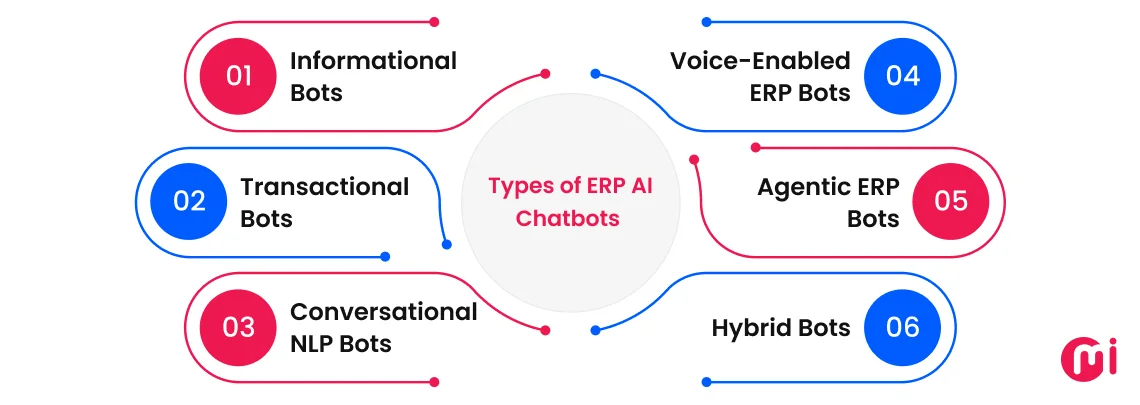
Informational Bots
These bots provide answers to queries by fetching live data from the ERP, such as order statuses, stock levels, payment schedules, and delivery ETAs. They are quick to deploy, high in adoption, and immediately valuable for teams relying on manual reporting.
Example: “What’s the outstanding balance on Vendor 0042?”
Instant response with balance, last payment date, and next due date.
Transactional Bots
These bots not only answer questions but also perform actions like purchase order approvals, expense submissions, leave applications, and invoice releases securely through the chat interface with full ERP audit logging.
Example: “Approve PO-1827 and notify the supplier.”
Approved, logged, supplier notification triggered.
Conversational NLP Bots
These bots handle complex, multi-turn interactions reflecting real business conversations. They understand context, handle ambiguity, and guide users through processes that span multiple steps and departments.
Example: “Show me all invoices from last quarter that went past 60-day payment terms and are linked to our top 10 suppliers by volume.”
Filtered report delivered in-chat, with drill-down options.
Voice-Enabled ERP Bots
These bots enable hands-free ERP access in environments where typing is impractical, such as production floors, logistics docks, or field service teams. Voice commands, ERP actions, and voice responses all occur within a wearable or mobile device.
Example: An AI chatbot in construction safety helps field workers report on-site hazards instantly through voice commands.
The system logs the issue in the ERP, alerts supervisors in real time, and maintains a complete compliance-ready audit trail.
Agentic ERP Bots
These bots monitor ERP data continuously, identify conditions that require action, and execute multi-step workflows autonomously, with human approval gates built in where governance demands them.
Example: The bot detects inventory of a high-demand SKU falling below reorder threshold.
It cross-checks budget availability, identifies the preferred supplier, drafts and routes a purchase order for manager approval, and logs the entire decision chain in the ERP.
Hybrid Bots
Hybrid Bots combine the above types as needed, answering queries, executing transactions, and escalating to agents or human teams when complexity warrants it.
Must-Have Features of an Enterprise ERP AI Chatbot
Before evaluating any ERP AI chatbot solution, ensure it includes these core capabilities:
Natural Language Processing (NLP) Engine
The chatbot must understand intent, handle varied phrasing, typos, incomplete queries, and domain-specific ERP terminology.
Real-Time ERP Data Sync
Responses should be based on real-time or near-real-time ERP data to ensure accuracy.
Sentiment Detection
The chatbot should be able to detect user sentiment to provide a more personalized experience.
Proactive Alerts and Threshold Monitoring
The chatbot should not only respond to questions but also send alerts based on predefined conditions.
Omnichannel Accessibility
The chatbot should be accessible across various channels to cater to different user preferences.
Multi-Language Support
The chatbot should be able to handle queries in multiple languages to support a diverse workforce.
Self-Learning and Continuous Improvement
The chatbot should continuously learn from user interactions to improve response accuracy.
Audit Logging
Every action initiated by the chatbot should be logged for compliance and auditing purposes.
Use Cases of ERP AI Chatbots Across Every Business Function
ERP AI chatbots can support a wide range of business operations, including:
Finance & Accounts
- Automated invoice status queries
- Payment reconciliation assistance
- Budget utilization checks
- Audit trail queries
Supply Chain & Procurement
- Real-time inventory level checks
- Purchase order creation and tracking
- Vendor performance queries
- Automated low-stock alerts and reorder triggers
Sales
- Order status tracking
- Sales forecast retrieval
- Customer credit limit checks
- Quote-to-order workflow automation
HR & Payroll
- Leave balance checks and applications
- Payslip retrieval
- Onboarding task tracking
- Policy Q&A automation
Expense Management
- High-Volume Automation
- Self-Service Functionality
- Operational Efficiency
- Multi-Currency and Policy Compliance
Manufacturing & Operations
- Production schedule queries
- Equipment maintenance status
- Shop floor reporting via voice
Executive & Management Layer
- On-demand KPI summaries via chat
- Variance analysis in plain language
- Board-ready ERP data summaries
IT & Helpdesk
- ERP navigation guidance
- Error resolution support
- User provisioning requests
Key Benefits of ERP AI Chatbots for Enterprises
Implementing ERP AI chatbots in your organization can lead to several benefits:
Faster Decision-Making
ERP AI chatbots provide quick access to information, enabling faster decision-making processes.
Increased ERP Adoption Across Teams
Chatbots make ERP systems more user-friendly, encouraging wider adoption across different departments.
Reduced Manual Workload
By handling routine queries, chatbots reduce repetitive tasks for teams while maintaining accuracy and compliance.
Improved Data Accessibility
Easy access to business information reduces dependency on specialists and enhances operational efficiency.
Lower Operational Costs
Automating responses to common queries reduces workload on staff, shortens ticket handling times, and decreases operational delays.
Enhanced Cross-Functional Visibility
Connecting information across departments provides a comprehensive view of operations, enabling better decision-making.
The Blueprint: A Practical Roadmap for ERP AI Chatbot Deployment
Successful deployment of ERP AI chatbots requires a structured approach:
Step 1: Audit High-Friction ERP User Journeys
Identify areas where teams spend the most time interacting with the ERP to prioritize use cases.
Step 2: Define Chatbot Scope
Decide on the type of chatbot deployment (informational, transactional, or agentic) based on organizational needs.
Step 3: Choose Your Approach
Select













Saudi Investors Eye Formation of Gaming Giant with EA and Savvy Games Merger

Furo Secures €3.44 Million Funding to Revolutionize Industrial Battery Storage

Apple’s Latest Innovation: iPhone Game Controllers in the Works

Apple Strengthens Sensor Technology with Acquisition of Sonera

The most Beautiful Android Games you’ve never played.

Exploring the Future: A Sneak Peek at the 2027 BMW i3 and the Evolution of the 3 Series

Polyarc’s Closure: A Bittersweet Farewell to Moss

Strategic Planning for Sustainable Farm Growth: A Comprehensive Guide to Financing, Weather Resilience, and Seasonal Cash Flow Management

Exciting News: iOS 27 Set to Launch Next Week!

EU Takes Action Against Instagram and Facebook for Violating Illegal Content Rules

Warning: Facebook Creators Face Monetization Loss for Stealing and Reposting Videos

Facebook’s New Look: A Blend of Instagram’s Style

Facebook Compliance: ICE-tracking Page Removed After US Government Intervention

Facebook and Instagram to Reduce Personalized Ads for European Users

InstaDub: Meta’s AI Translation Tool for Instagram Videos

Reclaim Your Account: Facebook and Instagram Launch New Hub for Account Recovery

Meta discontinues Messenger apps for Windows and macOS

Breaking Updates: Meta Connect 2025 Unveils Latest Developments
The most Beautiful Android Games you’ve never played.

Charge your Smartphone in 5 Minutes – How Batteries are about to Change!

10 CHEAP Smartphone Gadgets that Change Everything.

Huawei Mobile Cloud – The Huawei P20 Feature you didn’t know about!

PUBG MOBILE on Android – Disastrous or Revolutionary?

Why you should buy the Galaxy S8 right now.

Customize your Android Smartphone!

Xiaomi Mi Mix 2S Review – Beauty and the BEAST.

Samsung Galaxy X – New Info!
-
 Facebook11 months ago
EU Takes Action Against Instagram and Facebook for Violating Illegal Content Rules
-
 Facebook11 months ago
Warning: Facebook Creators Face Monetization Loss for Stealing and Reposting Videos
-
 Facebook9 months ago
Facebook’s New Look: A Blend of Instagram’s Style
-
 Facebook11 months ago
Facebook Compliance: ICE-tracking Page Removed After US Government Intervention
-
 Facebook9 months ago
Facebook and Instagram to Reduce Personalized Ads for European Users
-
 Facebook11 months ago
InstaDub: Meta’s AI Translation Tool for Instagram Videos
-
 Facebook9 months ago
Reclaim Your Account: Facebook and Instagram Launch New Hub for Account Recovery
-
 Apple11 months ago
Meta discontinues Messenger apps for Windows and macOS
