
The Google Home Speaker: A Sleek Device with a Few Quirks

Google Home Speaker Review: A Detailed Look at the New Smart Speaker
Upon unboxing the new Google Home Speaker, it immediately impressed with its performance in a few key tests. Even at maximum volume with music blasting, the speaker responded promptly to the wake word “Hey, Google.” Over two days of testing, the three microphones on the speaker consistently picked up the wake word, except for a whispered attempt to avoid waking up a baby in another room. Setting up the speaker in the bathroom, it excelled in picking up voice commands over running water, a task that Siri often struggles with.
While these basic interactions are essential for any smart speaker, they are not always guaranteed. Google designed the Home Speaker to not only control music and smart home devices but also serve as an ambient tool for daily tasks such as planning, accessing information, and productivity. The speaker’s performance in these areas, as well as the capabilities of its AI assistant, will be further explored in an upcoming full review.
One standout feature of the Home Speaker is its impressive sound quality. Despite its compact size, it delivers big, rich sound and can reach high volumes without distortion. Comparing it to the previous Nest Audio speaker, the Home Speaker holds its own in terms of volume and audio quality, albeit in a smaller form factor.
For those accustomed to smaller speakers like the UE Wonderboom, the Home Speaker offers a comparable listening experience. The Wonderboom may be slightly louder with emphasis on vocals and highs, while the Home Speaker delivers more bass. When testing with songs like “Sugar, We’re Goin Down” by Fall Out Boy, the differences in sound profile are evident, catering to personal preferences.
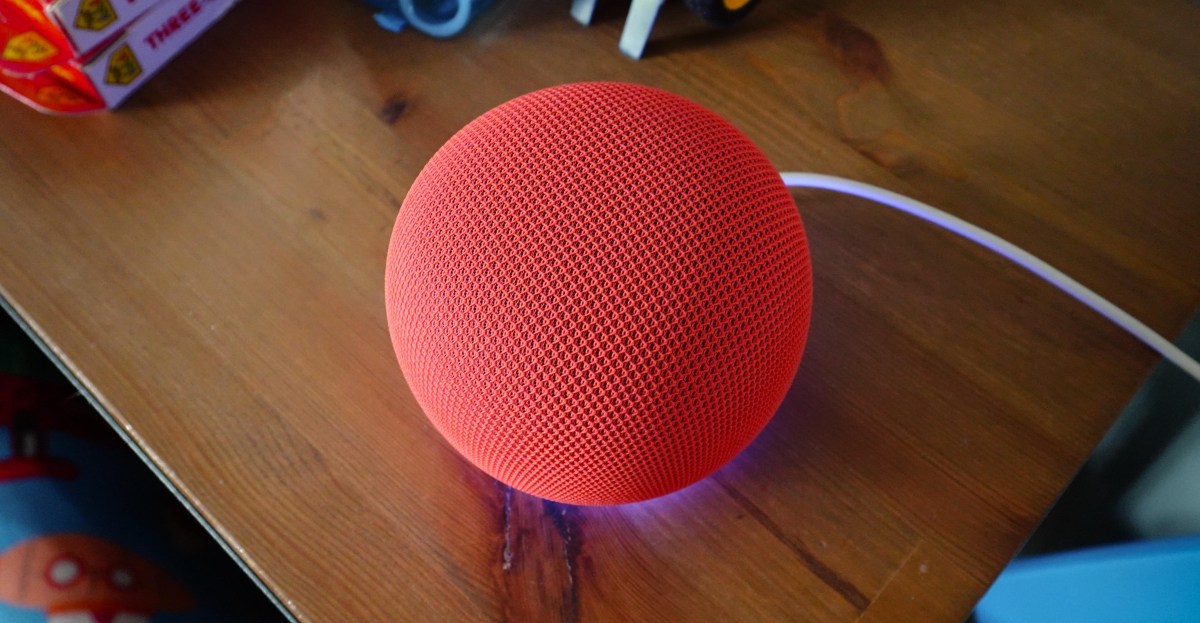
Visually, the Home Speaker stands out with its colorful, spherical design, available in four different colors. The absence of visible buttons or controls adds to its sleek appearance, with only a discreet white USB-C cable at the back. The touch-sensitive volume controls on the sides and the top for play/pause functionality contribute to its minimalist aesthetic.
Despite its elegant design, the Home Speaker’s user interface may not be immediately intuitive. The touch controls for volume adjustment can be challenging to locate, given the speaker’s round shape. The light ring indicator, which signals when the AI assistant is active, is positioned discreetly beneath the speaker, potentially hindering visibility.
Aside from its AI capabilities, the Home Speaker can also function as a standard Bluetooth speaker and supports Google Cast for streaming from other devices. Users can create audio groups with multiple speakers for synchronized playback or pair them with a Google TV Streamer for enhanced TV sound. While it may not replace a dedicated sound system, the Home Speaker offers a significant upgrade over built-in TV speakers.
In conclusion, the Google Home Speaker impresses with its audio performance and sleek design, especially considering its $99 price point. As Google’s first smart speaker in six years, it aims to integrate its AI assistant, Gemini, seamlessly into users’ homes for enhanced control and convenience. Further testing will determine whether the Home Speaker lives up to expectations and fulfills its promise as a versatile smart home device.
Correction June 24th: Contrary to our initial statement, the Google Home Speaker can indeed be used as a Bluetooth speaker.
Follow topics and authors
Stay updated on related topics and authors by following them for more content similar to this article.
- Follow David Pierce
- Follow AI
- Follow Gadgets
- Follow Google
- Follow Tech











BYD Ignites Price Battle in Australia Despite Chinese Government Caution

Chaos Unleashed: The Xbox Reset Disaster

AI Security Threats: Search Poisoning, Coding Tool Leaks, and Code Execution Risks

LOVE alt delete: A Y2K Nightmare of Virtual Romance

Motorola Signature 27: Revolutionizing the Smartphone Industry in 2026

Nexterity Revolutionizes Pipefitting with Automated Solutions

Seamless Tab Sharing: Google Chrome’s Latest Feature for Continuity Across Devices

Enter to Win a Cutting-Edge Apple MacBook Neo in Our Giveaway!

Breaking Barriers: Audi A6 E-Tron Shatters World Record with 831-Mile Range on a Single Charge

EU Takes Action Against Instagram and Facebook for Violating Illegal Content Rules

Warning: Facebook Creators Face Monetization Loss for Stealing and Reposting Videos

Facebook’s New Look: A Blend of Instagram’s Style

Facebook Compliance: ICE-tracking Page Removed After US Government Intervention

Facebook and Instagram to Reduce Personalized Ads for European Users

InstaDub: Meta’s AI Translation Tool for Instagram Videos

Reclaim Your Account: Facebook and Instagram Launch New Hub for Account Recovery

Meta discontinues Messenger apps for Windows and macOS

Breaking Updates: Meta Connect 2025 Unveils Latest Developments

The BEST $300 Phone (2018) ft. MKBHD, Technical Guruji, iJustine + More

Samsung Galaxy S9 Plus Gaming Review! (vs OnePlus 5T)

THE BEST PHONE HTC EVER MADE?

The Truth about Google?

Samsung S9/ S9+ vs iPhone X vs Galaxy Note 8 Battery Life DRAIN TEST

Samsung S9 / S9+ vs Mate 10 Pro vs iPhone X Charging SPEED Test

The BEST APPS in 2018 – ft. MKBHD, UrAvgConsumer, iJustine + More

The ULTIMATE Smartphone Unboxing!!

HOW GOOD can a $250 Smartphone Camera be!?
-
 Facebook11 months ago
EU Takes Action Against Instagram and Facebook for Violating Illegal Content Rules
-
 Facebook11 months ago
Warning: Facebook Creators Face Monetization Loss for Stealing and Reposting Videos
-
 Facebook10 months ago
Facebook’s New Look: A Blend of Instagram’s Style
-
 Facebook12 months ago
Facebook Compliance: ICE-tracking Page Removed After US Government Intervention
-
 Facebook10 months ago
Facebook and Instagram to Reduce Personalized Ads for European Users
-
 Facebook12 months ago
InstaDub: Meta’s AI Translation Tool for Instagram Videos
-
 Facebook10 months ago
Reclaim Your Account: Facebook and Instagram Launch New Hub for Account Recovery
-
 Apple11 months ago
Meta discontinues Messenger apps for Windows and macOS
