
Gadgets
Unveiling the Xiaomi 17: A Comprehensive Review

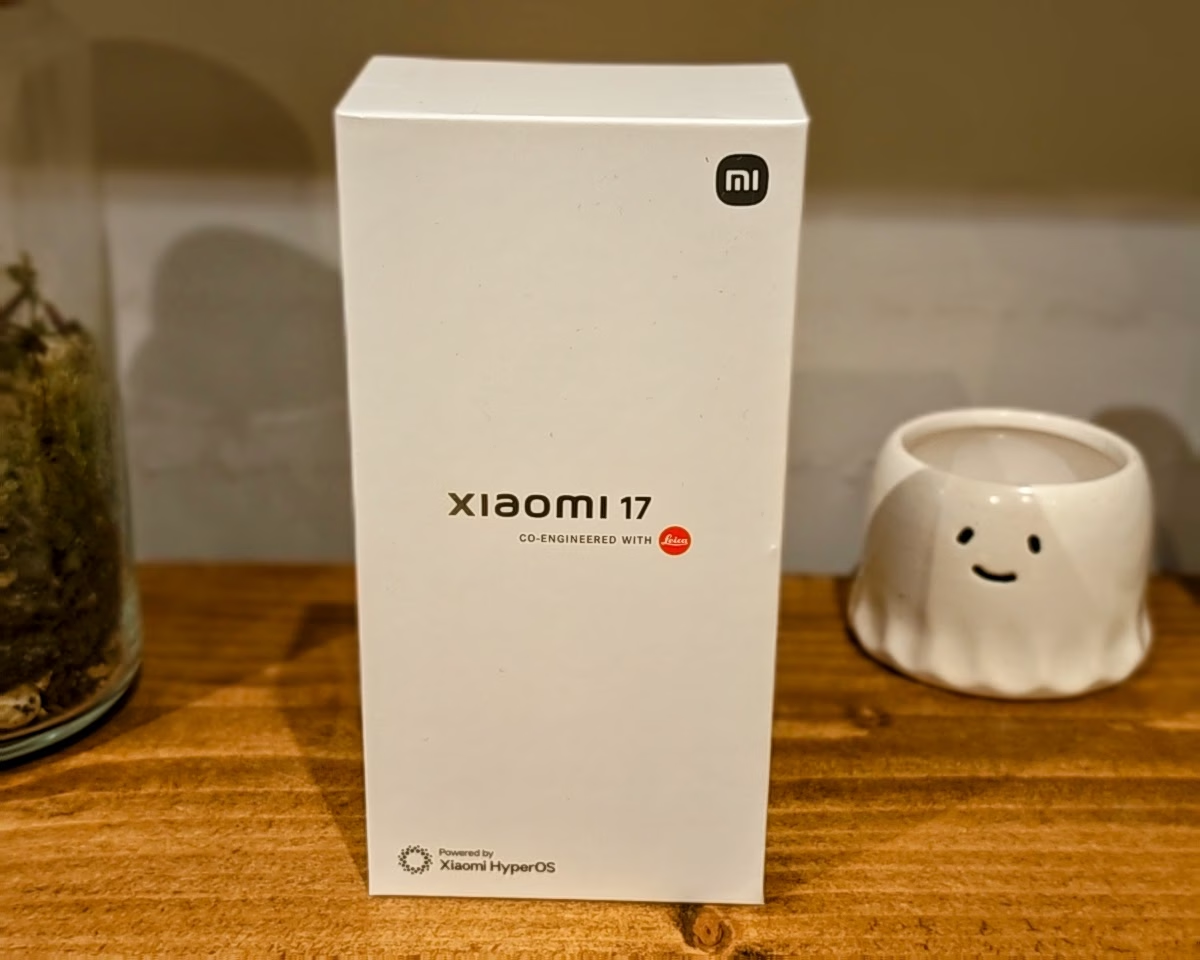
Any links to online stores should be assumed to be affiliates. The company or PR agency provides all or most review samples. They have no control over my content, and I provide my honest opinion.
Xiaomi 17 Review
Summary
The Xiaomi 17 is an iterative upgrade, but it’s still one of the most compelling compact flagship Android phones I’ve used. The headline feature is the 7,000 mAh silicon-carbon battery, which delivers genuinely class-leading endurance for a 6.3-inch handset, and the combination of 100 W wired and 50 W wireless charging makes it easy to live with day to day. Performance is predictably excellent thanks to the Snapdragon 8 Elite Gen 5 and UFS 4.1 storage, while the bright LTPO AMOLED panel and ultrasonic fingerprint sensor round out a very strong hardware package.
Where it falls short is in areas Xiaomi hasn’t meaningfully advanced: the rear camera hardware feels dated for the money, with a particularly underwhelming 2.6x telephoto compared with rivals, and HyperOS still isn’t as clean or cohesive as Google’s Pixel experience. If you prioritise battery life and top-tier performance in a compact chassis, this is the phone to beat; if camera quality and software polish come first, the Pixel 10 Pro remains the smarter buy.
Pros
-
Class-leading 7,000 mAh battery
-
Excellent flagship-grade performance
-
Fast 100 W wired charging
-
Bright, smooth LTPO AMOLED
-
Premium, compact 191 g build
Cons
-
Ageing rear camera hardware
-
Weak 2.6x telephoto zoom
-
HyperOS less polished than Pixel
-
Noticeable warmth under sustained loads
I reviewed the Xiaomi 15 this time last year and the Xiaomi 14 the year before that, and thought they were superb. They are also among the few small flagship-spec phones on the market, with the Samsung Galaxy S25 and Pixel 10 Pro as the only real competition.
The Xiaomi 17 represents another incremental step forward for Xiaomi’s compact flagship line. While the improvements aren’t revolutionary, the combination of a dramatically larger battery and the latest Snapdragon chipset makes this one of the most appealing small Android phones you can buy in 2026.
Related Reviews
Specification
| Body | |
| Dimensions | 151.1 x 71.8 x 8.1 mm (5.95 x 2.83 x 0.32 in) |
| Weight | 191 g (6.74 oz) |
| Build | Glass front (Dragon Crystal Glass), aluminium frame |
| SIM | Dual Nano-SIM |
| IP Rating | IP68 dust and water resistant (up to 1.5 m for 30 min) |
| Display | |
| Type | LTPO AMOLED, 68 B colours, 2160 Hz PWM dimming, 120 Hz refresh rate, Dolby Vision, HDR Vivid, HDR10+, peak brightness 3500 nits |
| Display Size | 6.3 inches (~97.1 cm²), ~89.5% screen-to-body ratio |
| Resolution | 1220 x 2656 pixels, 19.5:9 ratio (~464 ppi) |
| Protection | Xiaomi Dragon Crystal Glass |
| Operating System | |
| OS | Android 16, HyperOS 3 |
| Chipset | |
| Chipset | Qualcomm SM8850-AC Snapdragon 8 Elite Gen 5 (3 nm) |
| CPU | Octa-core (2×4.6 GHz Oryon V3 Phoenix L + 6×3.62 GHz Oryon V3 Phoenix M) |
| GPU | Adreno 840 |
| Memory | |
| RAM / Storage | 256 GB 12 GB RAM / 512 GB 12 GB RAM / 512 GB 16 GB RAM / 1 TB 16 GB RAM (UFS 4.1, no microSD slot) |
| Main Camera | |
| Main Camera | Triple: 50 MP (f/1.7, 23 mm wide, 1/1.31″, 1.2 µm, PDAF, OIS) + 50 MP (f/2.0, 60 mm telephoto, OIS, 2.6x optical zoom) + 50 MP (f/2.4, 17 mm ultrawide, 102°) |
| Main Camera Features | Laser AF, colour spectrum sensor, Leica lens, Dual-LED dual-tone flash, HDR, panorama |
| Main Video Recording | 8K @ 30 fps (HDR), 4K @ 30/60 fps (HDR10+, Dolby Vision, 10-bit LOG), 1080p @ 30/60/120/240/960 fps, 720p @ 1920 fps, gyro-EIS |
| Selfie Camera | |
| Selfie Camera | 50 MP (f/2.2, 21 mm wide, PDAF) |
| Selfie Features / Video | HDR, panorama; 4K @ 30/60 fps, 1080p @ 30/60 fps, HDR10+, gyro-EIS |
| Audio | |
| Audio | Stereo speakers with Dolby Atmos, Hi-Res 24-bit/192 kHz, Hi-Res Wireless, Snapdragon Sound |
| 3.5 mm jack | No |
| Connectivity | |
| Connectivity | Wi-Fi 802.11 a/b/g/n/ac/6/7 (dual-band, Wi-Fi Direct), Bluetooth 5.4 (aptX HD, Adaptive, LHDC 5), NFC, Infrared port, USB-C 3.2 (DisplayPort/OTG), no FM radio |
| Positioning | GPS (L1+L5), BDS (B1I+B1c+B2a), Galileo (E1+E5a), QZSS (L1+L5), NavIC (L5), GLONASS |
| Sensors | Under-display ultrasonic fingerprint, accelerometer, proximity, gyro, compass, barometer |
| Battery | |
| Battery | 7000 mAh (Si/C Li-Ion, non-removable) |
| Charging | 100 W wired (PD3.0/QC3+/PPS), 50 W wireless, 22.5 W reverse wireless |
In comparison to last year’s model, there have been the usual incremental upgrades:
- The usual upgrade to the latest flagship chipset, which this year is the Snapdragon 8 Elite Gen 5 (3 nm)
- Minor improvements to the display, though it is fractionally smaller with 6.3″ vs 6.36″ and a small reduction in resolution
- Internal storage has been upgraded to UFS 4.1 vs UFS 4.0
- Essentially the same rear cameras
- Selfie camera has been upgraded to 50MP vs 32MP
- Battery has had a massive upgrade from 5240 mAh to 7000 mAh
- Wired charging upgraded to 100W vs 90W and reverse wireless is now 22.5W vs 10W
The standout improvement is undoubtedly the battery. A 33% increase in capacity is remarkable for a phone that’s actually slightly smaller than its predecessor. This is where silicon-carbon battery technology really shows its worth, cramming 7000 mAh into a chassis that weighs just 191g.
For context, the Samsung Galaxy S25 Ultra with its 6.9″ display only manages a 5000 mAh battery, yet weighs considerably more at 232g. The Pixel 10 Pro with its 6.3″ screen has a 5060 mAh cell. The Xiaomi 17’s battery capacity is genuinely class-leading for a phone of this size.
The Xiaomi 17 maintains the refined design language established by its predecessor, with flat edges and minimal bezels creating a premium aesthetic. At 151.1 x 71.8 x 8.1 mm and 191g, it’s one of the most compact flagship phones available, yet somehow houses a 7000 mAh battery.
Build quality is excellent throughout. The aluminium frame feels solid without being overly heavy, and the matte glass back does an admirable job resisting fingerprints.
The IP68 certification ensures proper dust and water resistance, allowing for submersion up to 1.5 meters for 30 minutes. The screen of the Xiaomi 17 has impressively thin bezels on all sides, achieving an 89.5% screen-to-body ratio, slightly better than the Xiaomi 15 despite having a slightly smaller display. The Dragon Crystal Glass protection offers better scratch resistance than standard Gorilla Glass. The phone may warm up during intensive tasks due to the powerful Snapdragon 8 Elite Gen 5 chip, but the Stereoscopic Annular Cold Pump cooling system helps maintain efficient heat transfer, preventing thermal throttling. The rear-facing camera hardware remains the same as previous generations, with a resolution bump for the selfie camera. Overall, the camera performance is good, with the main sensor producing sharp images in good lighting conditions. The 50MP ultrawide camera is decent for group shots and landscapes but shows some softness towards the edges. The upgraded 50MP selfie camera produces sharp selfies with accurate colors. Video recording capabilities are comprehensive, with options for 8K and 4K Dolby Vision recording. The Snapdragon 8 Elite Gen 5 chipset offers impressive performance, matching or exceeding the Apple A19 in single-core performance. The Xiaomi 17 feels incredibly responsive in everyday use, with apps launching instantly and demanding games running smoothly at high settings. The UFS 4.1 storage provides a fast and responsive experience, with rapid app loading times and swift file transfers. However, there are thermal considerations to keep in mind when using the Xiaomi 17. During intense gaming sessions or heavy multitasking, the Snapdragon 8 Elite Gen 5 can generate significant heat, though Xiaomi’s cooling system helps prevent severe throttling. In benchmark tests, the GPU may show some throttling after extended use.
For most users, thermal issues will not be a major concern. Short gaming sessions or regular smartphone use should not push the phone hard enough to trigger significant thermal management. It’s only during prolonged heavy loads that the thermal limitations become noticeable. The Adreno 840 GPU is powerful enough to handle demanding games like Genshin Impact at max settings, but extended play may lead to some throttling as the phone warms up.
The standout feature of the Xiaomi 17 is its impressive 7000 mAh Si/C Li-Ion battery, a 33% increase in capacity from the previous generation. With the combination of the efficient Snapdragon 8 Elite Gen 5, LTPO display, and massive battery, the phone offers exceptional battery life, lasting up to several days for moderate to heavy users.
In terms of charging, the Xiaomi 17 supports 100W wired charging and 50W wireless charging, providing fast and convenient charging options. The phone also features 22.5W reverse wireless charging, allowing users to charge other devices wirelessly.
The Xiaomi 17 comes with Android 16 and HyperOS 3, offering a clean and modern interface with new features and improved AI capabilities. The ultrasonic fingerprint sensor is faster and more reliable than previous models, providing quick and secure unlocking.
Overall, the Xiaomi 17 offers impressive hardware in a compact package, with exceptional battery life and fast charging capabilities. Users looking for top-notch hardware may find the Xiaomi 17 to be a compelling choice, while those prioritizing camera quality and software experience may prefer the Pixel 10 Pro. The Samsung Galaxy S25, on the other hand, may offer less value compared to the other two options. Are you considering investing in a new flagship phone but unsure which one to choose? Let’s take a closer look at the Xiaomi 17 and see how it compares to other popular options on the market.
When comparing the Xiaomi 17 to the Samsung Galaxy S25 and Pixel 10 Pro, it’s clear that unless you’re heavily invested in Samsung’s ecosystem, the Xiaomi or Pixel might be a better choice. Both the Samsung and Pixel phones have seen only minor hardware improvements in recent generations, making the Xiaomi 17 stand out with its impressive battery life.
The Xiaomi 17 boasts a 7000 mAh silicon-carbon cell, delivering unparalleled two-day battery life that outshines its competitors. Paired with 100W wired and 50W wireless charging capabilities, the Xiaomi 17 offers the best battery experience in a compact flagship device.
Performance-wise, the Xiaomi 17 excels with the Snapdragon 8 Elite Gen 5 processor, providing top-tier speed for everyday use. While thermal management is good overall, extended gaming sessions may lead to some warmth and throttling.
In terms of camera quality, the Xiaomi 17 offers solid but not spectacular performance. The limited 2.6x optical zoom may feel lacking compared to other phones on the market, like the Pixel 10 Pro, which excels in computational photography.
The Xiaomi 17’s display is bright, sharp, and smooth with a 120Hz refresh rate and 3500 nits peak brightness. The ultrasonic fingerprint sensor is a welcome upgrade over previous models, adding to the overall user experience.
While the Xiaomi 17’s software, HyperOS, offers extensive customization options, it may not match the refinement and simplicity of Google’s Pixel UI. However, the phone’s premium build quality, solid materials, and IP68 water resistance make it a durable and reliable choice.
In conclusion, the Xiaomi 17 is a standout option for those prioritizing battery life and performance in a compact flagship phone. While it may fall short in camera quality and software experience compared to the Pixel 10 Pro, it remains a top contender in the market. If you value a polished ecosystem and software experience, the iPhone 17 Pro is another excellent choice to consider.
Overall, the Xiaomi 17 offers impressive battery life, top-tier performance, and exceptional display quality, making it a strong competitor in the flagship phone market. If you’re in the market for a new phone and prioritize battery life and raw performance, the Xiaomi 17 is definitely worth considering. Transform the following sentence into a question:
“You are going to the party tonight.”
Are you going to the party tonight? Transform the following sentence into a question:
“The cat is sleeping on the couch.”
Is the cat sleeping on the couch?












Lost in the Living Maze: Unraveling Hidden Terrain Magic Through Copy-Paste

Samsung Unveils Exclusive Galaxy Z Fold 8 BTS Edition

Navigating the Digital World: Expert Tech Advice for Everyman

OMass Therapeutics Secures €275 Million Funding to Advance Innovative Small-Molecule Therapies

The Evolution of Apple’s Smart Home Strategy: A Closer Look at Their Own Devices

Unveiling the Imposter: The Truth Behind the Fake WhatsApp Clone on the Play Store

Digital Protection: How a 1988 Law Could Safeguard Your Online Viewing Experience

BMW Unlocks Greater Range for i7 Model Through Innovative Technology

Modern Warfare 4: The Final Chapter and the Birth of a New COD Legacy

EU Takes Action Against Instagram and Facebook for Violating Illegal Content Rules

Warning: Facebook Creators Face Monetization Loss for Stealing and Reposting Videos

Facebook’s New Look: A Blend of Instagram’s Style

Facebook Compliance: ICE-tracking Page Removed After US Government Intervention

Facebook and Instagram to Reduce Personalized Ads for European Users

InstaDub: Meta’s AI Translation Tool for Instagram Videos

Reclaim Your Account: Facebook and Instagram Launch New Hub for Account Recovery

Meta discontinues Messenger apps for Windows and macOS

Breaking Updates: Meta Connect 2025 Unveils Latest Developments

$25,000 Gaming Setup – EVOLUTION!

The Maze Alpha X is HERE!

Cool Tech under $100 – December!

MYSTERY UNBOXING FROM GOOGLE!

TOP 6 Smartphones from Companies you NEVER Expected!

A Surprise Smartphone from EE!

DOOGEE MIX 2 VS DOOGEE MIX 1!

INCREDIBLE Smartphone Gadgets on Amazon!

10 Android Apps you NEED to try in 2017 / 2018
-
 Facebook12 months ago
EU Takes Action Against Instagram and Facebook for Violating Illegal Content Rules
-
 Facebook1 year ago
Warning: Facebook Creators Face Monetization Loss for Stealing and Reposting Videos
-
 Facebook10 months ago
Facebook’s New Look: A Blend of Instagram’s Style
-
 Facebook1 year ago
Facebook Compliance: ICE-tracking Page Removed After US Government Intervention
-
 Facebook10 months ago
Facebook and Instagram to Reduce Personalized Ads for European Users
-
 Facebook1 year ago
InstaDub: Meta’s AI Translation Tool for Instagram Videos
-
 Facebook11 months ago
Reclaim Your Account: Facebook and Instagram Launch New Hub for Account Recovery
-
 Apple12 months ago
Meta discontinues Messenger apps for Windows and macOS
