
Security
DragonForce Unleashes Hackers’ Microsoft Teams Relay Tactics to Conceal Backdoor.Turn C2 Traffic

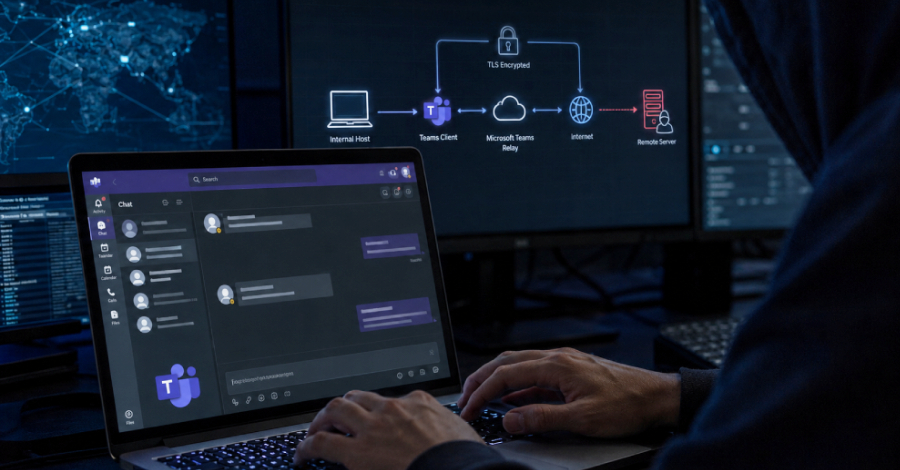
DragonForce Ransomware Group Exploits Microsoft Teams Infrastructure with Backdoor.Turn RAT
Recent reports have uncovered that threat actors linked to the DragonForce ransomware group have been utilizing a unique Go-based remote access trojan (RAT) known as Backdoor.Turn to mask their command-and-control (C2) communications within Microsoft Teams relay infrastructure.
Research conducted by Symantec and Carbon Black revealed that this backdoor was deployed in an attack against a prominent U.S. services firm, although the specific company remains undisclosed.
“Backdoor.Turn acquires an anonymous Teams visitor token from Microsoft’s Skype-powered identity services, leverages a legitimate Microsoft TURN relay for connection establishment, and initiates a QUIC session to the attacker’s true command-and-control (C2) server,” stated The Threat Hunter Team in a report shared with The Hacker News.
During the breach, the malicious actors were able to maintain persistence on the victim’s network for a duration of one to two months, masking their activities behind outbound connections to authentic Microsoft Teams servers.
Exploiting Microsoft’s TURN Relay Infrastructure
This incident marks the first known instance of threat actors misusing Microsoft’s Traversal Using Relays around NAT (TURN) relay infrastructure for malicious purposes.
Initial access to the victim network is believed to have been gained through the exploitation of a vulnerability in an SQL or MS-SQL server, with the possibility of involvement of an initial access broker (IAB) as well.
Timeline of Malicious Activities
The nefarious activities commenced in December 2025, with the attackers executing a PowerShell command to drop a deceptive ZIP archive posing as a tech support hotfix. This ZIP file facilitated a DLL side-loading attack, enabling the execution of a rogue DLL to carry out reconnaissance, establish persistence, and disable security software using a Huawei driver (“HWAuidoOs2Ec.sys”).
The attack methodology included the utilization of a bring your own vulnerable driver (BYOVD) technique, with the Huawei driver being utilized in a large-scale malvertising campaign targeting U.S.-based individuals seeking tax-related documents.
Advanced Attack Techniques
One noteworthy aspect of the attack was the deployment of Backdoor.Turn by injecting it into the legitimate “DbgView64.exe” process post the deployment of the DragonForce ransomware. This indicates an effort to sustain persistent access to the compromised host for future attacks or potential resale in underground markets.
Backdoor.Turn’s underlying TURN-based approach relies on a stealthy C2 communication technique called Ghost Calls, previously documented by Praetorian in August 2024. The RAT boasts a variety of capabilities, including command execution, process creation, network scanning, LDAP and Active Directory searches, lateral movement using credentials, and theft of browser credentials.
Evolution of DragonForce Ransomware Group
The findings underscore the DragonForce group’s adoption of sophisticated cyber tactics to conduct highly impactful targeted attacks, all while concealing covert data exfiltration from victims. The group has transitioned from a conventional ransomware-as-a-service (RaaS) model to a structured cartel setup, with a focus on continuous capability enhancement.
“The deployment of Backdoor.Turn, alongside their multi-vector BYOVD evasion, positions them as one of the most adept and persistent ransomware groups operating today,” stated Symantec and Carbon Black.











A $50,000 Smartphone for $400?

Ram Trucks Australia Braces for Price Increases Due to Emissions Regulations

Revving Up: Tractor Battle Adventure RPG Expands with Mod Support on Steam Workshop

Troubleshooting Guide: Unable to Access 192.168.0.1

Choosing the Right AI: Ensuring Trust in Multi-Model Translation Systems

Friday Night Baseball Madness: iPhone 18 Pro Edition

Partnership Potential: JAC & Huawei in Talks to Produce Electric Maserati Vehicles

Grand Theft Auto VI: The Soundtrack – Limited Edition Physical Release

The Never-Ending Battle of the Galaxy S27 Ultra Camera: A Tech Advisor’s Perspective

EU Takes Action Against Instagram and Facebook for Violating Illegal Content Rules

Warning: Facebook Creators Face Monetization Loss for Stealing and Reposting Videos

Facebook’s New Look: A Blend of Instagram’s Style

Facebook Compliance: ICE-tracking Page Removed After US Government Intervention

Facebook and Instagram to Reduce Personalized Ads for European Users

InstaDub: Meta’s AI Translation Tool for Instagram Videos

Reclaim Your Account: Facebook and Instagram Launch New Hub for Account Recovery

Meta discontinues Messenger apps for Windows and macOS

Breaking Updates: Meta Connect 2025 Unveils Latest Developments
A $50,000 Smartphone for $400?

Huawei P20 Pro Unboxing!

Huawei P20 Pro vs Samsung S9 Plus!

Huawei P20 vs P20 Pro vs iPhone 8 Plus vs S9 Battery Drain Test!

10 Android Mods that Change Everything

I used the first Android Phone in the World.

DOOGEE MIX 4 UNBOXING (PROTOTYPE)!

MYSTERY UNBOXING FROM SAMSUNG!

The Truth about Huawei P20 Pro – REAL Review
-
 Facebook11 months ago
EU Takes Action Against Instagram and Facebook for Violating Illegal Content Rules
-
 Facebook11 months ago
Warning: Facebook Creators Face Monetization Loss for Stealing and Reposting Videos
-
 Facebook9 months ago
Facebook’s New Look: A Blend of Instagram’s Style
-
 Facebook11 months ago
Facebook Compliance: ICE-tracking Page Removed After US Government Intervention
-
 Facebook9 months ago
Facebook and Instagram to Reduce Personalized Ads for European Users
-
 Facebook11 months ago
InstaDub: Meta’s AI Translation Tool for Instagram Videos
-
 Facebook10 months ago
Reclaim Your Account: Facebook and Instagram Launch New Hub for Account Recovery
-
 Apple11 months ago
Meta discontinues Messenger apps for Windows and macOS
