
Security
Deadly Deception: The LastPass Scam

Warning: LastPass Users Targeted by Phishing Campaign
LastPass has issued a warning to its customers regarding a sophisticated phishing campaign that aims to compromise their password vaults. The deceptive emails being sent out request access to the password vault under the guise of a legacy inheritance process.
According to LastPass, this malicious activity began in mid-October and has been traced back to a financially motivated threat group known as CryptoChameleon (UNC5356). This group is notorious for its involvement in cryptocurrency theft and has targeted popular wallets such as Binance, Coinbase, Kraken, and Gemini.
CryptoChameleon utilizes a phishing kit that specializes in stealing cryptocurrency by posing as legitimate platforms like Okta, Gmail, iCloud, and Outlook. LastPass users were previously targeted by this group in April 2024, but the latest campaign is more extensive and now includes targeting passkeys as well.
The fraudulent emails sent to LastPass users falsely claim that a family member has requested access to their vault by submitting a death certificate.
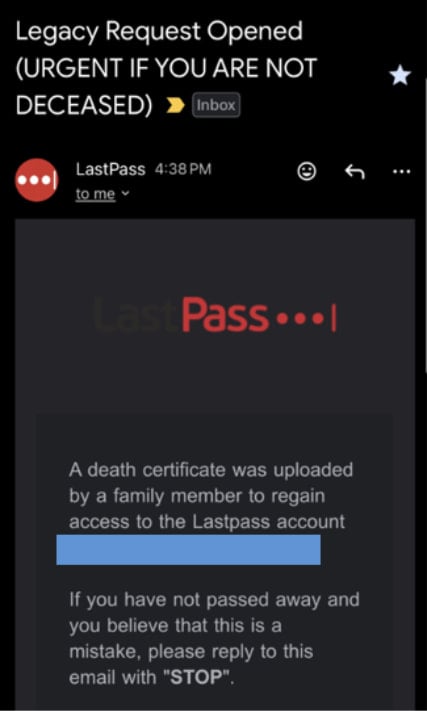
Source: LastPass
LastPass’s inheritance process includes an emergency access feature that allows designated individuals to request access to a user’s vault in the event of their death or incapacity. When such a request is initiated, the user receives an email notification, and access is granted after a specified waiting period.
The fraudulent legacy request contains an agent ID number to lend credibility to the scam, urging the recipient to take action by clicking on a link to cancel the request if they are not deceased. However, clicking on the link redirects them to a fake page on lastpassrecovery[.]com, prompting them to enter their master password.
LastPass has reported instances where the threat actors have even gone as far as calling victims posing as company staff and instructing them to enter their credentials on the phishing site.
One notable aspect of the CryptoChameleon attack targeting LastPass users is the use of passkey-focused phishing domains such as mypasskey[.]info and passkeysetup[.]com. These domains indicate a deliberate effort to steal users’ passkeys, which are crucial for passwordless authentication using FIDO2 / WebAuthn protocols.
Password managers like LastPass, 1Password, Dashlane, and Bitwarden have integrated passkeys as a more secure alternative to traditional passwords. However, threat actors have begun targeting these passkeys directly, posing a significant risk to user security.
In a previous data breach incident in 2022, LastPass experienced a breach where encrypted vault backups were stolen. This breach led to targeted attacks that resulted in significant losses, highlighting the importance of safeguarding sensitive information.
Recent reports indicate that 46% of environments have had passwords cracked, nearly doubling from the previous year’s figure of 25%. Stay informed with the Picus Blue Report 2025, which offers insights into prevention, detection, and data exfiltration trends.











Reviving the Legacy: Porsche Mission S Unveils Carrera GT-Inspired Gauge Cluster

Navigating the New Normal: Satya Nadella’s Journey in the Post-COVID World of Microsoft

Persona 4 Reborn: Unveiling Naoto Shirogane’s Return in New Trailer

Unveiling the Powerhouse: Xiaomi 18 Pro Max Global Leak Exposes Impressive Performance Features

Breaking News: Android U-Turn Officially Confirmed by Tech Advisor

Strategies for Building a Successful Home Services Franchise System: Driving Growth and Scalability

Apple and LG Unveil Game-Changing ‘Tap to Control’ HomeKit Features

The Surprising Decision: Tim Cook’s Early Departure Before iPhone Duo Launch

BMW’s Survey Reveals Surprising EV Range Preferences Among Americans

EU Takes Action Against Instagram and Facebook for Violating Illegal Content Rules

Warning: Facebook Creators Face Monetization Loss for Stealing and Reposting Videos

Facebook’s New Look: A Blend of Instagram’s Style

Facebook Compliance: ICE-tracking Page Removed After US Government Intervention

Facebook and Instagram to Reduce Personalized Ads for European Users

InstaDub: Meta’s AI Translation Tool for Instagram Videos

Reclaim Your Account: Facebook and Instagram Launch New Hub for Account Recovery

Meta discontinues Messenger apps for Windows and macOS

Breaking Updates: Meta Connect 2025 Unveils Latest Developments

I used a 2012 Smartphone in 2018 – Here’s what happened.

How to send ANY file Anywhere!

NEW Oneplus 5T Sandstone White Unboxing – The Ultimate Oneplus 5T?

HUAWEI P20 – THE SMARTPHONE REVOLUTION IS HERE?

How OnePlus succeeded when they should have failed.

Samsung sent us THIS! #AD

Ulefone Power 3 – Quad Camera Smartphone that last 2 weeks!

EPIC Smartphone FAILS that people will never forget.

The Best Android Launcher of 2018?
-
 Facebook12 months ago
EU Takes Action Against Instagram and Facebook for Violating Illegal Content Rules
-
 Facebook12 months ago
Warning: Facebook Creators Face Monetization Loss for Stealing and Reposting Videos
-
 Facebook10 months ago
Facebook’s New Look: A Blend of Instagram’s Style
-
 Facebook12 months ago
Facebook Compliance: ICE-tracking Page Removed After US Government Intervention
-
 Facebook10 months ago
Facebook and Instagram to Reduce Personalized Ads for European Users
-
 Facebook12 months ago
InstaDub: Meta’s AI Translation Tool for Instagram Videos
-
 Facebook10 months ago
Reclaim Your Account: Facebook and Instagram Launch New Hub for Account Recovery
-
 Apple12 months ago
Meta discontinues Messenger apps for Windows and macOS
