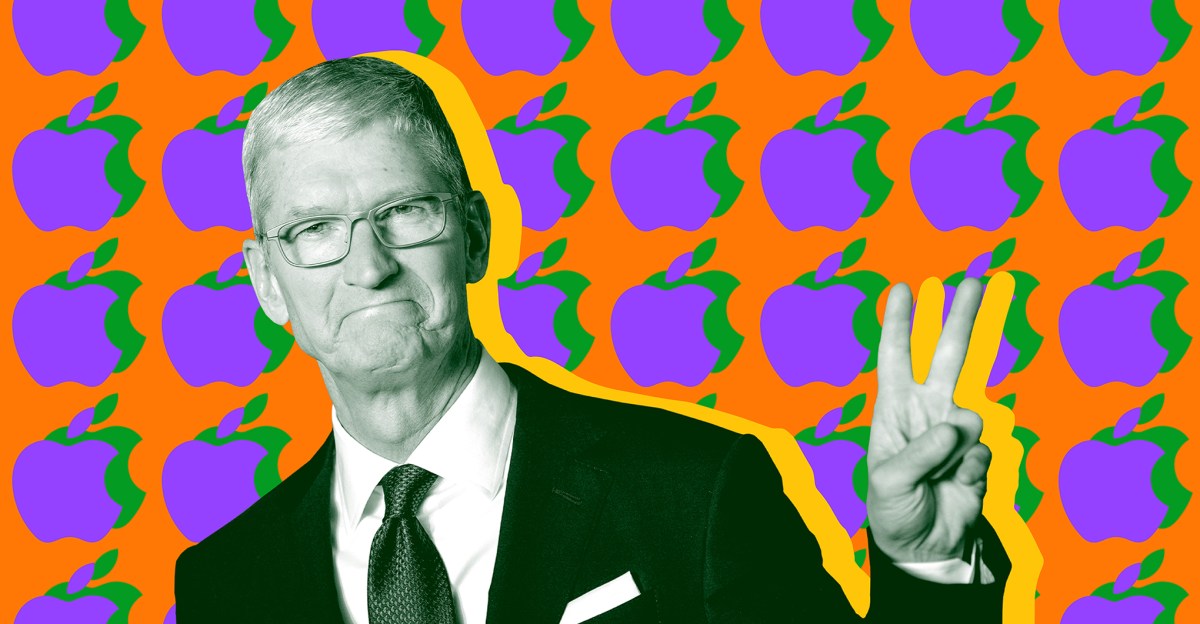
Upon stepping down from his role as Apple CEO today, Tim Cook leaves behind a largely positive environmental legacy. Among billionaire tech moguls concerned with the environment, Cook is likely to be remembered as one of the more responsible ones, though not without challenges. The company faces difficulties in meeting the climate goals set by Cook as it strives to keep up in the AI race.
Under Cook’s leadership, Apple established ambitious targets for reducing pollution generated by its products and suppliers. While other tech giants have seen their emissions increase due to the energy demands of AI, Apple has managed to maintain its carbon footprint without growth.
Despite these achievements, Apple has faced allegations of misleading customers with its sustainability claims. Many of the environmental challenges the company has faced under Cook’s tenure are expected to worsen with the rise of generative AI.
“If Tim Cook wants his legacy to be of a company that held its climate commitments he may have chosen the right time to leave.”
Apple emitted 15.3 million metric tons of gross carbon dioxide in 2025, equivalent to the pollution from 40 gas-fired power plants over a year. In 2020, the company aimed to reduce its carbon emissions by 75 percent by the end of the decade compared to 2015 levels. Currently, Apple has achieved a 60 percent reduction, which was highlighted in the announcement of Cook’s transition to executive chairman.
Cook emphasized that Apple’s shift to cleaner energy would not impede its growth. The company’s renewable energy investments were made with the intention of setting an example for others to follow, ensuring that economic viability was not sacrificed. In contrast, Google and Microsoft have seen a significant increase in greenhouse gas emissions due to the demands of generative AI.
Apple distinguished itself by establishing high standards for its suppliers, earning praise from environmental groups critical of Big Tech companies. A report in 2023 by Stand.earth compared Apple, Dell, Google, HP, Microsoft, and Nvidia, noting that Apple was the only company at the time to have set a 100 percent renewable electricity target for its suppliers.
In 2025, Apple received a B+ rating from Greenpeace East Asia for its efforts to promote more renewable energy within its supply chains. This contrasted sharply with companies like Nvidia, which lacked clear renewable energy targets or support for them in their supply chain.
However, there have been allegations of forced labor and conflict minerals in Apple’s supply chain. The company has also faced criticism for marketing some products as “carbon neutral” while questions have been raised about the accuracy of these claims. Despite introducing carbon-neutral devices, Apple’s transparency regarding suppliers’ greenhouse gas emissions has been called into question.
Apple faced a lawsuit over alleged false and misleading carbon neutrality claims, which was dismissed by a federal judge. Subsequently, the company ceased using the term “carbon neutral” in its advertising following regulatory actions by the EU.
Despite Apple’s efforts to reduce pollution, the company, along with other major corporations, opposed stricter international guidelines for reporting greenhouse gas emissions. Cook’s involvement in events that undermined climate action, such as supporting policies favoring fossil fuels, has raised concerns about the company’s commitment to environmental responsibility.
As the demand for advanced chips and cloud infrastructure grows, the challenge of maintaining Apple’s climate commitments becomes more critical. To uphold Tim Cook’s environmental legacy, the company must demonstrate that AI growth aligns with existing climate goals through emission reductions, increased renewable energy investments, and the creation of longer-lasting products.