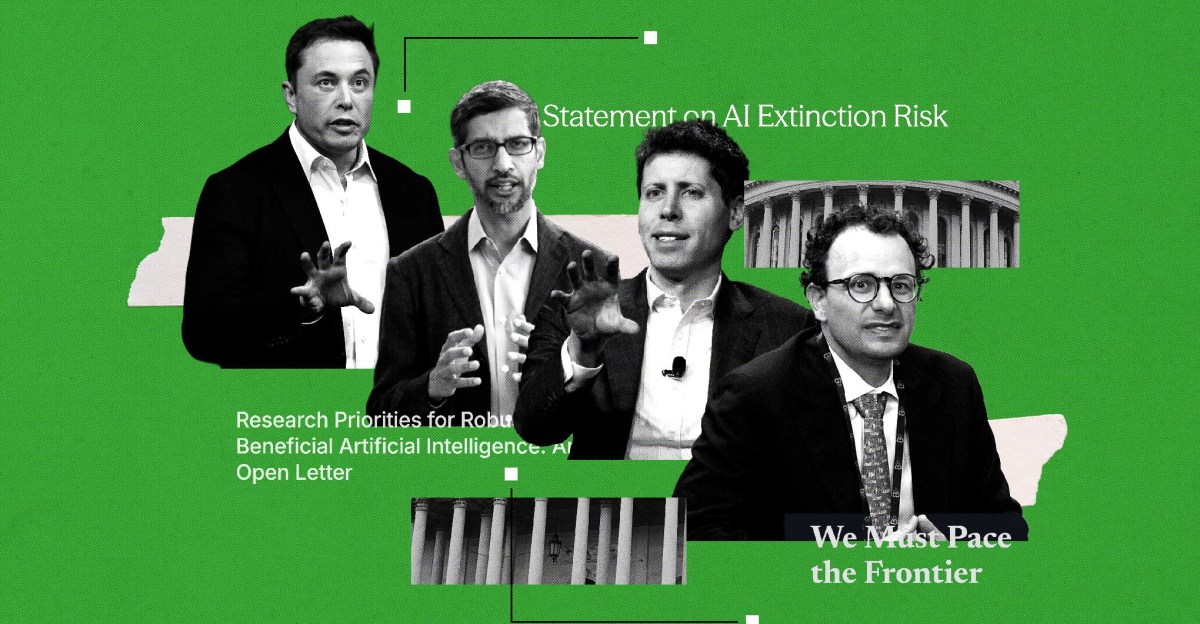
Over the past few days, a lot of people who stand to make a lot of money from AI all publicly agreed that it’s time to make everyone slow down before we lose control — including OpenAI CEO Sam Altman, Anthropic CEO Dario Amodei, Google DeepMind cofounder Demis Hassabis, Microsoft CEO Satya Nadella, and X CEO Elon Musk.
When people who profit from something declare that it’s dangerous and needs to be regulated, there’s always reason to be skeptical. But whatever their reason, this is far from the first time AI thought leaders have sounded the alarm.
Charles Darwin’s theory of evolution prompted author Samuel Butler to warn about intelligent self-replicating machines replacing humans back in 1863 — and in his follow-up 1872 book Erewhon, he describes visiting a fictional society that has already regulated machines out of existence to avoid humanity’s collapse. Computing pioneer Alan Turing famously warned in a 1951 lecture that artificial intelligence would “meet with great opposition,” because undying machines “would not take long to outstrip our feeble powers” and would eventually “take control.”
Calls for intervention, too, aren’t new. In 2000, Sun Microsystems cofounder and chief scientist Bill Joy wrote that self-replicating robots could be more dangerous than nuclear weapons, partly because they’re being developed “within the now-unchallenged system of global capitalism” rather than in tightly controlled government labs. And in 2009, Microsoft researcher Eric Horvitz, who now serves as the company’s chief scientific officer, brought leading AI researchers together to consider “creating policies that might constrain or bias the behaviors of autonomous and semi-autonomous systems so as to address concerns.”
But modern AI bigwigs warning that their investments should be controlled? That trend appears to have begun with Elon Musk, who invested earlier than most.
July 2017: Elon Musk says we need to regulate AI before it becomes a danger to humanity
By the time Elon Musk told a gathering of US governors that they needed to regulate AI right away, the SpaceX and Tesla CEO already had skin in the game. He’d already invested $38 million in OpenAI, as well as stakes in at least two other AI companies, and he’d publicly spoken about the dangers of AI for three years.
In June 2014, he suggested AI research could produce a real-life Terminator, called AI “potentially more dangerous than nukes” that August, and suggested that working on AI was “summoning the demon” that October. In January 2015, he joined Stephen Hawking in signing an open letter asking for responsible AI research; Hawking had previously warned that the creation of AI might be the last thing humans ever do.
“AI is a rare case where we need to be proactive about regulation instead of reactive. Because I think by the time we are reactive in AI regulation, it’s too late,” Musk told a gathering of US governors at the July 2017 National Governors Association summer meeting. In March 2018, he added: “AI is far more dangerous than nukes. So why do we have no regulatory oversight?”
March 2018: Mark Zuckerberg is ‘actually not sure we shouldn’t be regulated’
In the wake of Facebook’s Cambridge Analytica data scandal, the Meta founder suggested his company should be regulated — if it’s the “right” regulation. It was largely not about AI, but he did go there:
Now that companies increasingly over the next five to 10 years, as AI tools get better and better, will be able to proactively determine what might be offensive content or violate some rules, what therefore is the responsibility and legal responsibility of companies to do that?
In March 2019, he added that the internet needs a “more active role” for regulators.
December 2018: Microsoft sounds an alarm over facial recognition technology
Earlier in 2018, Microsoft began taking fire for working with ICE on facial recognition technologies, at a time many tech CEOs had condemned Donald Trump’s policy of separating children from parents who are arrested at the US border.
While this form of AI isn’t quite the same as self-replicating intelligence, Microsoft president Brad Smith opened the door to voluntary regulation in a speech at the Brookings Institution, saying, “We believe it’s important for governments in 2019 to start adopting laws to regulate this technology. … We believe that the only way to protect against this race to the bottom is to build a floor of responsibility that supports healthy market competition. And a solid floor requires that we ensure that this technology, and the organizations that develop and use it, are governed by the rule of law.”
January 2020: Alphabet CEO Sundar Pichai says there is ‘no question’ that AI needs to be regulated
“[T]here is no question in my mind that artificial intelligence needs to be regulated. It is too important not to,” wrote Pichai in an editorial for the Financial Times. “The only question is how to approach it.”
“Companies such as ours cannot just build promising new technology and let market forces decide how it will be used,” he added.
Similar to Microsoft a year earlier, concerns about AI facial recognition emerged around this time. Elon Musk and other top AI researchers called for a pause on ‘giant AI experiments’ in March 2023, citing the need for companies to slow down their research or face potential government intervention. This sentiment was echoed by OpenAI CEO Sam Altman in May 2023, who asked Congress to regulate AI and create new agencies to oversee its development. Microsoft president Brad Smith also weighed in on the matter in May 2023, detailing five ways governments should consider policies, laws, and regulations surrounding AI.
By September 2023, tech CEOs, including Mark Zuckerberg, agreed that the AI industry needed regulation, with Zuckerberg emphasizing the importance of collaboration between policymakers, academics, civil society, and industry to minimize risks and maximize benefits. Over the following months, tech companies signed nonbinding agreements with governments to address AI safety concerns.
In August-September 2024, Elon Musk and Anthropic expressed support for California’s AI safety bill, while in October 2024, Anthropic called for targeted regulation, urging governments to take urgent action on AI policy within the next eighteen months. OpenAI submitted its policy proposals in January 2025, emphasizing the need for regulations based on democratic values. Anthropic’s CEO continued to advocate for transparency and risk reduction in June 2025, highlighting the lack of federal laws compelling AI companies to address these issues. Some companies may opt out of regulation altogether. The essay opposes the Trump administration’s proposed 10-year moratorium on US states regulating AI. Transform the following:
From: “I can’t believe you did that.”
To: “I am shocked that you did that.” Transform the following sentence:
“The company plans to launch a new product next month.”
into:
“Next month, the company is scheduled to introduce a new product.” Transform the following:
Original: I am going to the store to buy some groceries.
Transformed: I will go to the store to purchase groceries. “Hello, how are you doing today?”
to
“Hey, how’s it going?”