
Startups
Building Trust with Impactful Homepage Messaging: A Startup’s Guide


Every startup asks potential customers for something. Sometimes it’s a purchase. Sometimes it’s an email address, a demo request, or simply a few more minutes of attention. People rarely give any of those things unless they feel confident about what they’re looking at.
Your homepage plays a big part in creating that confidence. Every headline, sentence, button, and proof point helps visitors decide whether your business understands their problem and offers a solution worth exploring.
When your messaging is clear, specific, and believable, people spend less time figuring out what you do and more time considering what comes next. That matters even more when your company doesn’t have a well-known name behind it.
This post shares practical ways to build trust through homepage messaging that gives visitors clear answers and solid reasons to keep moving forward.
We earn a commission if you make a purchase, at no additional cost to you.

We earn a commission if you make a purchase, at no additional cost to you.
Define Your Ideal User
A homepage that tries to speak to everyone ends up resonating with no one.
When your messaging stays broad, visitors have to do the work of figuring out whether your product applies to them. The truth is, most won’t bother.
The startups that convert well early on are usually the ones willing to get specific about who they’re talking to, even if that means excluding some visitors in the process.
- Start by naming your audience directly in your homepage copy. This doesn’t require a dedicated “Who it’s for” section, though that can work too. A well-placed phrase, like “built for independent consultants” or “designed for teams under 20”, tells the right visitor they’re in the right place within seconds. That recognition drives engagement more reliably than any generic value statement.
- From there, use language your ideal customer actually uses. Pull phrases from sales calls, support tickets, or customer reviews. If your audience describes their problem a certain way, mirror that language back to them. It signals that you understand their world without having to say so explicitly.
- Specificity also helps with positioning. A homepage that clearly defines its audience is harder to confuse with a competitor. It gives visitors a sharper reason to choose you over a broader alternative that technically does the same thing.
Clarify Your Value in One Sentence
Your homepage header carries more weight than any other line on your site.
Eye-tracking research shows visitors spend about 57% of their page time above the fold, which means whatever sits at the top either earns their attention or loses it. A vague headline burns that window fast.
The fix is simpler than most founders expect:
- Write one sentence that tells visitors exactly what you do, who you do it for, and what they get out of it.
- Cut the clever wordplay. Cut the abstract positioning.
- If someone unfamiliar with your industry reads your headline and immediately understands your offer, you’ve got it right. If they’d need to scroll or click to figure it out, rewrite it.
- Identify the single most important thing your product does for a customer. Then name it plainly.
- Pair it with a short line of microcopy below that adds a practical detail (for instance, clarifying the platform, the format, or the audience). Lead with whatever removes the most remaining doubt.
A clear example of how this looks can be seen by Uproas, a company that rents agency ad accounts for platforms like Meta, Google, and TikTok to advertisers who need elevated access and higher spending limits.
Their homepage header leads with the core benefit, and a short line directly beneath it names the specific platforms and the rental model. In turn, visitors understand the product, the mechanism, and the relevance to them without clicking a single link.
That’s the standard worth aiming for.
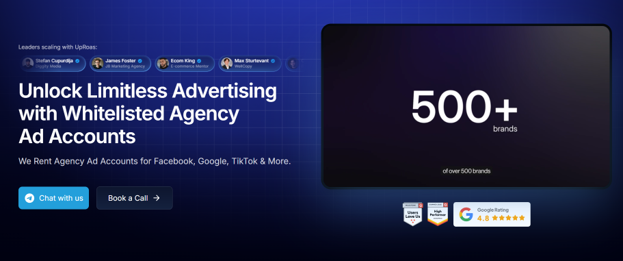
Source: uproas.io
Establish Credibility Immediately
Visitors arriving at your homepage carry a default level of skepticism, and for startups, that bar is higher than it is for established brands. They don’t know you yet, and generic claims like “trusted,” “experienced,,” or “professional” don’t move the needle.
What does move it is specificity, like a named person, a verifiable credential, or a concrete track record that gives visitors something real to hold onto.
Here’s how to establish credibility right from the get-go:
- Lead with proof that’s hard to fake. Put a real name and face behind your product.
- Reference specific experience, such as years in the field, a professional background, or a relevant qualification.
- If you have partnerships with recognizable platforms or brands, display them early. Visitors process logos and credentials quickly, and familiar names borrow trust in a way that self-written copy can’t replicate.
- Also consider addressing competitor weaknesses directly. If your space has a credibility problem (and many do), naming it signals that you understand the landscape and that you’ve built your service specifically to solve it. That’s a more convincing trust signal than any badge.
Start in Wyoming, a service that helps entrepreneurs and non-US residents form Wyoming LLCs and establish a legitimate US business presence, does this well.
Their homepage puts the founder front and center – a practicing Wyoming attorney with over a decade of legal experience.
Enhancing Credibility on Your Startup Homepage
One common strategy employed by startups to boost credibility on their homepage is by highlighting key partnerships with recognized platforms like Mercury and Relay, especially when many competing services are not even based in Wyoming. This not only differentiates the startup but also removes any hesitation potential visitors may have, ultimately preventing them from leaving the site.
Customer success stories are another powerful tool that can significantly impact how visitors perceive a startup. Research shows that 71% of marketers rely on customer success stories to build trust and credibility with potential buyers. By showcasing real customer testimonials, complete with faces, logos, and impactful outcomes, startups can provide social proof that resonates with visitors on a personal level.
- Pull together strong testimonials and pair them with visual elements like faces, logos, and noteworthy outcomes.
- Utilize video testimonials and case study data to further validate the success stories.
- Present enough information to convince visitors, while also providing a clear path for those interested in reading more.
- Keep customer testimonials concise and engaging, with the full stories accessible with just one click.
When it comes to replacing generic claims with concrete evidence, startups can elevate their credibility by backing up statements with verifiable data. Instead of using overused adjectives like “powerful” or “best-in-class,” startups should focus on incorporating numbers, ratings, and third-party sources that lend credibility to their claims.
- Review homepage copy to identify adjectives describing product quality and replace them with evidence-backed statements.
- Showcase ratings from reputable platforms like Trustpilot, G2, or Capterra, and highlight key operational metrics to provide context and scale.
- Ensure all numbers are accurate and up-to-date to maintain trust with visitors.
By implementing these strategies, startups like Juro and 15Five have successfully built trust and credibility on their homepages. Through a combination of customer success stories, evidence-backed claims, and strategic partnerships, these startups have effectively communicated their value proposition and established a strong foundation for engaging with potential customers.
Ultimately, the key to a successful startup homepage lies in crafting a message that is easy to understand and believe. By continuously refining language, structure, and supporting details, startups can create a compelling narrative that resonates with visitors and drives engagement and conversion.
Image by DC Studio on Magnific
Transform the following:
“Can you help me with this assignment?”
into:
“Would you be able to assist me with this task?”













Warhammer 40,000: Boltgun 2’s Mind-Bending Fleshmetal Puzzle Map Leaves Coders in Despair

Fitbit Edge: The Next Generation of Fitness Tracking

German-Ukrainian Startup Collaboration Intensifies as Innovation Shifts to the Forefront

Rare Deal Alert: Save $200 on the MacBook Air M5 – Limited Time Offer!

Google Acknowledges Compatibility Issues with Some Android Apps on Intel Googlebooks

Revolutionizing Mobile Filmmaking: Final Cut Camera Upgrade for iPhone 18 Pro

The Best Android Launcher of 2018?

135 Ultimate Performance Machines: A Collection of 1M Coupes and E30 M3s

ShinyHunters Suspect Rey Held in Jordan, Assisting FBI in Uncovering Group Members

EU Takes Action Against Instagram and Facebook for Violating Illegal Content Rules

Warning: Facebook Creators Face Monetization Loss for Stealing and Reposting Videos

Facebook’s New Look: A Blend of Instagram’s Style

Facebook Compliance: ICE-tracking Page Removed After US Government Intervention

Facebook and Instagram to Reduce Personalized Ads for European Users

InstaDub: Meta’s AI Translation Tool for Instagram Videos

Reclaim Your Account: Facebook and Instagram Launch New Hub for Account Recovery

Meta discontinues Messenger apps for Windows and macOS

Breaking Updates: Meta Connect 2025 Unveils Latest Developments
The Best Android Launcher of 2018?

Faraday Future FF 91 – 1050 Horsepower Madness!

The Truth about the OnePlus 5T – REAL Review.

Concept Smartphones that are better than Real Smartphones

Samsung Galaxy SII Unboxing!

The SECRET to Maximise Smartphone Battery Life?

We Designed the Ultimate Gaming Smartphone of 2018!

Using the Cheapest Smartphone in the World.

Samsung Galaxy S9+ Unboxing! (Clone)
-
 Facebook12 months ago
EU Takes Action Against Instagram and Facebook for Violating Illegal Content Rules
-
 Facebook12 months ago
Warning: Facebook Creators Face Monetization Loss for Stealing and Reposting Videos
-
 Facebook10 months ago
Facebook’s New Look: A Blend of Instagram’s Style
-
 Facebook12 months ago
Facebook Compliance: ICE-tracking Page Removed After US Government Intervention
-
 Facebook10 months ago
Facebook and Instagram to Reduce Personalized Ads for European Users
-
 Facebook12 months ago
InstaDub: Meta’s AI Translation Tool for Instagram Videos
-
 Facebook10 months ago
Reclaim Your Account: Facebook and Instagram Launch New Hub for Account Recovery
-
 Apple12 months ago
Meta discontinues Messenger apps for Windows and macOS
