
Security
Corporate Cyber Invasion: New Windows Malware Threatens Fortune 100 Firm


Ransomware Attackers Target Fortune 100 Finance Company with New Malware Strain
A recent cyber attack on a Fortune 100 finance company involved the use of a new malware strain called PDFSider. This malicious software was utilized by the attackers to deliver harmful payloads on Windows systems.
The attackers employed social engineering tactics to gain remote access by posing as technical support workers. They attempted to deceive company employees into installing Microsoft’s Quick Assist tool, allowing them to infiltrate the network.
PDFSider was discovered by researchers at cybersecurity firm Resecurity during an incident response. They describe the malware as a stealthy backdoor that provides long-term access to compromised systems, exhibiting characteristics commonly associated with Advanced Persistent Threat (APT) tradecraft.
Legitimate EXE, Malicious DLL
According to a spokesperson from Resecurity, PDFSider has been observed in Qilin ransomware attacks. The threat hunting team at Resecurity has noted that multiple ransomware actors are actively using the backdoor to deploy their malicious payloads.
The PDFSider backdoor is distributed through spearphishing emails containing a ZIP archive. This archive includes a legitimate, digitally signed executable for the PDF24 Creator tool, alongside a malicious version of a DLL called cryptbase.dll. When the legitimate executable is run, it loads the attacker’s DLL file, enabling code execution on the system through a technique known as DLL side-loading.
Attackers have also attempted to trick email recipients into launching the malicious file by using decoy documents tailored to the targets. In one instance, they impersonated a Chinese government entity as the document’s author.
Resecurity explains that while the EXE file has a valid signature, vulnerabilities in the PDF24 software allowed attackers to exploit it to load the malware, bypassing Endpoint Detection and Response (EDR) systems effectively.
With the rise of AI-powered coding, cybercriminals are finding vulnerable software more easily. PDFSider loads directly into memory to minimize disk artifacts and utilizes anonymous pipes to execute commands via CMD.
Infected hosts receive a unique identifier, and their system information is gathered and sent to the attacker’s Virtual Private Server (VPS) over DNS (port 53). The malware uses the Botan 3.0.0 cryptographic library and AES-256-GCM for encryption during command-and-control (C2) exchanges.
PDFSider employs anti-analysis mechanisms such as RAM size checks and debugger detection to avoid detection in sandboxes. Resecurity suggests that the malware is more aligned with espionage tradecraft than financially motivated attacks, designed to maintain covert access, execute remote commands, and communicate securely.
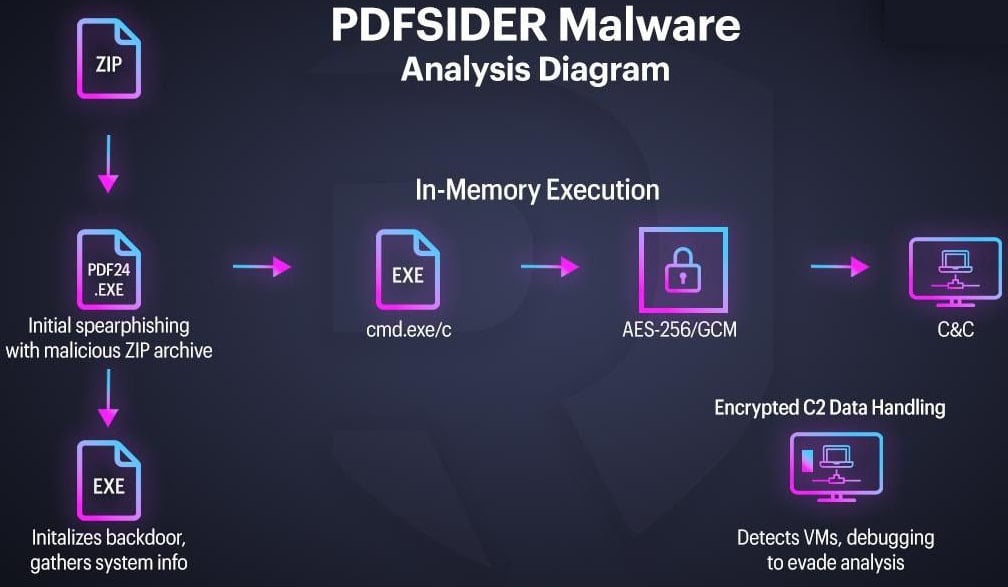
Source: Resecurity

As budget season approaches, over 300 CISOs and security leaders have shared their insights on planning, spending, and prioritizing for the year ahead. Discover emerging trends and benchmark strategies with this comprehensive report.
Learn how top leaders are translating investments into tangible results and addressing cybersecurity challenges in 2026.









Uncovering the Bronze Age Influence in Paradox’s Afterworld: A Deeper Dive Beyond the Top Five Reference Points

iPhone Duo: The Future of Mobile Dominance

Tech Advisor: The Delayed Android 17 QPR1 Update for Pixel 11

Venture Capital Firm Monte Carlo Capital Secures €13 Million for Fund II to Back Early-Stage DeepTech, AI, and SpaceTech Startups

The Battle Over iPhone Driver’s Licenses: Florida and Rhode Island Stand Firm

How Smart is the AI-Powered Huawei Mate 10 – with EMUI 8.0?

Reviving the Legacy: Porsche Mission S Unveils Carrera GT-Inspired Gauge Cluster

Navigating the New Normal: Satya Nadella’s Journey in the Post-COVID World of Microsoft

Persona 4 Reborn: Unveiling Naoto Shirogane’s Return in New Trailer

EU Takes Action Against Instagram and Facebook for Violating Illegal Content Rules

Warning: Facebook Creators Face Monetization Loss for Stealing and Reposting Videos

Facebook’s New Look: A Blend of Instagram’s Style

Facebook Compliance: ICE-tracking Page Removed After US Government Intervention

Facebook and Instagram to Reduce Personalized Ads for European Users

InstaDub: Meta’s AI Translation Tool for Instagram Videos

Reclaim Your Account: Facebook and Instagram Launch New Hub for Account Recovery

Meta discontinues Messenger apps for Windows and macOS

Breaking Updates: Meta Connect 2025 Unveils Latest Developments
How Smart is the AI-Powered Huawei Mate 10 – with EMUI 8.0?

I used a 2012 Smartphone in 2018 – Here’s what happened.

How to send ANY file Anywhere!

NEW Oneplus 5T Sandstone White Unboxing – The Ultimate Oneplus 5T?

HUAWEI P20 – THE SMARTPHONE REVOLUTION IS HERE?

How OnePlus succeeded when they should have failed.

Samsung sent us THIS! #AD

Ulefone Power 3 – Quad Camera Smartphone that last 2 weeks!

EPIC Smartphone FAILS that people will never forget.
-
 Facebook12 months ago
EU Takes Action Against Instagram and Facebook for Violating Illegal Content Rules
-
 Facebook12 months ago
Warning: Facebook Creators Face Monetization Loss for Stealing and Reposting Videos
-
 Facebook10 months ago
Facebook’s New Look: A Blend of Instagram’s Style
-
 Facebook12 months ago
Facebook Compliance: ICE-tracking Page Removed After US Government Intervention
-
 Facebook10 months ago
Facebook and Instagram to Reduce Personalized Ads for European Users
-
 Facebook12 months ago
InstaDub: Meta’s AI Translation Tool for Instagram Videos
-
 Facebook10 months ago
Reclaim Your Account: Facebook and Instagram Launch New Hub for Account Recovery
-
 Apple12 months ago
Meta discontinues Messenger apps for Windows and macOS
