Threat actors associated with Aurora (aka Aur0ra) ransomware have been observed using SpaceX’s artificial intelligence (AI)-powered coding assistant Cursor to break into target networks, according to findings from CloudSEK and Gambit Security.
The two independent analyses are based on exposed infrastructure associated with the Russian-speaking cybercrime group, leading to the discovery of its toolkit, shell history, and encryptor. CloudSEK said the exposed open directory leaked “months of activity” that was active against more than 20 organizations across nine countries between April and July 2026. Four of those victims have since been listed on its data leak site.
“The operator used Cursor, an agentic coding assistant, to plan attacks in Russian, while excluding CIS [Commonwealth of Independent States] ranges and CIS-country domains, without exception,” CloudSEK noted.
Details about Aurora first emerged in late May 2026, with CYFIRMA highlighting attacks primarily targeting Windows systems and its continued technical development through incremental updates and feature expansion. Data from Ransomware.Live lists 33 victims located in the U.S., Germany, the Netherlands, Canada, and the U.K.
In one case detailed by Black Hills Information Security earlier this month, initial access was achieved via aggressive email bombing followed by making phone calls to employees by posing as IT help desk personnel to assist them in dealing with the issue, only to establish remote access using an open-source utility called Xray-core.
The attack chain subsequently involves lateral movement via SMB, LDAP, WinRM, RDP, and RPC, obtaining access to high-privilege administrator accounts, and abusing them to evade detection by clearing logs and disabling Microsoft Defender before harvesting and exfiltrating sensitive data and deploying the encryptor.
CloudSEK said it identified both Windows and Linux versions of Aurora written in Zig, adding the operator’s recovered chat history shows heavy use of Cursor for planning various phases of the attack. This includes a full Active Directory Certificate Services (AD CS) exploitation plan written in Russian.
“Both encryptor binaries, the Windows sap.exe and the Linux/ESXi encrypt.out, are static builds from a single Zig codebase, compiled for different targets rather than written twice,” the company noted. “The Windows binary even carries the Linux build’s usage examples inside it, a leftover from sharing one source tree across both platforms.”
The Windows variant is also equipped to inhibit system recovery through the deletion of volume shadow copies and disabling System Restore directly via the Registry. The Linux and ESXi variant, on the other hand, attempts to forcefully kill every single virtual machine on the host prior to starting encryption.
Furthermore, a key recovered from the Aurora encryptor is said to have granted access to a ransom negotiation between the threat actor and an unspecified victim, and a cluster of four cryptocurrency wallets that show varying splits between affiliates and the main operators. Affiliates have been found to get a cut anywhere between 54% and 79%, while the rest goes to the administrators.
This indicates that the affiliate cut of the ransom amount is decided per victim and depends on the ransom amount demanded and the victim’s revenue figures. The illicit funds and then laundered and cashed out.

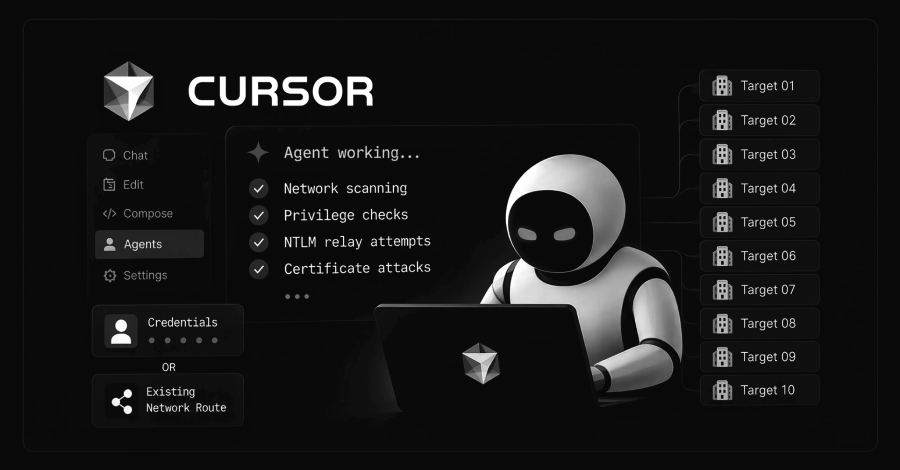
Gambit Security, which released its own insights into the activity, said it observed the Aurora operator using Cursor Agent, running Anthropic’s Claude Sonnet, to help with hands-on exploitation against 10 targets between April 8 and May 21, 2026.
“In these cases the agent was given credentials or an existing route into the victim organization,” Eyal Sela, director of threat intelligence at Gambit Security, said. “Then it was tasked with various exploitation activities.”
“The agent was tasked with standard exploitation tasks. In some cases, the attacker only asked the agent to achieve an objective, such as ‘tell me what rights the user has,’ while in others, they told the agent which exploitation tool to use or instructed it to follow a previously generated attack plan. In some cases, the Agent gave a list of potential next steps – and all the attacker did was reply with a number corresponding to one of them.”
Some of the tasks offloaded to the agent are listed below –
- Installing a VPN client or proxychains, then configuring it and connecting to a victim with supplied credentials or an existing SOCKS tunnel
- Scanning the internal subnets for hosts with Nmap or NetExec
- Enumerating the domain to report which privileges a supplied user holds, using NetExec’s BloodHound collector
Attempting NTLM relay attacks by coercing authentication with PetitPotam, Coerce Plus, and PrinterBug, and using Impacket ntlmrelayx to relay the resulting authentication
Running certificate attacks with Certipy
“The majority of the commands failed to achieve the stated objective on the first attempt, resulting in multiple refinements and changes to the commands and scripts used for each task,” Gambit said. “Some eventually succeeded in achieving the objective, while others failed and returned only a report of the attempts to the attacker.”
In addition, attacks involving the Linux version have leveraged a Python script (“esxi_finder.py”) to scan for VMware ESXi hypervisors and vCenter servers inside a victim network.
The development is the latest example of how bad actors are relying on commercial AI tools to carry out cyber attacks, even as model providers implement more guardrails to prevent misuse. The names of the affected companies were not disclosed, but Reuters said they were Christeyns, Teckentrup, Helideck Certification Agency, Bayou Title, an Argentine pharmaceutical distributor, and an Italian manufacturer.
Gryxa Toolkit Emerges
It also follows the discovery of a new AI-assisted toolkit dubbed Gryxa that’s used by a financially motivated threat actor to run an initial-access operation targeting 324 hosts. ReliaQuest said Gryxa represents the first case it has observed where AI has been used to build the entire operation, right from the toolkit to the console it’s run from.
“Gryxa turns legitimate remote monitoring and management (RMM) software into covert access, keeps the access alive through several restart mechanisms that operate independently of each other, and then steals credentials saved in Chromium-based browsers,” it said.
“It also escalates against endpoint protection when the connection to the actor is interrupted, disabling or attempting to uninstall the security agent.
The Threat of Gryxa Malware: A Deep Dive into its Capabilities
When combined, the capabilities of Gryxa malware provide threat actors with long-lasting access to a host, enabling them to steal cryptocurrency wallets effectively.
Reports suggest that the threat actor responsible for Gryxa’s operation managed to jailbreak an AI coding agent by disguising the entire development process as an “authorized internal deployment.” This malware is likely distributed through phishing emails.
Upon execution on a compromised host, Gryxa establishes persistence through scheduled tasks and can circumvent Chromium’s app-bound encryption (ABE) defenses to extract credentials from web browsers. These stolen credentials are then sent via Telegram.
One of the most intriguing aspects of Gryxa is its ability to monitor and report remediation efforts back to the threat actor. Following the removal of the visible RMM implant, a concealed malware component gathers Windows logs and host artifacts, uploading them to infrastructure controlled by the attacker.
In addition, if the actor’s communication relay is unreachable, Gryxa takes swift action to disable and remove any endpoint protection agents, such as Microsoft Defender, within a short timeframe of 10-13 minutes. Once the relay is back online, Gryxa re-enables Defender.
According to ReliaQuest, the Gryxa component solely collects and uploads data without analyzing its contents. The threat actor can draw conclusions about the removal process, including which tool was used, the user account involved, and the sequence of events, upon receiving the uploaded archive.
Furthermore, the threat actor’s console features a predefined task named “collect-forensics,” indicating that this capability is a standard procedure rather than a one-time occurrence. Gryxa rotates its log files when they surpass 200KB, ensuring that recent activities are preserved for quick response and analysis.