
Amazon
Amazon’s Record AI Spending Leads to Negative Cash Flow Despite AWS Boom

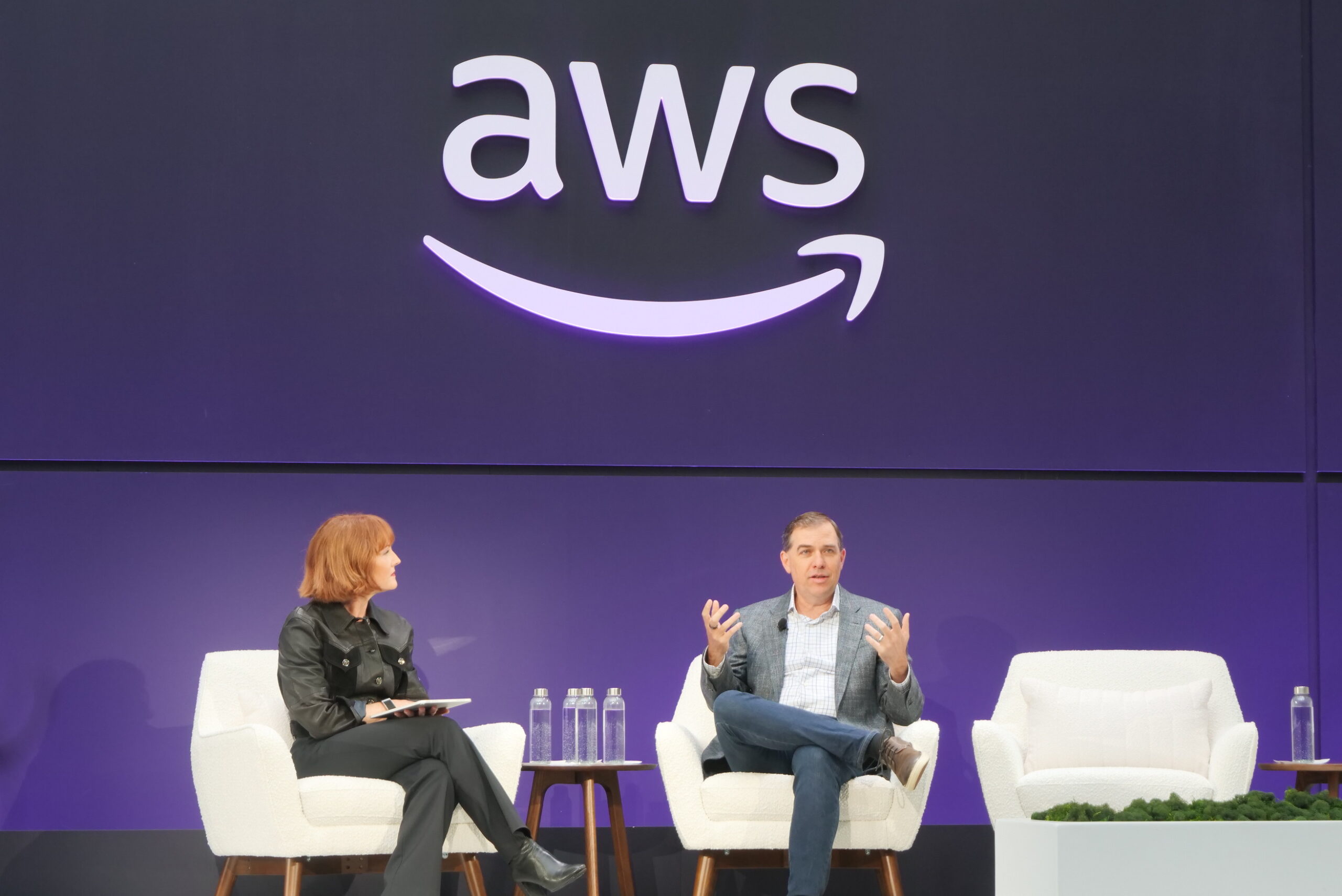
Amazon Web Services Reports Strong Revenue Growth
In its latest financial report, Amazon Web Services (AWS) revealed a remarkable 37% growth in revenue, marking its fastest pace since the end of 2021. However, the company’s substantial investments in data centers and infrastructure to drive this growth led to negative free cash flow for the first time since 2023.
The tech giant reported a total revenue of $200.6 billion for the second quarter, a 20% increase, with operating income reaching $27.5 billion, up by 43%. These results exceeded both Wall Street’s expectations and Amazon’s own guidance.
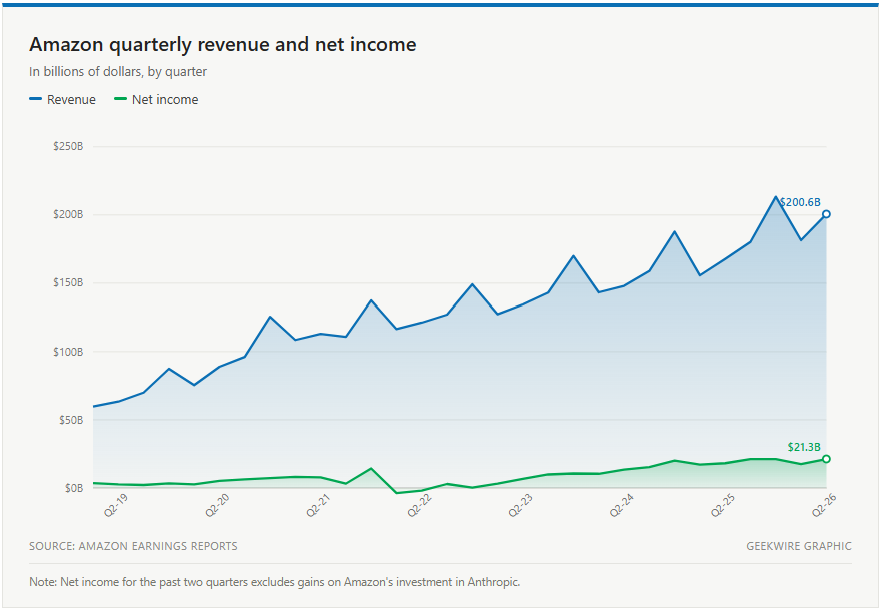
The company’s profits reached $62.6 billion, translating to $5.75 per share. Notably, this figure includes $53.4 billion in pre-tax gains, mainly from Amazon’s investment in Anthropic. Excluding these gains, the earnings per share (EPS) would have been approximately $1.95, surpassing analyst predictions of $1.82.
Following the report, Amazon’s shares surged more than 8% in after-hours trading.
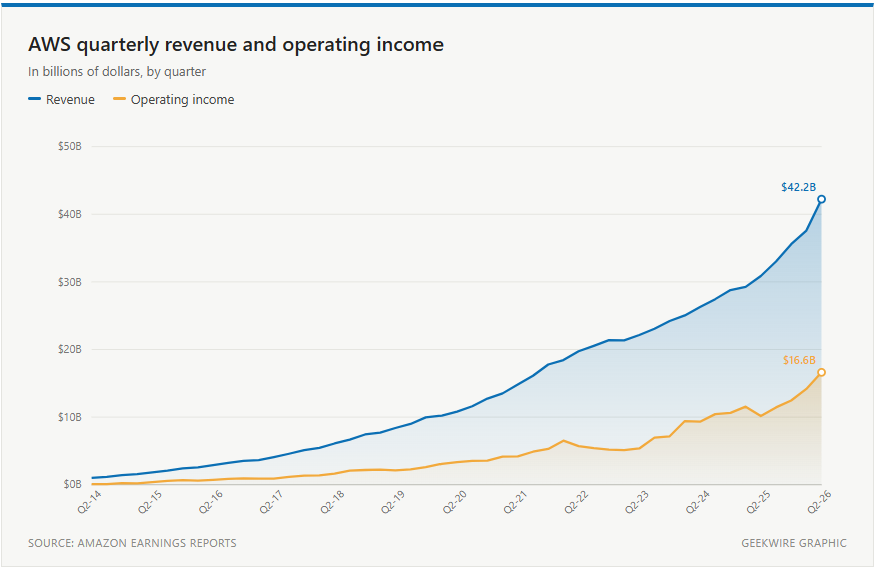
AWS revenue for the quarter hit $42.2 billion, with an annualized run rate of $169 billion. The cloud division’s operating income increased by 64% to $16.6 billion, raising the AWS operating margin to 39.4% from 32.9% a year earlier, indicating that the AI expansion is now yielding profits in addition to revenue.
CEO Andy Jassy highlighted the robust performance of AWS, noting that both the AI and chips businesses had surpassed run rates of over $25 billion each. The chips business, which Jeff Bezos identified as a key pillar of the company, had a run rate of $20 billion just three months ago.
Amazon’s operations generated $161.4 billion over the past 12 months. However, the company spent a net $169 billion on property and equipment, a $66.1 billion increase from the previous year, primarily due to AI investments. This resulted in a free cash flow deficit of $7.6 billion, in contrast to the $18.2 billion surplus from the prior 12 months.
Free cash flow is a crucial financial metric that reflects the amount of cash a company generates after covering operating expenses and investments in infrastructure like data centers and warehouses.
Update: During its earnings call, Amazon raised its capital spending forecast, anticipating approximately $220 billion in cash capital expenditure for the year, up from the earlier projection of $200 billion. This increase was attributed to higher memory chip costs.
Addressing the cash flow challenges, Jassy explained that the timing of investments in data centers is critical. While upfront capital is required for data centers about two years before they become operational, their revenue-generating potential extends over 30 years without recurring upfront costs.
Jassy further elaborated that servers and networking equipment, purchased a few months before deployment, take nearly three years to break even, with a useful life span of at least five to six years. Most of Amazon’s AI capacity is now committed for terms exceeding five years.
“We’ll experience capex and free cash flow challenges until these data centers are operational, generating revenue, and several years into the utilization of these servers,” Jassy noted.
Other Highlights from Amazon’s Earnings Release:
Online store sales: Increased by 15% to $70.4 billion, up from 10% growth in the same quarter last year, driven by the decision to move Prime Day to June.
Advertising revenue: Grew by 26% to $19.8 billion, up from 22% growth in the corresponding quarter a year ago, with Prime Day contributing to the surge in spending by sellers and brands.
Third-party seller services revenue: Rose by 16% to $46.8 billion, with independent sellers representing 61% of units sold in Amazon’s stores.
Subscription services: Including Prime memberships, increased by 12% to $13.7 billion.












Exploring the Exciting Updates of iOS 27: A Look Beyond Artificial Intelligence

A $50,000 Smartphone for $400?

Ram Trucks Australia Braces for Price Increases Due to Emissions Regulations

Revving Up: Tractor Battle Adventure RPG Expands with Mod Support on Steam Workshop

Troubleshooting Guide: Unable to Access 192.168.0.1

Choosing the Right AI: Ensuring Trust in Multi-Model Translation Systems

Friday Night Baseball Madness: iPhone 18 Pro Edition

Partnership Potential: JAC & Huawei in Talks to Produce Electric Maserati Vehicles

Grand Theft Auto VI: The Soundtrack – Limited Edition Physical Release

EU Takes Action Against Instagram and Facebook for Violating Illegal Content Rules

Warning: Facebook Creators Face Monetization Loss for Stealing and Reposting Videos

Facebook’s New Look: A Blend of Instagram’s Style

Facebook Compliance: ICE-tracking Page Removed After US Government Intervention

Facebook and Instagram to Reduce Personalized Ads for European Users

InstaDub: Meta’s AI Translation Tool for Instagram Videos

Reclaim Your Account: Facebook and Instagram Launch New Hub for Account Recovery

Meta discontinues Messenger apps for Windows and macOS

Breaking Updates: Meta Connect 2025 Unveils Latest Developments
A $50,000 Smartphone for $400?

Huawei P20 Pro Unboxing!

Huawei P20 Pro vs Samsung S9 Plus!

Huawei P20 vs P20 Pro vs iPhone 8 Plus vs S9 Battery Drain Test!

10 Android Mods that Change Everything

I used the first Android Phone in the World.

DOOGEE MIX 4 UNBOXING (PROTOTYPE)!

MYSTERY UNBOXING FROM SAMSUNG!

The Truth about Huawei P20 Pro – REAL Review
-
 Facebook11 months ago
EU Takes Action Against Instagram and Facebook for Violating Illegal Content Rules
-
 Facebook11 months ago
Warning: Facebook Creators Face Monetization Loss for Stealing and Reposting Videos
-
 Facebook9 months ago
Facebook’s New Look: A Blend of Instagram’s Style
-
 Facebook11 months ago
Facebook Compliance: ICE-tracking Page Removed After US Government Intervention
-
 Facebook9 months ago
Facebook and Instagram to Reduce Personalized Ads for European Users
-
 Facebook11 months ago
InstaDub: Meta’s AI Translation Tool for Instagram Videos
-
 Facebook10 months ago
Reclaim Your Account: Facebook and Instagram Launch New Hub for Account Recovery
-
 Apple11 months ago
Meta discontinues Messenger apps for Windows and macOS
