
Inovation
NSF Boosts Quantum Technologies with $290m Investment

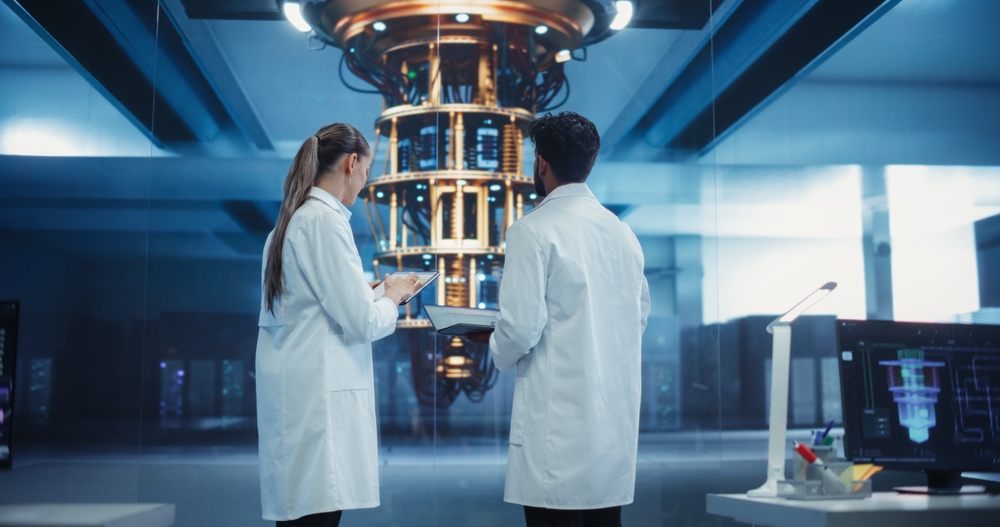
The United States National Science Foundation (NSF) Invests Over $290 Million in Quantum Technology Research
An investment exceeding $290 million by the United States National Science Foundation (NSF) has been allocated to eight research institutes dedicated to addressing the most significant scientific and engineering challenges in the realm of quantum technologies.
This five-year funding initiative will drive research in quantum computing, sensing, simulation, error correction, and hardware development.
Of the eight institutes, three are newly established, while five existing centers will receive renewed financial support. Each institute is set to receive approximately between $28 to $37 million, with collaborative research teams spanning across 19 states and 36 higher education institutions. The program also fosters partnerships between federal agencies, universities, and over 30 companies.
This initiative marks a substantial expansion of NSF’s Quantum Leap Challenge Institutes program, which was launched in 2020 as part of the US National Quantum Initiative (NQI).
The primary objective of these institutes is to advance quantum research beyond basic science by addressing the current limitations in reliability, scalability, and manufacturing that hinder the practical application of quantum systems.
Acting NSF Director Brian Stone stated, “For over forty years, NSF has been laying the groundwork for research and discoveries that drive today’s modern quantum computing, sensing, and communication technologies. It is now time for targeted efforts to leverage this knowledge base and propel us further ahead for the benefit of all Americans. The NSF Quantum Leap Challenge Institutes represent our next phase in comprehending the quantum world around us.”
Overcoming Challenges in Quantum Technology
Quantum technologies leverage unique properties such as superposition and entanglement to perform computations and measurements in ways that traditional systems cannot replicate. However, the transition from theoretical advantages to practical technology poses significant engineering challenges.
Quantum information is highly susceptible to environmental interferences, and quantum computers necessitate advanced error-correction mechanisms and precise hardware control.
Additional applications encounter obstacles ranging from large-scale component manufacturing to interconnecting disparate quantum processors.
The recent NSF funding aims to directly address these challenges. The Fault Tolerant Quantum Systems, Architectures and Applications institute will explore methods to enhance the resilience of quantum hardware and software, potentially through the integration of novel materials.
The Hybrid Quantum Architectures and Networks institute is focused on developing modular quantum computers that can interconnect different qubit types, enabling optimal utilization of each technology.
Concurrently, the Manufacturable and Resilient Superconducting Quantum Information Systems institute will concentrate on enhancing Josephson junctions, crucial components in superconducting quantum systems.
A significant emphasis is placed on quantum error correction, with the PRACTIQAL institute investigating hardware, algorithms, and theoretical approaches aimed at minimizing errors and enhancing the practicality of larger quantum computers.
Exploring Quantum Sensing for Innovative Applications
Beyond quantum computing, the NSF program delves into the potential of quantum sensing to revolutionize measurement systems’ sensitivity.
The Quantum Sensing for Biophysics and Bioengineering institute (QuBBE) is developing quantum sensors capable of high-sensitivity probing of biological processes. Their research includes quantum nanoprobes and techniques for studying intracellular properties, potentially introducing new tools for biology and medicine.
Q-SEnSE takes a comprehensive approach to precision measurement, exploring quantum simulations, molecular sensors, solid-state systems, and highly accurate atomic clocks.
The initiative also encompasses quantum simulation research, with the Robust Quantum Simulation institute focusing on algorithms and architectures for studying complex physical phenomena.
Simultaneously, the Challenge Institute for Quantum Computation will investigate novel algorithms and hardware architectures utilizing various approaches such as neutral atoms, trapped ions, and solid-state systems.
Industry Collaboration and Education Integration
NSF emphasizes collaboration as a fundamental aspect of the initiative, promoting partnerships among federal entities like Department of Energy national laboratories, the National Institute of Standards and Technology, and over 30 participating companies.
The institutes will also receive backing for education and workforce development. The program anticipates training hundreds of students and early-career researchers over the five-year period through partnerships with universities, community colleges, schools, and scientific organizations.
This educational focus underscores a broader challenge in quantum technologies: progress hinges not only on resolving technical hurdles but also on cultivating a skilled workforce capable of constructing and operating quantum systems.
NSF envisions these institutes as establishing a sustainable research ecosystem connecting fundamental discoveries with technologies that can ultimately be mass-produced and deployed.
This investment signifies more than an acceleration of quantum computing advancements. By supporting advancements in computing, sensing, simulation, materials, and error correction, NSF is targeting the foundational infrastructure essential for transitioning quantum technologies from promising laboratory concepts to practical tools.













Arizona Sunshine: Unleashing the Doggy Co-op Mode in January

International Collaboration: Surrey, Sheffield, and Melbourne Join Forces on £3.2m Project to Create Provably Secure Sandbox for AI Agents

Tech Advisor Announces Samsung Galaxy Phones Now Available on Google Play Store

Exploring the Boundaries of Physical AI: Insights from an Nvidia Veteran Turned Investor

The Latest Updates on Apple’s iPhone Duo

Google Unveils Revolutionary ‘Universal’ Online Shopping Cart for Seamless Shopping Experience

Upgrade Alert: HomePod Mini 2 and HomePod 2 Set to Become Default Mac Speakers

Finally Fixing my Wi-Fi – Zyxel Multy X!

Lost in the Living Maze: Unraveling Hidden Terrain Magic Through Copy-Paste

EU Takes Action Against Instagram and Facebook for Violating Illegal Content Rules

Warning: Facebook Creators Face Monetization Loss for Stealing and Reposting Videos

Facebook’s New Look: A Blend of Instagram’s Style

Facebook Compliance: ICE-tracking Page Removed After US Government Intervention

Facebook and Instagram to Reduce Personalized Ads for European Users

InstaDub: Meta’s AI Translation Tool for Instagram Videos

Reclaim Your Account: Facebook and Instagram Launch New Hub for Account Recovery

Meta discontinues Messenger apps for Windows and macOS

Breaking Updates: Meta Connect 2025 Unveils Latest Developments
Finally Fixing my Wi-Fi – Zyxel Multy X!

$25,000 Gaming Setup – EVOLUTION!

The Maze Alpha X is HERE!

Cool Tech under $100 – December!

MYSTERY UNBOXING FROM GOOGLE!

TOP 6 Smartphones from Companies you NEVER Expected!

A Surprise Smartphone from EE!

DOOGEE MIX 2 VS DOOGEE MIX 1!

INCREDIBLE Smartphone Gadgets on Amazon!
-
 Facebook12 months ago
EU Takes Action Against Instagram and Facebook for Violating Illegal Content Rules
-
 Facebook1 year ago
Warning: Facebook Creators Face Monetization Loss for Stealing and Reposting Videos
-
 Facebook10 months ago
Facebook’s New Look: A Blend of Instagram’s Style
-
 Facebook1 year ago
Facebook Compliance: ICE-tracking Page Removed After US Government Intervention
-
 Facebook10 months ago
Facebook and Instagram to Reduce Personalized Ads for European Users
-
 Facebook1 year ago
InstaDub: Meta’s AI Translation Tool for Instagram Videos
-
 Facebook11 months ago
Reclaim Your Account: Facebook and Instagram Launch New Hub for Account Recovery
-
 Apple12 months ago
Meta discontinues Messenger apps for Windows and macOS
